
Person · 1515 – 24 February 1588
Johann Weyer
Netherlandish court physician (1515–1588) whose De praestigiis daemonum (1563) argued that accused witches were deluded melancholics who needed care, not the fire. Later hailed, contestably, as a founder of psychiatry.
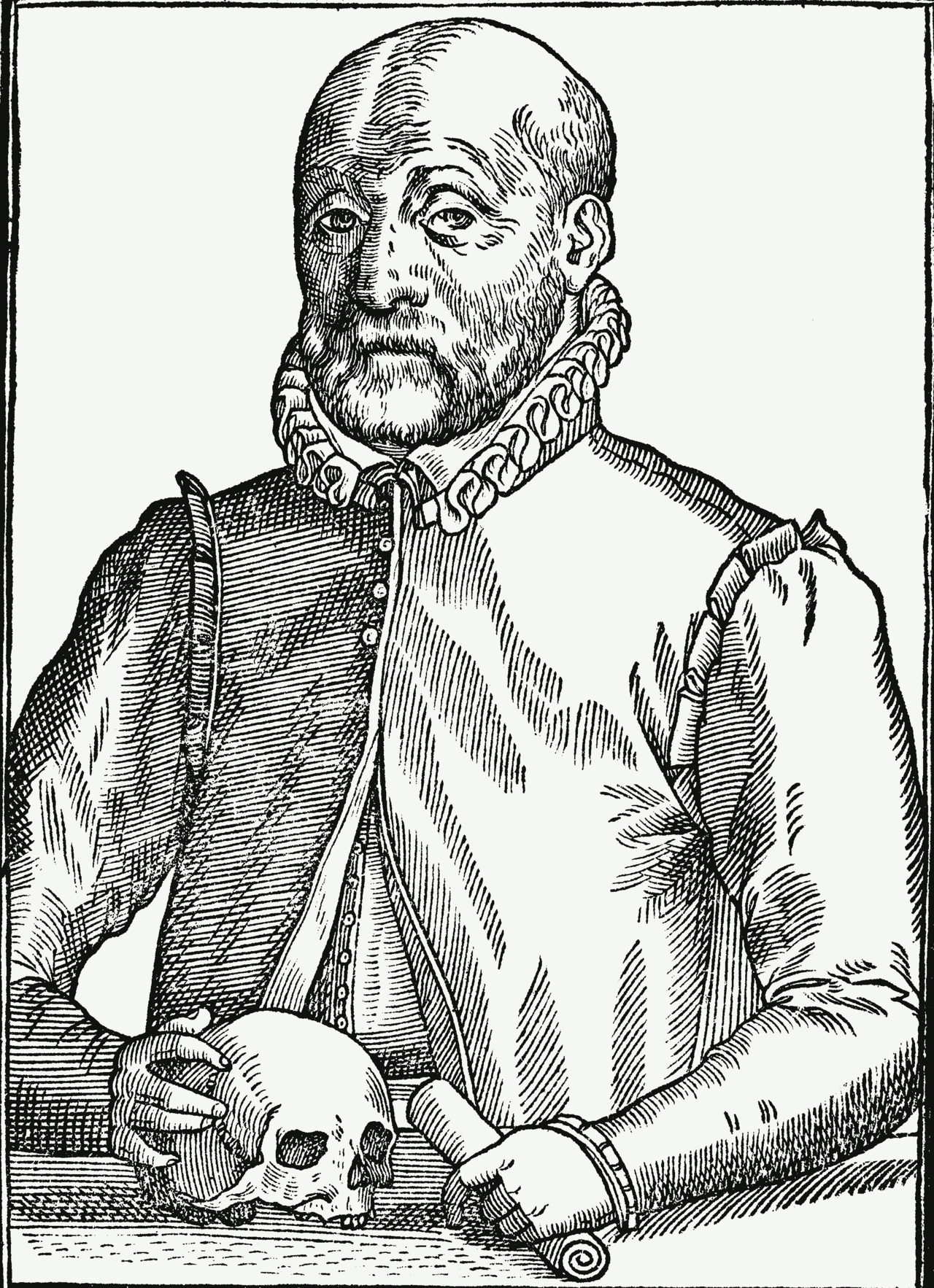
In the 1560s a girl from Unna in Westphalia, Barbara Kremers, was said to have lived for more than a year without eating or drinking. Pilgrims brought her gifts, and her parents asked the Duke of Cleves for a certificate of the miracle. The duke's physician took her into his own house instead, and soon found that her sister had been feeding her in secret3. The physician was Johann Weyer, and the case was typical of him: he preferred a natural explanation, tested in his own household, to a supernatural one taken on trust.
From Grave to the court of Cleves
Weyer, who signed himself Johannes Wier, was born in 1515 at Grave in the Duchy of Brabant, the son of a hop merchant3,8. At about fourteen he went to live with the humanist and occult philosopher Heinrich Cornelius Agrippa in Antwerp, followed him to Bonn, and in 1534 went to Paris to study medicine; whether he ever took a doctorate is doubtful3,8. He practised in Grave, became town physician of Arnhem in 1545, and there met his first witchcraft cases3,8. About 1550 he became physician to Duke William of Jülich-Cleves-Berg, whose court was unusually tolerant of religious dissent, a protection Weyer would need3,8.
De praestigiis daemonum
His great book, De praestigiis daemonum ("On the deceptions of demons"), was printed in Basel by Johannes Oporinus in 1563. Weyer revised it repeatedly, and German and French versions followed3,8. It was not a work of unbelief. The devil was real and powerful, and Weyer even appended, in 1577, a catalogue of demons and their ranks8. His argument was about who could be blamed. The women tried as witches were mostly old, poor and simple; the devil worked on imaginations already disordered by melancholy, the cold, dark humour of humoral medicine, so that they believed they had done things that were physically impossible. Confessions extracted under torture proved nothing. Such women, he urged, needed physicians and pastors, not judges and executioners3,8. Learned magicians who deliberately sought the devil's help, and poisoners, were another matter, and he allowed that they might be punished8.
The book travelled quickly. In England Reginald Scot drew on it heavily in The Discoverie of Witchcraft (1584), and praised Weyer's account of people who believed themselves turned into wolves:
J. Wierus declareth verie learnedlie, the cause, the circumstance, and the cure of this disease.2
Quotation checked against the 1886 text
Enemies and readers
Weyer's opponents saw at once what was at stake. The Heidelberg physician Thomas Erastus answered him, and in 1580 the French jurist Jean Bodin attacked him in De la démonomanie des sorciers; James VI of Scotland joined the case against him in his Daemonologie (1597)8. The Catholic Church put De praestigiis on the Index of Prohibited Books3. Weyer retired from the duke's service in 1578, his son Galenus succeeding him, and died at Tecklenburg on 24 February 1588, while visiting a patient3,8.
By then his name stood for a position. Robert Burton, surveying the debate in The Anatomy of Melancholy (1621), simplified it:
Many deny witches at all, or if there be any they can do no harm; of this opinion is Wierus1
Quotation checked against the 1621 text
A founder of psychiatry, made later
In the twentieth century Weyer acquired a new reputation. Historians of psychiatry, among them Gregory Zilboorg in lectures published as The Medical Man and the Witch during the Renaissance (1935), made him a hero of a story in which physicians recognised mental illness behind the witch trials and rescued its victims from the theologians5,7. Weyer, who turned the law's attention to the state of mind of the accused, can fairly be counted among the ancestors of forensic psychiatry3.
What remains is a physician who used medical knowledge to argue for mercy at a time when it was dangerous to do so, and whose book has been available in a full English translation, edited by George Mora, since 19914.
Key dates
- 1534 Weyer, a former pupil of Heinrich Cornelius Agrippa, goes to Paris to study medicine.
- 1545 Weyer becomes town physician of Arnhem, where he first meets witchcraft cases in his practice.
- 1550 About this year Weyer becomes physician to Duke William of Jülich-Cleves-Berg.
- 1563 Johannes Oporinus prints Weyer's De praestigiis daemonum in Basel.
- 1577 Weyer adds his catalogue of demons, Pseudomonarchia daemonum, to the book and publishes De lamiis.
- 1580 Jean Bodin's De la démonomanie des sorciers attacks Weyer as a protector of witches.
- 24 February 1588 Weyer dies at Tecklenburg while visiting a patient.
Weyer on this site
Sources
- Primary source Robert Burton, The Anatomy of Melancholy, Oxford: Henry Cripps (first edition 1621; nineteenth-century edition) (1621). Quotations checked against this text.
- Primary source Reginald Scot, The Discoverie of Witchcraft (reprint of the 1584 edition, ed. Brinsley Nicholson), London: Elliot Stock (1584). Quotations checked against this text.
- Museum or archive Een weldenkend en humaan mens: Johannes Wier (1515-1588), Brabants Historisch Informatie Centrum.
- Scholarship George Mora (ed.), Witches, Devils, and Doctors in the Renaissance: Johann Weyer, De praestigiis daemonum (trans. John Shea, ed. George Mora and Benjamin G. Kohl), Binghamton, NY: Medieval & Renaissance Texts & Studies (1991).
- Scholarship Thomas J. Schoeneman, The role of mental illness in the European witch hunts of the sixteenth and seventeenth centuries: an assessment, Journal of the History of the Behavioral Sciences 13(4) (1977).
- Scholarship Simon Kemp and Kevin Williams, Demonic possession and mental disorder in medieval and early modern Europe, Psychological Medicine 17(1) (1987).
- Scholarship Gregory Zilboorg, The Medical Man and the Witch during the Renaissance, Baltimore: Johns Hopkins Press (Noguchi lectures, 1935) (1935).
- Wikipedia Johann Weyer, Wikipedia.
Cross-checked with Wikidata Q719711 and the English Wikipedia article.
Read next
 Antiquity–19th century
Demonic possession and its critics
Many cultures have explained fits, voices and despair as the work of spirits. How Europeans argued over possession from Hippocrates to Charcot, and why the story that medicine simply defeated superstition is too simple.
 c. 400 BCE–1900s
Melancholia
For two thousand years melancholia meant fear and sorrow without cause, blamed on black bile. How physicians from Aretaeus to Kraepelin defined it, and how it became 'depression'.
 c. 400 BCE–1800s
The four humours
For two thousand years, European and Islamic medicine explained madness and melancholy by four bodily fluids. What the theory claimed about the mind, how it shaped treatment, and how it slowly lost its hold.
 Essay · 6 min
Can we diagnose the dead?
Why this site never diagnoses historical figures, and hedges every modern equivalent it gives: the evidence was made for other purposes, diseases change their identities, and each age's diagnoses of the dead reflect its own medicine.
 1680s–1980
Hysteria
Named for the womb, hysteria became medicine's catch-all for symptoms it could not explain. Its history from Greek texts to Sydenham, Charcot and Freud, and why it was dropped in 1980.