
Theory · Antiquity–19th century
Demonic possession and its critics
Many cultures have explained fits, voices and despair as the work of spirits. How Europeans argued over possession from Hippocrates to Charcot, and why the story that medicine simply defeated superstition is too simple.
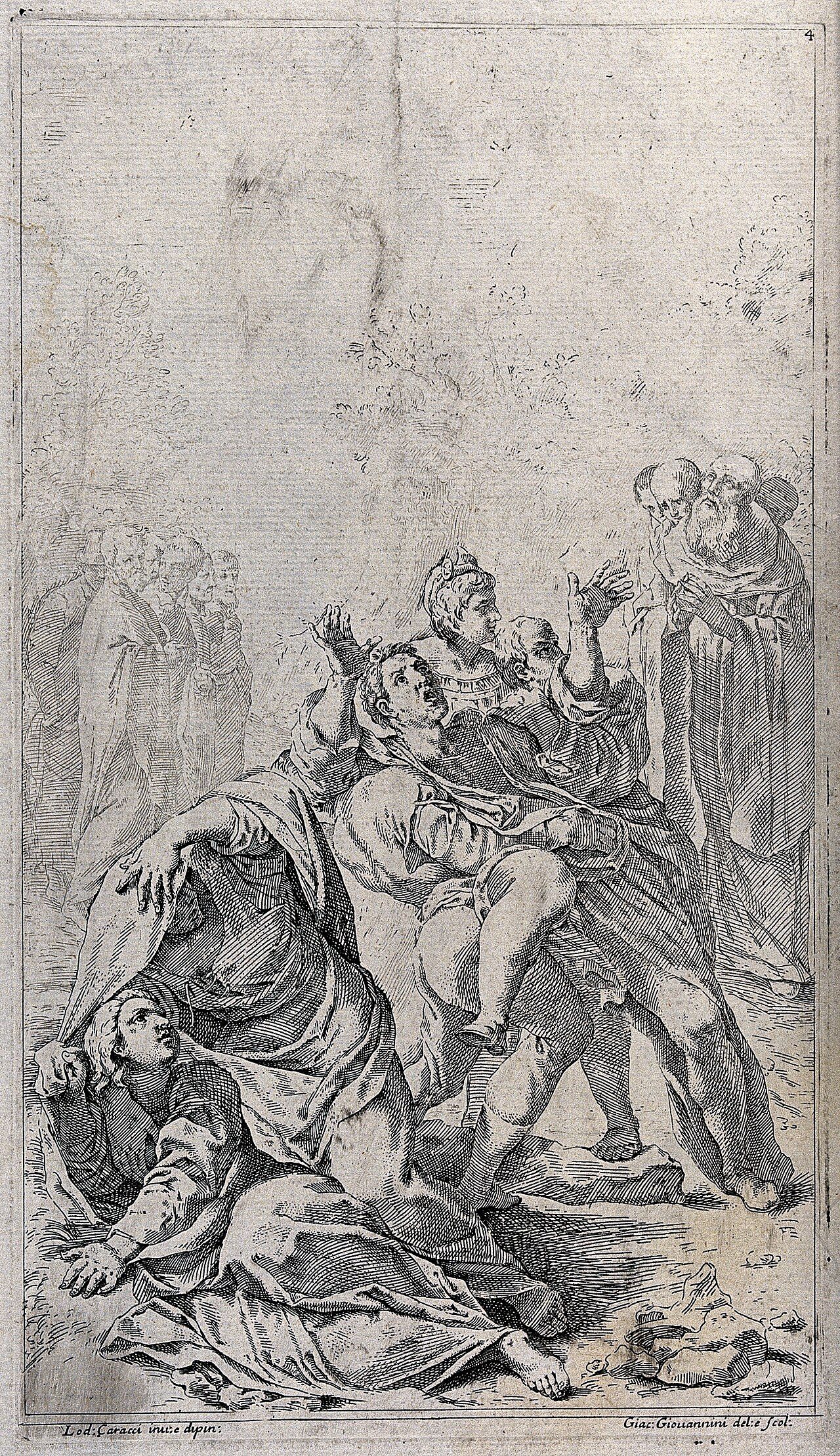
Around 1600 a young Frenchwoman, Marthe Brossier, drew crowds as a demoniac, with convulsions, contortions and a roaring voice. Three physicians, Marescot, Riolan and Duret, were asked to examine her. Their verdict, as Esquirol recalled it more than two centuries later, fitted into five Latin words: nihil a daemone; multa ficta, a morbo pauca, "nothing from the devil; many things feigned; few things from disease"3. It is a neat summary of one side of a very long argument. For as long as people have suffered fits, voices, sudden rages and deep despair, some have blamed spirits and others have looked for causes in the body; and for most of that time many people, physicians included, held both views at once.
Ancient voices
The earliest European statement of the medical side is the Hippocratic treatise On the Sacred Disease, written around 400 BCE about epilepsy, which Greeks attributed to the gods. Its author would have none of it:
it appears to me to be nowise more divine nor more sacred than other diseases, but has a natural cause from which it originates like other affections.1
Quotation checked against the 1849 text
He went further, accusing the "conjurors, purificators, mountebanks, and charlatans" who treated the disease with purifications and incantations of using divinity "as a pretext and screen of their own inability to afford any assistance"1. He located madness in the brain and its humours, not in the heavens1. Belief in possession was not so easily dismissed. The Gospels' accounts of Jesus casting out demons gave Christian Europe a powerful model of possession and its cure by exorcism in his name12.
Possession in the Christian centuries
It is a modern myth that medieval Europeans saw all madness as demonic. Physicians trained in Galen explained most mental disorder by humours, injuries and fevers, and the historians Simon Kemp and Kevin Williams found that over the medieval and early modern periods the range of disorders attributed to possession actually narrowed, with large individual and cultural differences at any one time5.
What changed in the sixteenth and seventeenth centuries was the scale and violence of the witch trials, in which the fits of a supposedly bewitched person could become evidence against a neighbour. Some physicians and lawyers pushed back. Johann Weyer, physician to the Duke of Cleves, argued in De praestigiis daemonum (1563) that most of the women accused of witchcraft were deluded by melancholy, their confessions products of a disordered imagination7. In England the Kentish gentleman Reginald Scot made a similar case in The Discoverie of Witchcraft (1584):
melancholie abounding in their head, and occupieng their braine, hath deprived or rather depraved their judgements, and all their senses: I meane not of coosening witches, but of poore melancholike women, which are themselves deceived.2
Quotation checked against the 1886 text
In London at the start of the seventeenth century the physician Edward Jorden argued in court that the fits of a girl, Mary Glover, which were blamed on a neighbour, Elizabeth Jackson, were a natural disease. He set out his argument the next year in A Briefe Discourse of a Disease Called the Suffocation of the Mother, an early English text on what would later be called hysteria4,8. The court was not persuaded, and Jackson was convicted8. At Loudun in western France in 1634, the possession of a convent of Ursuline nuns ended with the parish priest, Urbain Grandier, convicted of sorcery and burned9.
From exorcist to magnetiser
By the eighteenth century educated opinion had moved, but popular demand for exorcism had not. In the 1770s the Catholic priest Johann Joseph Gassner drew great crowds in southern Germany by commanding devils to depart. In 1775 the Bavarian Academy in Munich invited Franz Anton Mesmer to give his opinion. Mesmer said that Gassner was sincere but that his cures worked by animal magnetism, a natural force; Gassner's career faded, and the historian Henri Ellenberger later placed this confrontation at the birth of modern dynamic psychiatry10.
Possession becomes a symptom
The early psychiatrists absorbed possession into their classifications. Esquirol described "demonomania", the conviction of being possessed or damned, as a form of melancholy, and treated its history as a tale of fear spread by preaching and the stake3. Changing fears, he thought, changed the content of madness:
That man is now in a madhouse, because he fears the police, who would formerly have been burnt because he feared the devil.3
Quotation checked against the 1845 text
In 1887 Jean-Martin Charcot and his pupil Paul Richer published Les Démoniaques dans l'art, which read the contorted figures in paintings of exorcisms as portraits of the hysterical attacks they saw at the Salpêtrière11. For these doctors, the history of possession was the history of medicine slowly recognising its own patients.
Belief in possession did not disappear when psychiatry stopped using it. Kemp and Williams noted its survival in Pentecostal churches, and exorcism is still practised in the Catholic Church and other Christian traditions5,12.
Key dates
- c. 400 BCE The Hippocratic On the Sacred Disease denies that epilepsy, or any disease, is sent by the gods.
- 1563 Johann Weyer's De praestigiis daemonum argues that many accused witches are deluded melancholic women.
- 1584 Reginald Scot's Discoverie of Witchcraft attributes witches' confessions to melancholy and fraud.
- 1603 Edward Jorden's Briefe Discourse argues that fits blamed on witchcraft in a London case were a natural disease, 'the suffocation of the mother'.
- 1634 After the possession of Ursuline nuns at Loudun, the priest Urbain Grandier is convicted of sorcery and burned.
- 1775 Franz Anton Mesmer tells the Munich Academy that the priest Johann Joseph Gassner's exorcisms work by animal magnetism.
- 1838 Esquirol's treatise describes 'demonomania' as a form of melancholy.
- 1887 Charcot and Paul Richer publish Les Démoniaques dans l'art, reading the possessed of old pictures as hysterical patients.
Sources
- Primary source Hippocratic writers, The Genuine Works of Hippocrates, vol. 2 (trans. Francis Adams): On the Sacred Disease, London: Sydenham Society (1849). Quotations checked against this text.
- Primary source Reginald Scot, The Discoverie of Witchcraft (reprint of the 1584 edition, ed. Brinsley Nicholson), London: Elliot Stock (1886). Quotations checked against this text.
- Primary source Jean-Étienne Dominique Esquirol, Mental Maladies: A Treatise on Insanity (trans. E. K. Hunt), Philadelphia: Lea and Blanchard (1845). Quotations checked against this text.
- Primary source Edward Jorden, A Briefe Discourse of a Disease Called the Suffocation of the Mother, London: John Windet (1603).
- Scholarship Simon Kemp and Kevin Williams, Demonic possession and mental disorder in medieval and early modern Europe, Psychological Medicine 17(1): 21–29 (1987).
- Scholarship Thomas J. Schoeneman, The role of mental illness in the European witch hunts of the sixteenth and seventeenth centuries: an assessment, Journal of the History of the Behavioral Sciences 13(4): 337–351 (1977).
- Wikipedia Johann Weyer, Wikipedia (2026).
- Wikipedia Edward Jorden, Wikipedia (2026).
- Wikipedia Loudun possessions, Wikipedia (2026).
- Wikipedia Franz Mesmer, Wikipedia (2026).
- Wikipedia Jean-Martin Charcot, Wikipedia (2026).
- Wikipedia Exorcism in Christianity, Wikipedia (2026).
Cross-checked with Wikidata Q26155706 and the English Wikipedia article.
Read next
 c. 400 BCE–1900s
Melancholia
For two thousand years melancholia meant fear and sorrow without cause, blamed on black bile. How physicians from Aretaeus to Kraepelin defined it, and how it became 'depression'.
 1680s–1980
Hysteria
Named for the womb, hysteria became medicine's catch-all for symptoms it could not explain. Its history from Greek texts to Sydenham, Charcot and Freud, and why it was dropped in 1980.
 1770s–1850s
Animal magnetism and mesmerism
Franz Anton Mesmer claimed an invisible fluid linked all living things and could cure nervous disorders. A royal commission found only imagination at work, but his methods led to hypnotism and the psychology of suggestion.
 c. 400 BCE–1800s
The four humours
For two thousand years, European and Islamic medicine explained madness and melancholy by four bodily fluids. What the theory claimed about the mind, how it shaped treatment, and how it slowly lost its hold.
 Essay · 6 min
Can we diagnose the dead?
Why this site never diagnoses historical figures, and hedges every modern equivalent it gives: the evidence was made for other purposes, diseases change their identities, and each age's diagnoses of the dead reflect its own medicine.
 1374–1600s
Dancing mania
Outbreaks of compulsive dancing along the Rhine and Moselle between 1374 and the 1500s, blamed on saints and demons, later named a 'mania' by doctors. Their cause is still argued over.