
Theory · c. 400 BCE–1800s
The four humours
For two thousand years, European and Islamic medicine explained madness and melancholy by four bodily fluids. What the theory claimed about the mind, how it shaped treatment, and how it slowly lost its hold.
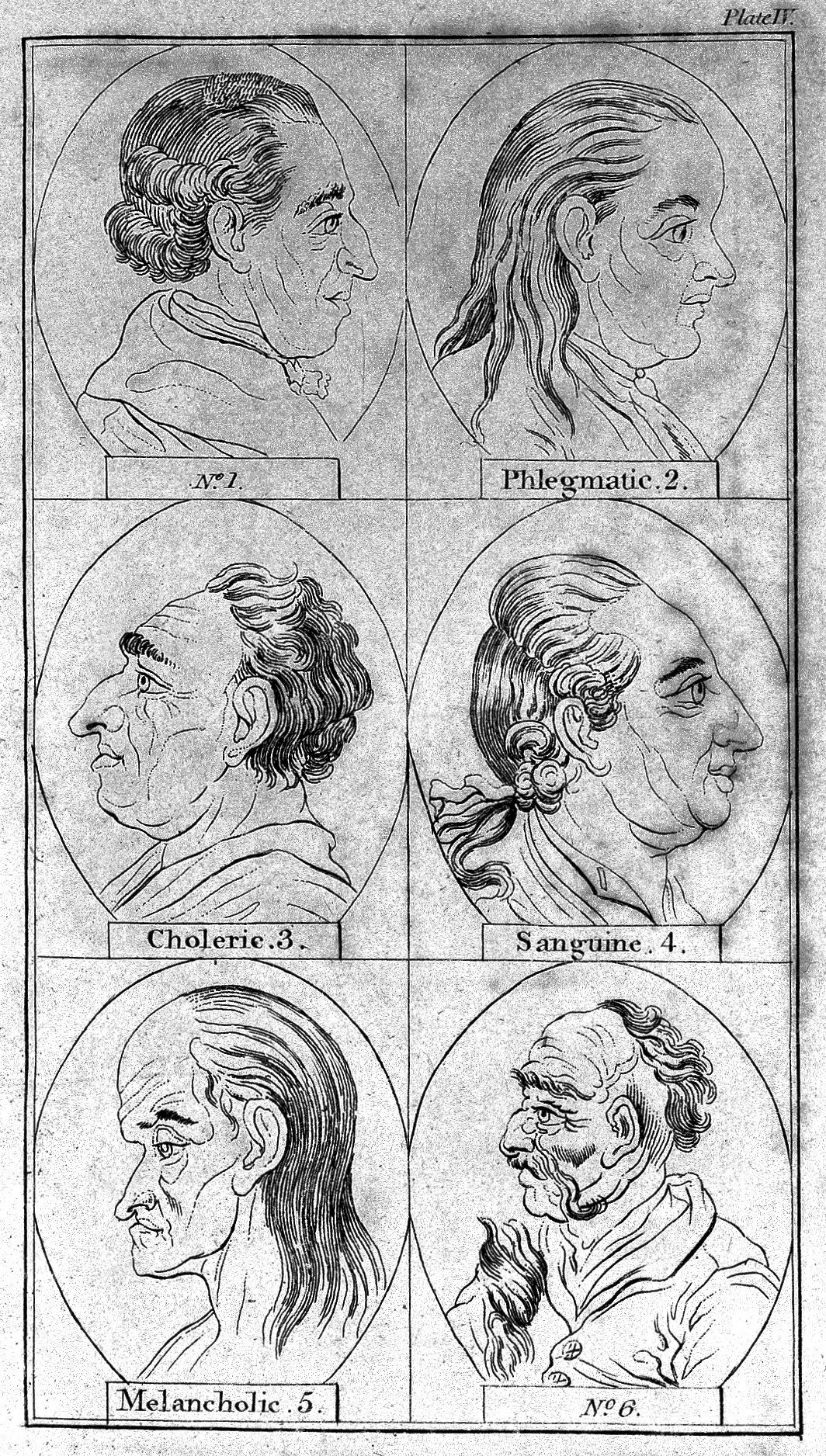
To a physician in Elizabethan London, as to one in second-century Rome or tenth-century Baghdad, there was nothing mysterious about a person who sat for months in fear and sorrow, convinced of some private catastrophe. Something in the body had gone wrong, and the likeliest culprit was a thick, cold, dark fluid called black bile: in Greek, melaina cholē, which gave the condition its name, melancholia3,5. The theory of the four humours was a theory of the whole body, but it carried within it an explanation of madness that lasted from classical Greece to the age of the asylum.
Four fluids and their qualities
The canonical scheme appears in the Hippocratic treatise On the Nature of Man, written around 400 BCE: the body is made of blood, phlegm, yellow bile and black bile, and health is their right proportion7. Each fluid carried two of the four qualities of hot, cold, wet and dry, and later writers tied them to the seasons, the ages of life and the four elements6,7. Galen of Pergamum, the most influential physician of the Roman empire, developed the scheme into a theory of temperaments in which a person's constitution, and so their liability to particular diseases and particular moods, depended on the mixture of qualities5,7. Through Arabic and Latin translations, his version governed learned medicine into the seventeenth century6.
Robert Burton summarised the inherited physiology for English readers in 1621. Blood was "a hot, sweet, temperate, red humour", phlegm "cold and moist", choler "hot and dry, bitter", and the fourth3:
Melancholy, cold and dry, thick, black, and sour, begotten of the more feculent part of nourishment, and purged from the spleen, is a bridle to the other two hot humours, blood and choler3
Quotation checked against the 1621 text
The humours and the mind
The humours mattered to madness because they acted on the brain. The author of the Hippocratic On the Sacred Disease (epilepsy) insisted that joys, griefs, fears and madness all came from the brain, and that the brain went wrong when it became "more hot, more cold, more moist, or more dry than natural"1. He even sorted the mad by humour:
Those who are mad from phlegm are quiet, and do not cry out nor make a noise; but those from bile are vociferous, malignant, and will not be quiet1
Quotation checked against the 1849 text
A short Hippocratic aphorism set the template for melancholia: "If a fright or despondency last for a long time, it is a melancholic affection"1. Mania was linked with hot yellow bile or overheated blood; melancholy with black bile, which could rise as smoky "vapours" to cloud the brain3,5. Galen added a famous observation, that melancholic patients often held a single fixed false belief, one convinced he had become a kind of snail, another sure that flute players were constantly playing beside his house, while reasoning soundly about everything else5.
The theory was flexible, and thoughtful physicians knew its limits. Aretaeus of Cappadocia, writing in Greek under the Roman empire, explained melancholy as black bile rising to the stomach and diaphragm, and then added an important qualification2:
And yet, in certain of these cases, there is neither flatulence nor black bile, but mere anger and grief, and sad dejection of mind2
Quotation checked against the 1856 text
From theory to treatment
A disorder of fluids called for removing fluid. Bleeding, purging with hellebore and other drugs, vomiting, sweating and blistering all aimed to draw off excess or corrupt humours, while diet, sleep, exercise, air and the passions (the "non-naturals") were adjusted to restore balance; these are described on the page on bloodletting, purging and emetics3,6. Humoral reasoning explains treatments that otherwise seem arbitrary: Renaissance authorities quoted by Burton even advised boring the skull of a melancholic patient "to let out the fuliginous vapours", one of the few recorded rationales for trepanation in mental illness3. Because the humours could be influenced by diet and regimen, the theory also gave patients and their families a sense of what they could do; much of Burton's book is advice on living.
Humoral thinking was not opposed to religion. Burton thought the devil could work on a melancholy body, and the debate over possession often turned on whether fits and visions came from black bile or from spirits3.
The long decline
The theory did not fall at a single blow. Andreas Vesalius's anatomy of 1543 showed Galen wrong about much of the body's structure, and William Harvey's demonstration of the circulation in 1628 undermined the old physiology of blood made in the liver and consumed by the tissues6. Physicians of the seventeenth and eighteenth centuries increasingly spoke of nerves, fibres and the brain rather than fluids, and in psychiatry the change was marked by Pinel, who classified insanity by its observed forms rather than by humours5. Esquirol wrote of the "humorists" as a past school, and renamed melancholy "lypemania"4,5:
Pursuing the atrabile into the circulation, the humorists deduce from blood-letting a general precept against melancholy.4
Quotation checked against the 1845 text
The Royal College of Physicians' museum notes that by the 1800s the humours had been fully discredited as real substances, yet bleeding and purging remained standard therapy well into that century6. The vocabulary outlived the physiology. People still describe themselves as melancholy or phlegmatic, sanguine or in a bad humour, and the four temperaments lived on in writing about personality long after the fluids behind them had been abandoned6,7.
Key dates
- c. 400 BCE The Hippocratic treatise On the Nature of Man names blood, phlegm, yellow bile and black bile as the constituents of the body.
- c. 400 BCE The Hippocratic On the Sacred Disease attributes madness to a brain disordered by phlegm or bile, not to the gods.
- 170 Galen of Pergamum builds the humours into a system of temperaments that dominates medicine for fifteen centuries.
- 1621 Robert Burton's Anatomy of Melancholy sets out the four humours as the physiology of a melancholy age.
- 1628 William Harvey's De motu cordis demonstrates the circulation of the blood.
- 1838 Esquirol's treatise criticises the 'humorists' who pursued black bile into the blood.
Sources
- Primary source Hippocratic writers, The Genuine Works of Hippocrates, vol. 2 (trans. Francis Adams): Aphorisms; On the Sacred Disease, London: Sydenham Society (1849). Quotations checked against this text.
- Primary source Aretaeus of Cappadocia, The Extant Works of Aretaeus, the Cappadocian (trans. Francis Adams), London: Sydenham Society (1856). Quotations checked against this text.
- Primary source Robert Burton, The Anatomy of Melancholy, Oxford (1621). Quotations checked against this text.
- Primary source Jean-Étienne Dominique Esquirol, Mental Maladies: A Treatise on Insanity (trans. E. K. Hunt), Philadelphia: Lea and Blanchard (1845). Quotations checked against this text.
- Scholarship Diogo Telles-Correia and João Gama Marques, Melancholia before the twentieth century: fear and sorrow or partial insanity?, Frontiers in Psychology 6: 81 (2015).
- Museum or archive Science or superstition: the rise and fall of galenic medicine, Royal College of Physicians Museum (2026).
- Wikipedia Humorism, Wikipedia (2026).
Cross-checked with Wikidata Q5782572 and the English Wikipedia article.
Read next
 c. 400 BCE–1900s
Melancholia
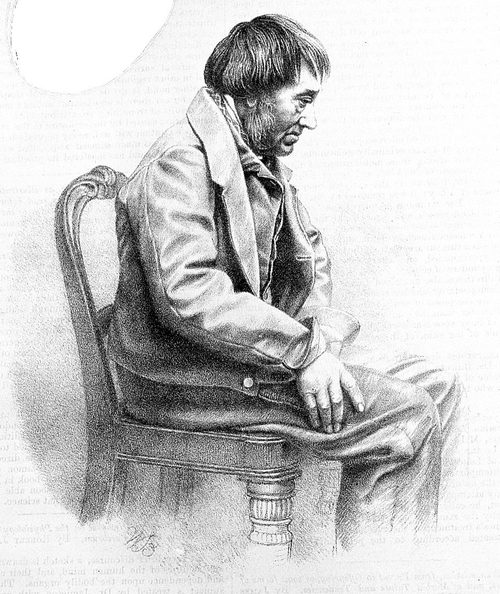
For two thousand years melancholia meant fear and sorrow without cause, blamed on black bile. How physicians from Aretaeus to Kraepelin defined it, and how it became 'depression'.
 c. 100 CE–1980
Mania
Mania once meant madness itself: raving, sleepless, sometimes joyful. How the word narrowed from Aretaeus to Kraepelin, and how it became one pole of manic-depressive illness.
 Antiquity–1850s · Abandoned
Bloodletting, purging and emetics
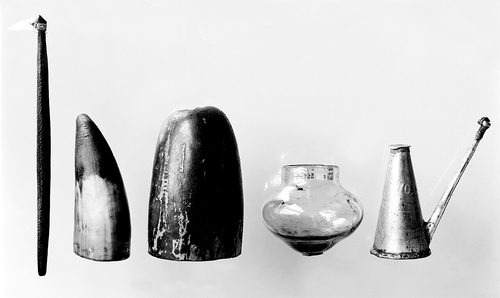
For two thousand years doctors bled, purged and vomited people with mania and melancholy. How depletion worked in theory, how it was done at Bethlem and in Philadelphia, and how it faded in the nineteenth century.
 1600s–1800s
Hypochondria and the vapours
Before it meant fear of illness, hypochondria was a real disease of the gut and nerves, the male twin of hysteria and, with the vapours, the fashionable 'English malady' of the 1700s.
 Mesolithic–17th century · Transformed
Trepanation
Holes cut in living skulls survive from the Stone Age onwards, many of them healed. What the archaeology shows, why the idea that they let out evil spirits is a nineteenth-century guess, and where madness fits in.
 Antiquity–19th century
Demonic possession and its critics
Many cultures have explained fits, voices and despair as the work of spirits. How Europeans argued over possession from Hippocrates to Charcot, and why the story that medicine simply defeated superstition is too simple.