
Person · 13 September 1918 – 7 January 2005
Rosemary Kennedy
Eldest daughter of Joseph and Rose Kennedy (1918–2005), left severely disabled by a lobotomy in 1941, whose hidden life shaped her family's work for people with intellectual disabilities.
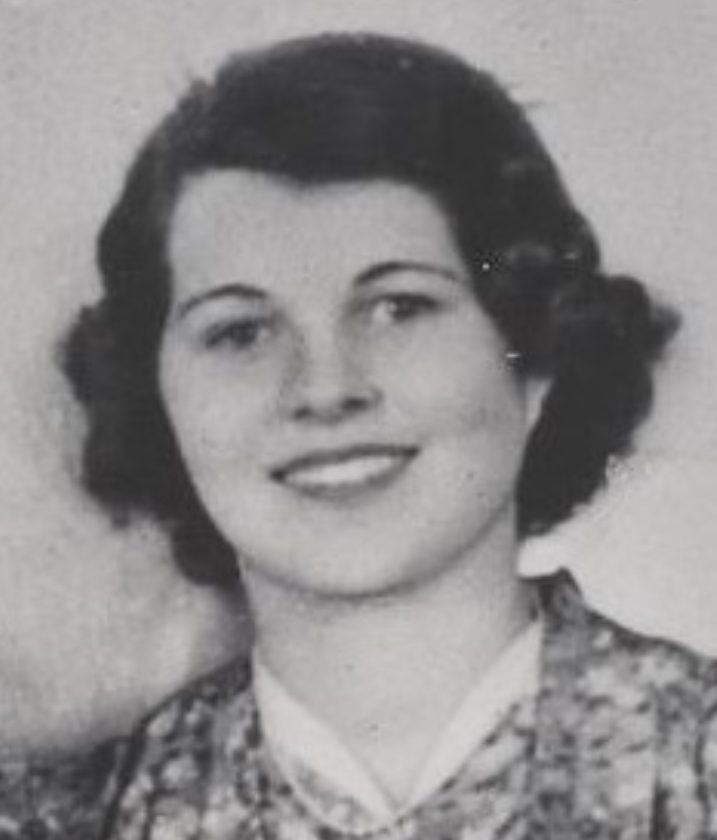
Rosemary Kennedy is often remembered for a single day in November 1941. She lived for another sixty-three years, and her family's decision first to hide her and then, gradually, to speak about her changed how Americans talked about intellectual disability. Much of what can be told is the life that others recorded around her.
Growing up a Kennedy
Rose Marie Kennedy was born at the family home in Brookline, Massachusetts, on 13 September 1918, the third child and first daughter of Joseph P. Kennedy and Rose Fitzgerald Kennedy2,7. She was slower than her brothers to crawl, walk and use her hands, and it was only when her younger sisters overtook her that her parents accepted something was different2. The cause has never been established; her biographer Kate Clifford Larson attributes it to a difficult, prolonged birth2,5.
Her parents kept her at home and in ordinary schools for as long as they could, then sent her to a series of boarding schools that offered special teaching2. She loved dances, shopping for clothes and time with friends, and was frustrated that she could not keep up with her competitive brothers and sisters2. In 1938, when her father was ambassador in London, she was presented at court, and she was happy at a convent school in England that taught by the Montessori method2,5. War brought the family home in 1940. Back in the United States, moved from school to school, she grew rebellious; she began slipping out of a convent school at night, and her family feared that she would be exploited or would embarrass them2.
1941
Joseph Kennedy learned of a new operation said to calm agitation and depression. It was not yet accepted by the American Medical Association, but its promoters assured him of success2. In November 1941, at his request, Walter Freeman and James Watts performed a prefrontal lobotomy on Rosemary, then aged 23, in Washington2,7. According to Larson and others, her mother was told only afterwards7. It was clear at once that the operation had failed. Rosemary lost most of her ability to walk and talk; her personality was changed for good, and she was left physically disabled2,4.
Hidden
She was taken directly to an institution: first, for several years, Craig House, a private psychiatric hospital north of New York City, and from 1949 St Coletta, an institution for people with disabilities at Jefferson, Wisconsin, where her father had a house built for her2,7. There she received individual care and therapy, but she was largely cut off from her family2. Her mother did not visit her for some twenty years, and the family explained her absence to the press by calling her reclusive7. Only after her father's death in 1969 did the family bring her back into its life, with visits to Florida, Washington and Cape Cod; she learned to walk again, with a limp, but never regained clear speech7.
Eunice, the President and the Special Olympics
Her sister Eunice Kennedy Shriver became the family's advocate for people with intellectual disabilities, running the Joseph P. Kennedy Jr. Foundation from 19573. In October 1961 President John F. Kennedy set up a President's Panel on Mental Retardation, with Eunice as its consultant3. In September 1962 she wrote in the Saturday Evening Post that her sister had an intellectual disability, the family's first public acknowledgement; the article, "Hope for the Retarded", was later called a watershed in changing attitudes3. That summer she had opened a day camp for children with intellectual disabilities at her home outside Washington, the beginning of what became, in 1968, the Special Olympics3.
On 5 February 1963 the President sent Congress a special message on mental illness and "mental retardation", the term of the time, calling for "a bold new approach" and condemning institutions "from which death too often provided the only firm hope of release"1. He signed two laws that October, the second, on 31 October, funding community mental health centres and facilities for people with intellectual disabilities3. Their later history is told under deinstitutionalisation.
Last years
Rosemary Kennedy died at Fort Atkinson Memorial Hospital, near St Coletta, on 7 January 2005, aged 86, with her brother Edward and sisters Eunice, Jean and Patricia beside her6,7. Her family's statement called her "a lifelong jewel to every member of our family"6. She is buried beside her parents in Brookline7.
Key dates
- 1938 Rosemary Kennedy is presented at court in London, where her father is the American ambassador.
- November 1941 At her father's request, Walter Freeman and James Watts lobotomise Rosemary Kennedy, aged 23; she is left unable to walk or speak clearly.
- 1949 Rosemary Kennedy moves to St Coletta, an institution for people with disabilities at Jefferson, Wisconsin, where she lives for the rest of her life.
- September 1962 Eunice Kennedy Shriver discloses in the Saturday Evening Post that her sister has an intellectual disability.
- 31 October 1963 President Kennedy signs the law funding community mental health centres and facilities for people with intellectual disabilities.
- 7 January 2005 Rosemary Kennedy dies at Fort Atkinson, Wisconsin, aged 86, with four of her siblings beside her.
Kennedy on this site
Sources
- Primary source John F. Kennedy, Special Message to the Congress on Mental Illness and Mental Retardation, The American Presidency Project, UC Santa Barbara (1963-02-05).
- Official Rosemary Kennedy, The Eldest Kennedy Daughter, National Park Service (John Fitzgerald Kennedy National Historic Site).
- Reference Out of the Shadows: Events Leading to the Founding of Special Olympics, Special Olympics.
- Reference Review of Kate Clifford Larson, Rosemary: The Hidden Kennedy Daughter, BookPage (2015).
- Reference Review of Kate Clifford Larson, Rosemary: The Hidden Kennedy Daughter, Kirkus Reviews (2015).
- Reference Rosemary Kennedy, former president's sister, dies, The Irish Times (2005-01-08).
- Wikipedia Rosemary Kennedy, Wikipedia.
Cross-checked with Wikidata Q265595 and the English Wikipedia article.
Read next
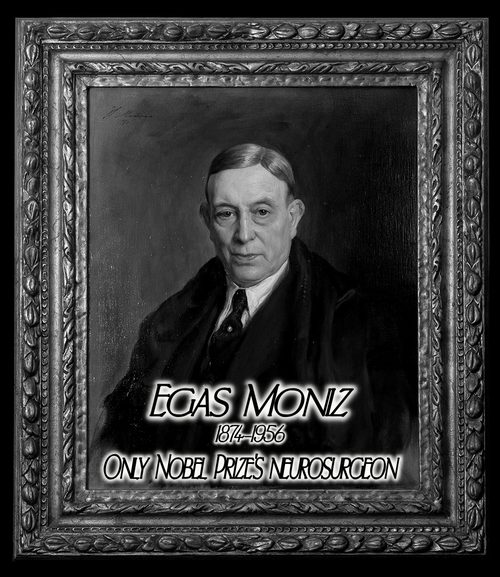 1935–1960s · Abandoned
Lobotomy
Brain surgery to cut the frontal lobes' connections, begun in Lisbon in 1935 and rewarded with a Nobel Prize in 1949. Tens of thousands were operated on before drugs and evidence of harm ended it.
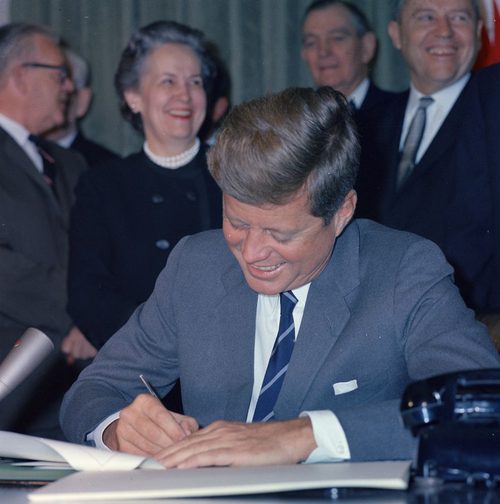 1955–2000 · Transformed
Deinstitutionalisation
From the mid-1950s Western countries emptied their great mental hospitals: US public hospitals fell from about 559,000 patients to under 72,000 in forty years. Whether patients were freed or abandoned is still argued.
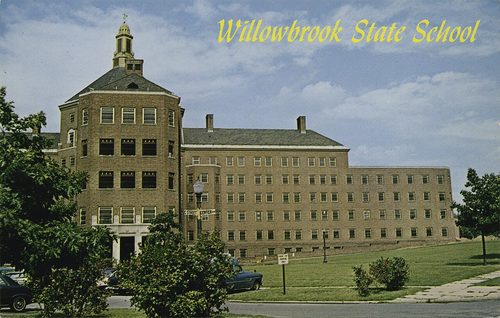 United States · 1947
Willowbrook State School
A New York state institution on Staten Island for people with intellectual disabilities, 1947–1987. Overcrowding, neglect and hepatitis experiments made it a national scandal and a turning point for disability rights.
 1883–1970s
Eugenics and psychiatry
Eugenics promised to reduce mental illness by preventing 'unfit' people from having children. How psychiatrists helped build sterilisation laws in the United States and Europe, Buck v. Bell, and the road to the Nazi killing of patients.
 Essay · 7 min
Who got locked up, and why
Asylum populations were never a simple sample of the mentally ill. Poverty, family, the Poor Law, sex, migration, race, age and bodily disease all decided who was confined, and historians still argue over how much each counted.