
Essay · 1800s–1960s
Who got locked up, and why
Asylum populations were never a simple sample of the mentally ill. Poverty, family, the Poor Law, sex, migration, race, age and bodily disease all decided who was confined, and historians still argue over how much each counted.
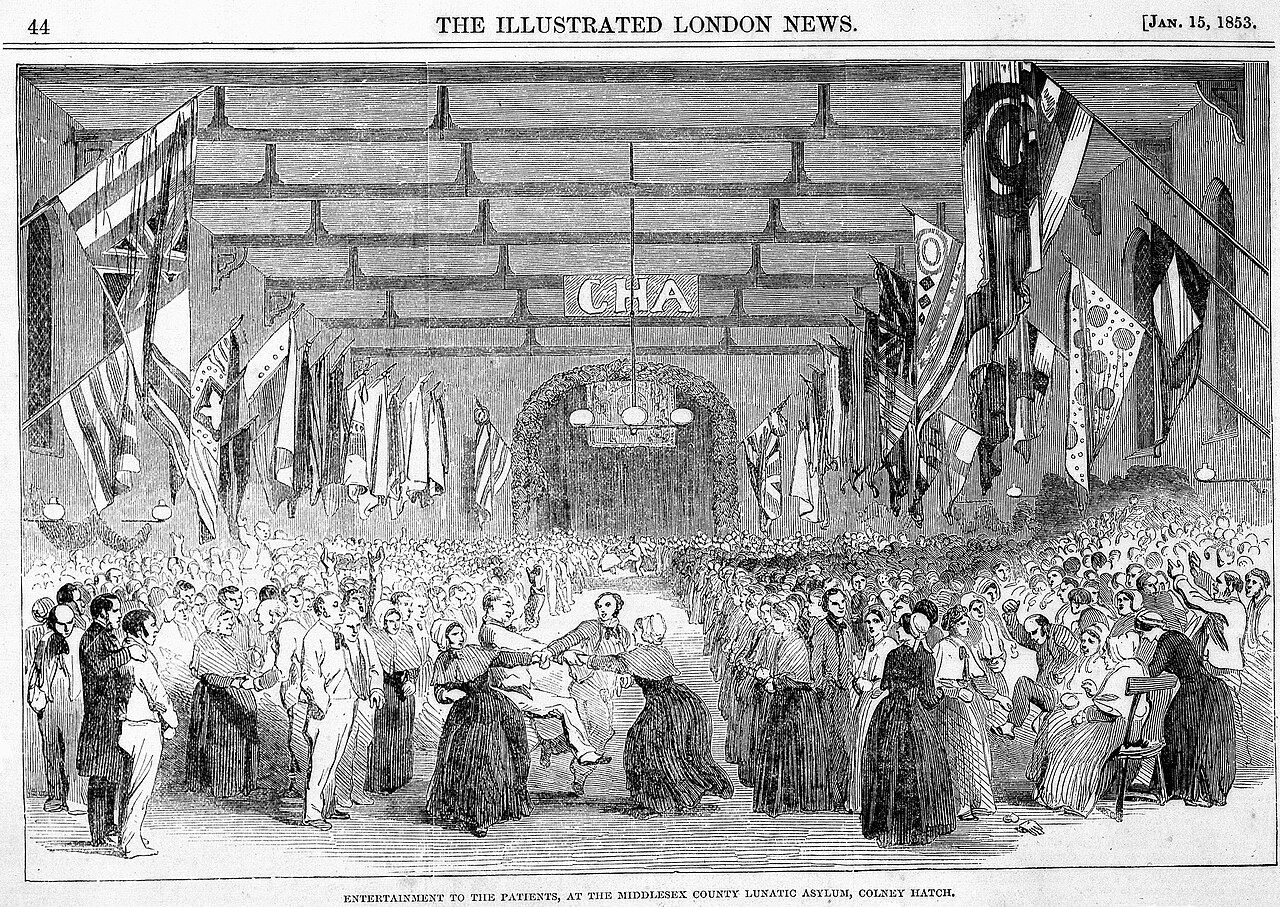
An asylum admission register of the 1870s has columns for name, age, sex, occupation, religion, the "supposed cause" of the illness, and who paid. Read down those columns and the people who appear in them do not look like a cross-section of everyone who was mentally ill. They look like a cross-section of everyone who was mentally ill and had run out of other places to be.
That is the argument of this essay. Illness was usually necessary for confinement, but it was rarely sufficient. Whether a troubled person ended up in an asylum depended on money, on the family's ability or wish to keep them, on what the Poor Law would pay for, on what the law allowed a husband or a parish to do, and on the categories that doctors and officials used to sort people. Historians disagree about which of these mattered most, and the disagreements are themselves part of the history.
Poverty and the parish
The nineteenth-century public asylum was, above all, an institution for the poor. In England and Wales the legislation of 1845 obliged counties and boroughs to provide for the "pauper lunatics" in their areas, and most did so by building county asylums14. Under the law of 1828 a pauper could be admitted on the order of two magistrates, or of a parish overseer and clergyman, with one medical certificate, while a private patient needed two3. When Simon Hill and Richard Laugharne studied 511 admissions to the Cornwall county asylum at Bodmin between 1870 and 1875, every patient was publicly funded; private patients went elsewhere5.
Where they went mattered. In the first year after admission, the Bodmin patients' mortality was 34 per cent, against 12 per cent at Ticehurst, a private asylum for the well-off5. Class shaped the odds of surviving the asylum as well as of entering it.
The Poor Law also decided where a pauper's illness would be housed. Catherine Cox and Hilary Marland show Lancashire's Poor Law authorities preferring to keep "lunacy cases" in workhouses, which were cheaper for them, and asylum superintendents in the 1850s resisting; by the 1880s superintendents were complaining instead that Poor Law officials were trying to "dump" chronic workhouse cases into asylum wards4. The decision was often about cost before it was about diagnosis.
Before the asylum, the alternative for many poor people was worse. Dorothea Dix opened her Memorial of 1843 with a survey of what she had found in the jails and almshouses of Massachusetts (Dorothea Dix):
the present state of Insane Persons confined within this Commonwealth, in cages, closets, cellars, stalls, pens!6
Quotation checked against the 1843 text
Andrew Scull, the most influential critic of the Victorian asylum, argues that the institutions built to rescue such people soon became something else. The chapter titles of his history tell the story: "Madness and Market Society", "The Accumulation of Chronic Cases", "Warehouses of the Unwanted"2. On his account, rising asylum numbers reflected less a rise in madness than the growing willingness of families and officials to hand over people they could not or would not support (Counting the confined: asylum populations, 1800–2000)2.
Families and their reasons
The other great decider was the family. David Wright, reviewing more than three dozen studies of admissions across several countries, argues that confinement is better understood as a household strategy than as something imposed by doctors: families under the pressures of industrial life used the asylum to cope with relatives who had become dependent or violent1. On this view the asylum doctor usually received a decision that had already been made at home.
A family strategy could also be a weapon. In Illinois a law of 1851 allowed a husband to have his wife admitted to the state hospital without the evidence required in other cases, and Elizabeth Packard spent three years in the asylum at Jacksonville on that basis13. Wives and daughters were not the only people confined by relatives for reasons that had more to do with property, religion or disobedience than illness, but the law gave husbands unusual power over them.
Women, men and the "female malady"
In The Female Malady (1985) the literary historian Elaine Showalter argued that in nineteenth-century Britain madness had become first and foremost a female condition, both in the asylum statistics and in the culture's images of the madwoman9. The argument was widely adopted. It has also been sharply criticised.
The sexes were confined for different reasons. Women were admitted after childbirth, under the diagnosis of puerperal insanity, and were more often labelled with hysteria. Men filled the wards of the asylum's deadliest diagnosis, general paralysis, a late form of syphilis that struck mostly men in mid-life; at Bodmin, every one of the fourteen patients admitted with it in 1870–75 died in the asylum5.
Strangers: migrants and race
Migrants were over-represented wherever they were poor and far from family. At Rainhill, the asylum serving Liverpool, Irish-born patients made up half of the resident population by 1871, and newspapers blamed them for the need to build more asylums4. In New York, Nellie Bly found women on Blackwell's Island who could not make themselves understood at all. Of one German-speaking woman brought before the examining doctor, she wrote:
She answered in German, saying she did not speak English nor could she understand it.7
Quotation checked against the 1887 text
In the American South the asylum was segregated by law and by medical theory. Before the Civil War the Louisiana physician Samuel Cartwright had invented a "disease", drapetomania, to explain why enslaved people ran away. Afterwards, Virginia chartered the Central Lunatic Asylum at Petersburg in June 1870 for Black patients from across the state; it admitted only Black patients until the 1960s, and only in 1967 began taking patients "regardless of race or national origin"11. Who was confined in the South, and where, was decided first by race.
Bodies: epilepsy, disability and old age
Much of the asylum population had conditions that would now be treated as neurological, developmental or age-related rather than psychiatric. The Alleged Lunatics' Friend Society, an early patients' group, objected that the County Asylums Act of 1845 encouraged the confinement of people with epilepsy and learning disabilities who had no need to be there (The patients who wrote back)3.
In the twentieth century those groups were given their own law. Britain's Mental Deficiency Act of 1913 created four classes of "defectives", among them "moral imbeciles", defined as people showing a permanent mental defect "coupled with strong vicious or criminal propensities on which punishment has had little or no deterrent effect"10. A defective could be sent to an institution or placed under guardianship in certain additional circumstances, and one of them was that the person
is in receipt of poor relief at the time of giving birth to an illegitimate child or when pregnant of such child.10
Quotation checked against the 1913 text
The clause did not make unmarried motherhood a ground for detention by itself: the woman had first to be certified as a "defective". But it shows how easily the Act's categories followed poverty and conduct. When Parliament replaced the Act in 1959, it added that no one could be treated as suffering from mental disorder "by reason only of" what it called "immoral conduct"15. The same logic, pressed further by eugenics and psychiatry, filled institutions such as Willowbrook after the Second World War.
Old age was the slowest change. In Sydney, of 12,745 admissions to the Darlinghurst Reception House between 1868 and 1900, 911 were people aged sixty or over; more than half of them were diagnosed with dementia, and nearly four in five were sent on to a hospital for the insane12. Older people with dementia had always been cared for somewhere; increasingly, that somewhere was the asylum.
What the registers can and cannot tell us
Admission registers are the best evidence we have, but they record the asylum's categories, not the patients' lives. A "supposed cause" of "intemperance" or "religious excitement" tells us what the clerk believed, and the diagnoses changed meaning from place to place: mania accounted for 38 per cent of admissions at Bodmin but 71 per cent at the Buckinghamshire asylum5. That is one reason why so many questions in this essay remain open, and why the site treats modern labels for these patients with caution (Can we diagnose the dead?).
What the registers show beyond doubt is that confinement followed the lines of a society's inequalities. The asylum took the poor more readily than the rich, the stranger more readily than the neighbour, and the person nobody would keep at home more readily than the one who had somewhere to go. When the great hospitals emptied after the 1950s (Deinstitutionalisation), the same question, of who has somewhere else to be, decided who left first.
Key dates
- 1843 Dorothea Dix's Memorial describes insane people held in the jails and almshouses of Massachusetts.
- 8 August 1845 The County Asylums Act becomes law in England and Wales, alongside the Lunacy Act of 4 August that creates the Commissioners in Lunacy.
- June 1870 Virginia's legislature charters the Central Lunatic Asylum at Petersburg for Black patients only.
- 1871 Irish-born patients make up half the residents of the Rainhill asylum near Liverpool.
- 15 August 1913 The Mental Deficiency Act receives royal assent, creating four legal classes of 'defectives' who could be detained.
- 1967 Central State Hospital in Virginia begins admitting patients regardless of race.
Sources
- Scholarship David Wright, Getting Out of the Asylum: Understanding the Confinement of the Insane in the Nineteenth Century, Social History of Medicine 10(1): 137–155 (1997).
- Scholarship Andrew Scull, The Most Solitary of Afflictions: Madness and Society in Britain, 1700–1900, Yale University Press (1993).
- Scholarship Nicholas Hervey, Advocacy or folly: the Alleged Lunatics' Friend Society, 1845–63, Medical History 30(3): 245–275 (1986).
- Scholarship Catherine Cox and Hilary Marland, 'Receptacles for the Insane': Accommodating Pauper Lunacy in Nineteenth-Century Lancashire, Centre for the History of Medicine, University of Warwick.
- Scholarship Simon A. Hill and Richard Laugharne, Mania, dementia and melancholia in the 1870s: admissions to a Cornwall asylum, Journal of the Royal Society of Medicine 96(7): 361–363 (2003).
- Primary source Dorothea L. Dix, Memorial to the Legislature of Massachusetts, Boston: Monroe & Francis (1843). Quotations checked against this text.
- Primary source Nellie Bly, Ten Days in a Mad-House (1887). Quotations checked against this text.
- Scholarship Andrew Scull, Dazeland (review of Elaine Showalter, The Female Malady), London Review of Books 9(19) (1987-10-29).
- Scholarship Joan Busfield, The Female Malady? Men, Women and Madness in Nineteenth Century Britain, Sociology 28(1): 259–277 (1994).
- Primary source Herbert Davey, The Law Relating to the Mentally Defective: the Mental Deficiency Act, 1913, London: Stevens and Sons (1913). Quotations checked against this text.
- Official Central State Hospital: our history, Virginia Department of Behavioral Health and Developmental Services.
- Scholarship Brian Draper, Older people admitted to Darlinghurst Reception House in the nineteenth century, Australasian Psychiatry 34(3): 292–296 (2026).
- Primary source E. P. W. Packard, The Prisoners' Hidden Life, or Insane Asylums Unveiled, Chicago: the author (1868). Quotations checked against this text.
- Reference Robert J. Ashworth, Mad, Bad - or just Unwanted? Part Two, The Workhouse (workhouses.org.uk) (1999).
- Official Mental Health Act 1959 (as enacted), legislation.gov.uk (1959).
Read next
 Essay · 8 min
Counting the confined: asylum populations, 1800–2000
Asylum numbers in England and the United States rose for a century and then fell by three-quarters or more. What the official counts measured was how long people stayed, not how many fell ill, as their own compilers warned.
 Essay · 7 min
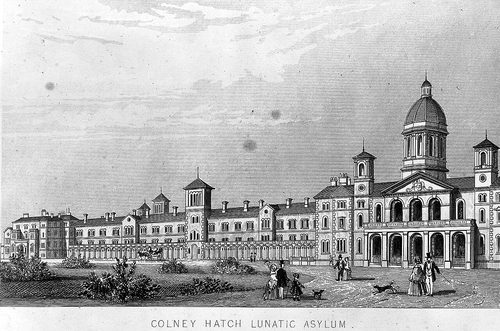
The rise and fall of the asylum
How the public asylum grew from a few small madhouses into hospitals of thousands, and was then closed: an argument that its failures came from its success at taking in the people no other institution would hold.
 1820s–1940s
General paralysis of the insane
The deadliest diagnosis in the Victorian asylum: grandiose delusions, failing speech and paralysis, usually fatal within a few years. In 1913 it was proved to be a late form of syphilis.
 1820s–1920s
Puerperal insanity
The nineteenth century's name for madness after childbirth: common in asylum admissions, thought highly curable, and central to infanticide trials, until doctors decided it was no special disease at all.
 1851–1860s
Drapetomania
A 'disease' invented in 1851 by the Louisiana physician Samuel Cartwright to explain why enslaved people ran away. It was medicalised racism in defence of slavery, and was mocked even in its own day.
 1883–1970s
Eugenics and psychiatry
Eugenics promised to reduce mental illness by preventing 'unfit' people from having children. How psychiatrists helped build sterilisation laws in the United States and Europe, Buck v. Bell, and the road to the Nazi killing of patients.
Pages that mention Who got locked up, and why
- Diagnosis Drapetomania
- Diagnosis Puerperal insanity
- Essay Counting the confined: asylum populations, 1800–2000
- Essay The patients who wrote back
- Essay The rise and fall of the asylum
- Person Dorothea Dix
- Person Elizabeth Packard
- Person Franco Basaglia
- Person John Conolly
- Person Nellie Bly
- Person Rosemary Kennedy
- Place Bicêtre and the unchaining
- Place Geel and family care
- Place Hadamar and the Nazi killing of patients
- Place The York Retreat
- Place The asylum on Blackwell's Island
- Place Willowbrook State School
- Theory Eugenics and psychiatry
- Treatment Restraint and the non-restraint movement