
Treatment · 1955–2000
Deinstitutionalisation
From the mid-1950s Western countries emptied their great mental hospitals: US public hospitals fell from about 559,000 patients to under 72,000 in forty years. Whether patients were freed or abandoned is still argued.
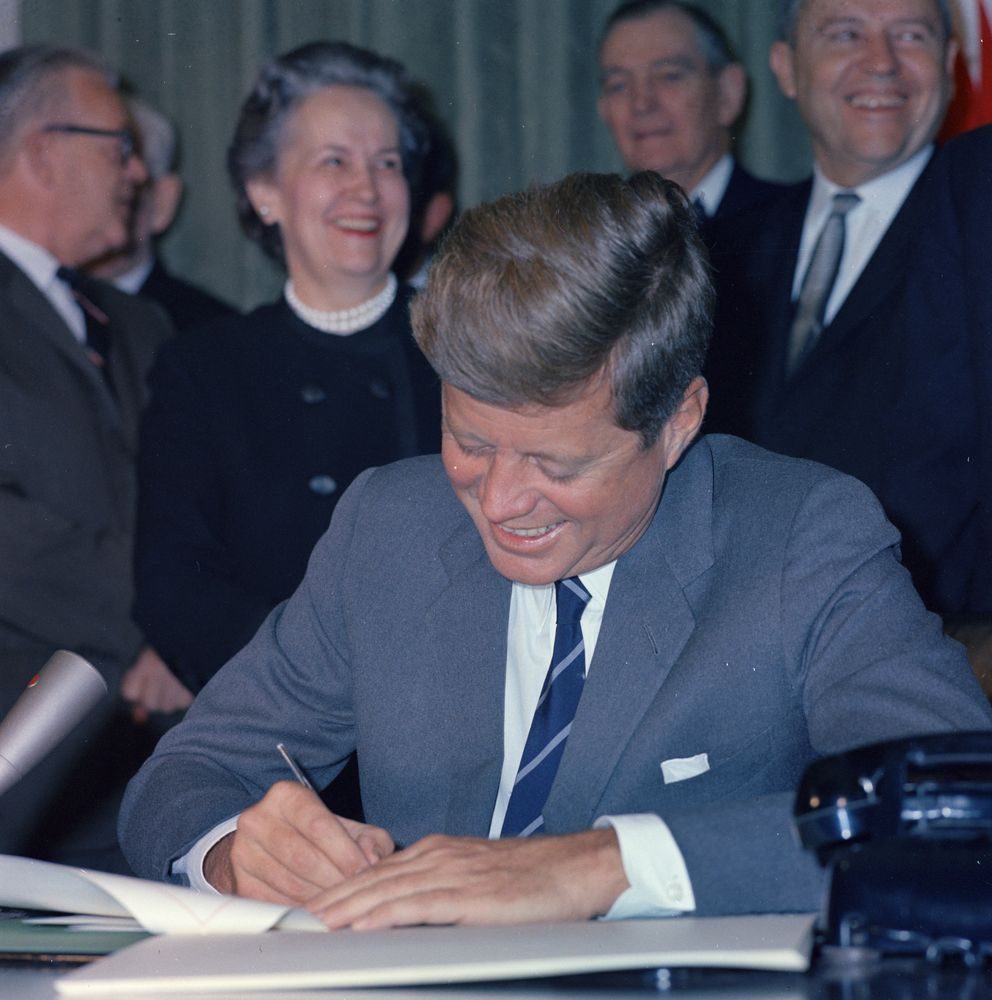
In 1955 more than half a million people lived in the public mental hospitals of the United States, and about 150,000 people were under treatment in the mental hospitals of England and Wales. Forty years later most of those hospitals were closed or closing. This transfer of people out of the asylums, called deinstitutionalisation, was one of the largest social changes of the twentieth century, and was carried out with remarkably little agreement about what was to replace them3,4.
The peak
The asylum populations of the 1950s were the result of a century of building and filling (see The rise and fall of the asylum). In 1955 American public mental hospitals held 558,239 patients4. In England and Wales the number in mental hospitals rose by more than a thousand during 1954, to 140,487, then fell by 1,047 during 1955, after averaging a rise of 850 a year3. The decline had begun.
Several things pushed in the same direction. Chlorpromazine and the drugs that followed it made many patients calmer and easier to discharge10. Sociologists and psychiatrists, among them Erving Goffman and Franco Basaglia, described the asylum itself as a harmful "total institution"; journalists and campaigners exposed neglect and abuse in institutions such as Willowbrook in New York and Ely Hospital in Britain7. And governments saw the possibility of saving money on enormous, ageing buildings7.
Britain: the water towers
On 9 March 1961 Enoch Powell, the Minister of Health, told the annual conference of the National Association for Mental Health that in fifteen years England might need only half as many mental hospital places as it had, a "redundancy" of 75,000 beds. Most of the rest should be in wards of general hospitals2. He described the old asylums, "isolated, majestic, imperious, brooded over by the gigantic water-tower and chimney combined", and promised to "err on the side of ruthlessness" in closing them2. He was explicit that this made sense only if local authorities built community services to take over the care, and warned that the plan would fail without public resolve2.
The Mental Health Act 1959 had already removed the legal distinction between psychiatric and other hospitals7. Closures came slowly at first and then, under the policy known as "care in the community", fast: large-scale closures began in the 1980s, and by the early twenty-first century almost none of the Victorian county asylums remained in use as hospitals7.
The United States: "a bold new approach"
On 5 February 1963 President Kennedy sent Congress a special message on mental illness and what was then called mental retardation. About 800,000 people, he said, were in institutions, most of them "confined and compressed within an antiquated, vastly overcrowded, chain of custodial State institutions", and nearly half the patients in state mental hospitals were in places holding more than 3,0001. He predicted that with a new programme the number in custodial care could be cut by half or more "within a decade or two", and that "the cold mercy of custodial isolation will be supplanted by the open warmth of community concern and capability"1. His sister Rosemary had been left disabled by a lobotomy twenty years before7.
The Community Mental Health Centers Construction Act, passed later in 1963, paid for local centres where people could be treated while living at home8. Only about half the planned centres were built, none was fully funded, and the Act gave no money to run them in the long term8. The decisive shift came with Medicaid and Medicare in 1965 and federal disability payments in the 1970s, which made it cheaper for states to move patients out of state hospitals, often into nursing homes and boarding houses paid for by federal money4,7. Court rulings in the 1970s narrowed the grounds for involuntary detention and established patients' rights7. By 1994 the nation's public psychiatric hospitals held 71,619 people4.
Italy: Law 180
Italy went furthest. From 1961, pilot projects in Gorizia, Trieste, Arezzo, Perugia and other cities, inspired above all by the psychiatrist Franco Basaglia, showed that patients could be moved from custodial hospitals into community services such as group homes, day centres and cooperatives run by patients7,9. On 13 May 1978 Parliament passed Law 180, known as the Basaglia law. It barred all new admissions to public mental hospitals at once, and readmissions two years later; acute care moved to small psychiatric wards in general hospitals, limited to fifteen beds, and compulsory treatment became an exception requiring the mayor's authorisation5. The 78,538 people in Italian mental hospitals in 1978 fell by more than half within a decade, to 7,704 by 1998, and the last hospitals were dismantled by 20005.
Freed or abandoned?
For many people who left the hospitals, ordinary life in the community was an improvement on decades on a locked ward; even Torrey, the policy's best-known critic, accepted that for perhaps the majority its aims had been at least partly realised4. For others it meant cheap boarding houses, the streets or prison. For a substantial minority, Torrey wrote, it had been "a psychiatric Titanic"4.
Key dates
- 1955 US public mental hospitals hold about 559,000 patients, their highest number; in England and Wales the mental hospital population begins to fall.
- 9 March 1961 Enoch Powell, Minister of Health, tells the National Association for Mental Health that half of England's mental hospital places may go within fifteen years: the 'water tower' speech.
- 1963 Congress passes the Community Mental Health Centers Construction Act, funding local centres as an alternative to state hospitals.
- 5 February 1963 President Kennedy's special message to Congress on mental illness and mental retardation calls for a 'bold new approach' based on community care.
- 1965 Medicaid and Medicare are created in the United States, shifting the cost of care away from state hospitals.
- 13 May 1978 Italy's parliament passes Law 180, the 'Basaglia law', closing mental hospitals to new admissions.
- 2000 The last public mental hospitals in Italy are dismantled.
Sources
- Primary source John F. Kennedy, Special Message to the Congress on Mental Illness and Mental Retardation, The American Presidency Project, UC Santa Barbara (1963-02-05).
- Primary source Enoch Powell, Address to the National Association of Mental Health Annual Conference, 9 March 1961 ('water tower' speech), Nuffield Trust, NHS history (1961-03-09).
- Primary source Board of Control (England and Wales), Annual Report of the Board of Control to the Lord Chancellor for the year 1955, London: HMSO (1956).
- Scholarship E. Fuller Torrey, Out of the Shadows: Confronting America's Mental Illness Crisis (excerpt), PBS Frontline / John Wiley & Sons (1997).
- Scholarship Corrado Barbui, Davide Papola, Benedetto Saraceno, Forty years without mental hospitals in Italy, International Journal of Mental Health Systems 12:43 (2018).
- Scholarship Sebastian Schildbach, Carola Schildbach, Criminalization Through Transinstitutionalization: A Critical Review of the Penrose Hypothesis in the Context of Compensation Imprisonment, Frontiers in Psychiatry 9:534 (2018).
- Wikipedia Deinstitutionalisation, Wikipedia.
- Wikipedia Community Mental Health Act, Wikipedia.
- Wikipedia Basaglia Law, Wikipedia.
- Museum or archive Paul Charpentier, Henri-Marie Laborit, Simone Courvoisier, Jean Delay, and Pierre Deniker, Science History Institute.
Cross-checked with Wikidata Q2657096 and the English Wikipedia article.
Read next
 1952–present · Transformed
Chlorpromazine
A French drug tried on psychiatric patients in Paris in 1952. Chlorpromazine calmed psychosis without stupor, emptied wards and began the age of psychiatric drugs, with lasting side-effects.
 Essay · 7 min
The rise and fall of the asylum
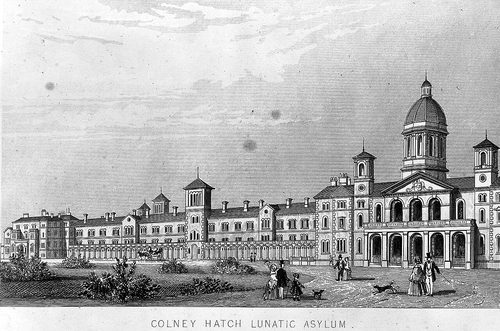
How the public asylum grew from a few small madhouses into hospitals of thousands, and was then closed: an argument that its failures came from its success at taking in the people no other institution would hold.
 Essay · 8 min
Counting the confined: asylum populations, 1800–2000
Asylum numbers in England and the United States rose for a century and then fell by three-quarters or more. What the official counts measured was how long people stayed, not how many fell ill, as their own compilers warned.
 United States · 1947
Willowbrook State School
A New York state institution on Staten Island for people with intellectual disabilities, 1947–1987. Overcrowding, neglect and hepatitis experiments made it a national scandal and a turning point for disability rights.
 United States · 1848
The Kirkbride asylums
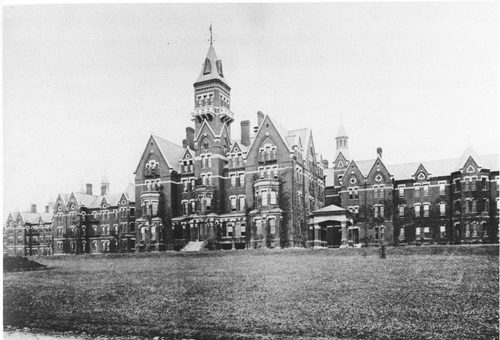
About seventy American state asylums built from 1848 to about 1910 to Thomas Kirkbride's plan of a central block with staggered wings, meant to heal by light, air and order. Many are demolished; some reused.
Essay · 7 min
"On being sane in insane places": Rosenhan's study and its challengers
In 1973 David Rosenhan reported that eight sane people were admitted to psychiatric hospitals by claiming to hear voices. The study helped reshape American psychiatry; later research suggests it was not done as described.
Pages that mention Deinstitutionalisation
- Essay "On being sane in insane places": Rosenhan's study and its challengers
- Essay Counting the confined: asylum populations, 1800–2000
- Essay The rise and fall of the asylum
- Essay Who got locked up, and why
- Person Dorothea Dix
- Person Franco Basaglia
- Person Rosemary Kennedy
- Person Thomas Story Kirkbride
- Person Walter Freeman
- Place Geel and family care
- Place Hanwell Asylum
- Place The Kirkbride asylums
- Place Willowbrook State School
- Theory The biological turn
- Treatment Chlorpromazine
- Treatment Lobotomy