
Place · 1947 – 17 September 1987
Willowbrook State School
A New York state institution on Staten Island for people with intellectual disabilities, 1947–1987. Overcrowding, neglect and hepatitis experiments made it a national scandal and a turning point for disability rights.
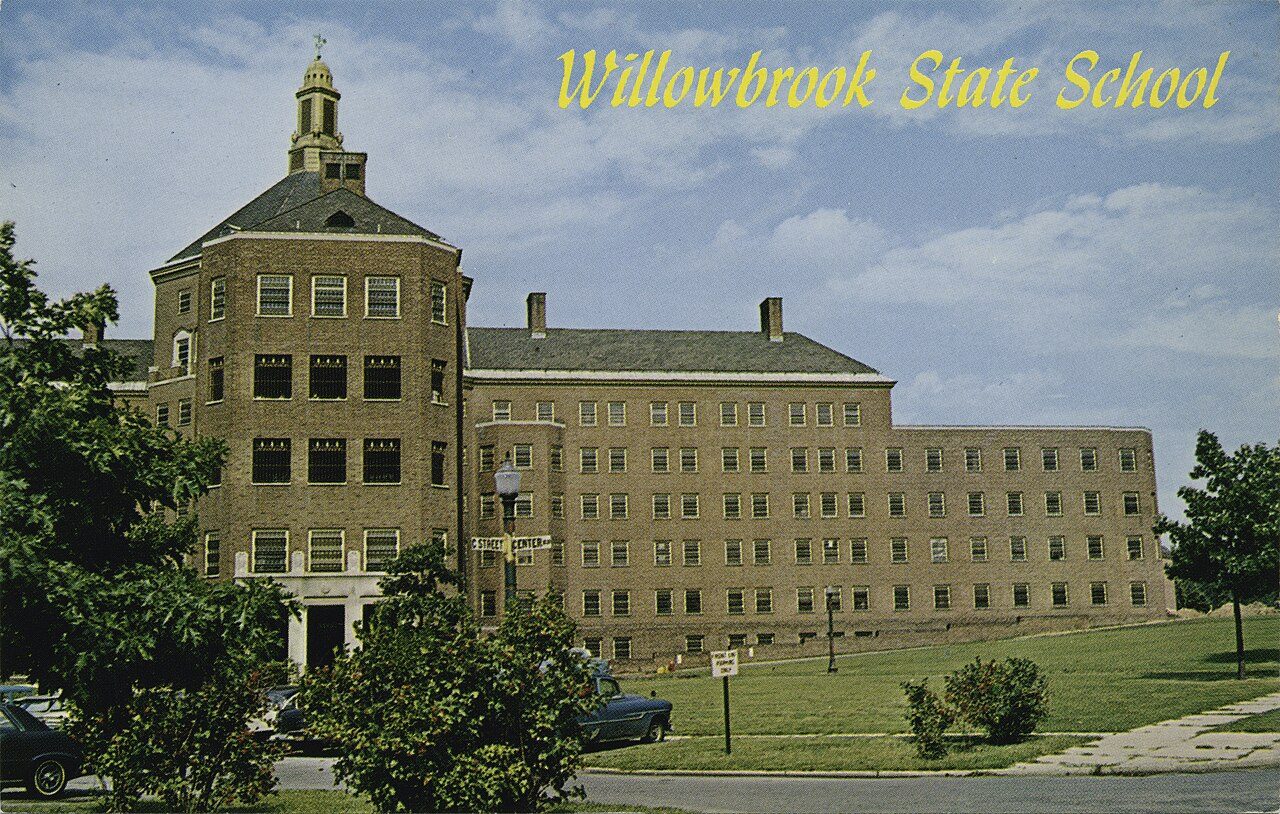
Willowbrook was planned in 1938 as a state school for children with intellectual disabilities on 375 acres of Staten Island. Before it could open, the Second World War intervened and the new buildings were taken over by the army. The New York State Department of Mental Hygiene finally admitted its first residents in 19478. Forty years later it closed in disgrace, and its name had become shorthand, in the United States, for what institutions could do to the people they were meant to care for4,5.
Overcrowding
Willowbrook was built for about 4,000 people. By the mid-1960s it held more than 6,000, and at its peak, in 1969, about 6,200 children and adults, which made it the largest state institution of its kind in the country3,4,8. Many residents had been placed there by their families, by foster-care agencies or by other public services, and stayed for years8. There were too few attendants, too little clothing and too little of everything else; a staff physician, William Bronston, later called it a "human warehouse"3.
In 1965 Senator Robert F. Kennedy made an unannounced visit. He said he had found residents "living in filth and dirt, their clothing in rags, in rooms less comfortable and cheerful than the cages in which we put animals in a zoo", and called the institution a "snake pit"3,4. The state drew up a five-year plan of improvements. Conditions improved briefly and then slid back3,4.
The hepatitis studies
Crowding made disease endemic. Hepatitis spread so readily that, according to Saul Krugman of New York University, most children admitted caught it soon after arrival8. From 1956 to 1971 Krugman and his colleagues used Willowbrook to study the disease. Among other experiments, they deliberately infected newly admitted children with the virus, from material taken from infected residents, to follow its course and test protection with gamma globulin7,8. The work helped to distinguish infectious hepatitis, spread from person to person, from serum hepatitis, spread by blood, the forms later called hepatitis A and B8.
Exposure and the courts
In early 1972 a young reporter for WABC-TV in New York, Geraldo Rivera, took a camera crew into Willowbrook. His report, broadcast as Willowbrook: The Last Disgrace, showed overcrowded wards, inadequate sanitation and residents left without care or occupation, and was seen by millions3,4,8. On 17 March 1972 parents and parents' organisations, represented by the New York Civil Liberties Union and the Legal Aid Society, filed a class action in federal court on behalf of the 5,000 residents2,4.
On 10 April 1973 Judge Orrin Judd refused to close the institution or to recognise a constitutional right to treatment, but held that its residents had a constitutional right to protection from harm: they were, he wrote, "entitled to at least the same living conditions as prisoners"1,2,3. Two years later the parties settled. The consent judgment, approved on 5 May 1975, set detailed standards of care and declared the institution's purpose to be to "ready each resident … for life in the community at large", with the residents to be moved to "the least restrictive and most normal living conditions possible"3,4. It set a target of no more than 250 residents, which was met only in March 19863,6.
Closure
Renamed the Staten Island Developmental Center in 1974, Willowbrook was emptied ward by ward as its residents, the "Willowbrook class", moved to group homes and other community settings. On 17 September 1987 Governor Mario Cuomo declared it "officially and forever closed"5,6,8. Part of the site became the campus of the College of Staten Island, whose library holds the archives of the residents, staff and parents who brought about the closure8.
The case shaped American law. Publicity from Willowbrook helped pass the federal Civil Rights of Institutionalized Persons Act of 1980, and the consent judgment became a model for community placement across the country3,8. Its obligations did not end in 1987: a permanent injunction of 1993 still governs the state's duties to surviving class members, and in 2020 The New York Times reported continuing abuse and neglect of some of them in group homes5,6,8.
Key dates
- 1947 The New York State Department of Mental Hygiene opens Willowbrook State School on Staten Island, in buildings first used as a wartime army hospital.
- 1956 Saul Krugman's studies of hepatitis begin at Willowbrook; they continue until 1971.
- 1965 Senator Robert F. Kennedy visits Willowbrook and calls it a 'snake pit'.
- 1972 Geraldo Rivera's television report on Willowbrook is watched by millions; on 17 March parents file a class action in federal court.
- 10 April 1973 Judge Orrin Judd finds that Willowbrook's residents have a constitutional right to protection from harm.
- 5 May 1975 The Willowbrook consent judgment is approved, committing New York State to move residents into community homes.
- 17 September 1987 Governor Mario Cuomo declares Willowbrook 'officially and forever closed'.
Also on this site
Sources
- Primary source United States District Court, Eastern District of New York (Judge Orrin G. Judd), New York State Association for Retarded Children v. Rockefeller, 357 F. Supp. 752 (E.D.N.Y. 1973), Leagle (1973-04-10).
- Reference NYSARC & Parisi v. Carey: case summary, Civil Rights Litigation Clearinghouse, University of Michigan.
- Reference The closing of Willowbrook, Disability Justice.
- Official National Council on Disability, Forty Years After The Willowbrook Consent Decree, NCD Celebrates How Far We've Come, NCD (2015-05-05).
- Official New York State Office for People With Developmental Disabilities, Willowbrook, OPWDD.
- Official Minnesota Governor's Council on Developmental Disabilities, Willowbrook timeline, Parallels in Time.
- Scholarship Sarah C. Mead Jasperse, Michael P. Kelly, Contextualizing Contemporary Research Ethics Policies and Practices in Significant Historical Events, Behavior Analysis in Practice (2025).
- Wikipedia Willowbrook State School, Wikipedia.
Cross-checked with Wikidata Q4893633 and the English Wikipedia article.
Read next
 1955–2000 · Transformed
Deinstitutionalisation
From the mid-1950s Western countries emptied their great mental hospitals: US public hospitals fell from about 559,000 patients to under 72,000 in forty years. Whether patients were freed or abandoned is still argued.
 Essay · 7 min
Who got locked up, and why
Asylum populations were never a simple sample of the mentally ill. Poverty, family, the Poor Law, sex, migration, race, age and bodily disease all decided who was confined, and historians still argue over how much each counted.
 Essay · 8 min
Counting the confined: asylum populations, 1800–2000
Asylum numbers in England and the United States rose for a century and then fell by three-quarters or more. What the official counts measured was how long people stayed, not how many fell ill, as their own compilers warned.
 1883–1970s
Eugenics and psychiatry
Eugenics promised to reduce mental illness by preventing 'unfit' people from having children. How psychiatrists helped build sterilisation laws in the United States and Europe, Buck v. Bell, and the road to the Nazi killing of patients.
 Essay · 7 min
The rise and fall of the asylum
How the public asylum grew from a few small madhouses into hospitals of thousands, and was then closed: an argument that its failures came from its success at taking in the people no other institution would hold.