
Treatment · 1935–1960s
Lobotomy
Brain surgery to cut the frontal lobes' connections, begun in Lisbon in 1935 and rewarded with a Nobel Prize in 1949. Tens of thousands were operated on before drugs and evidence of harm ended it.
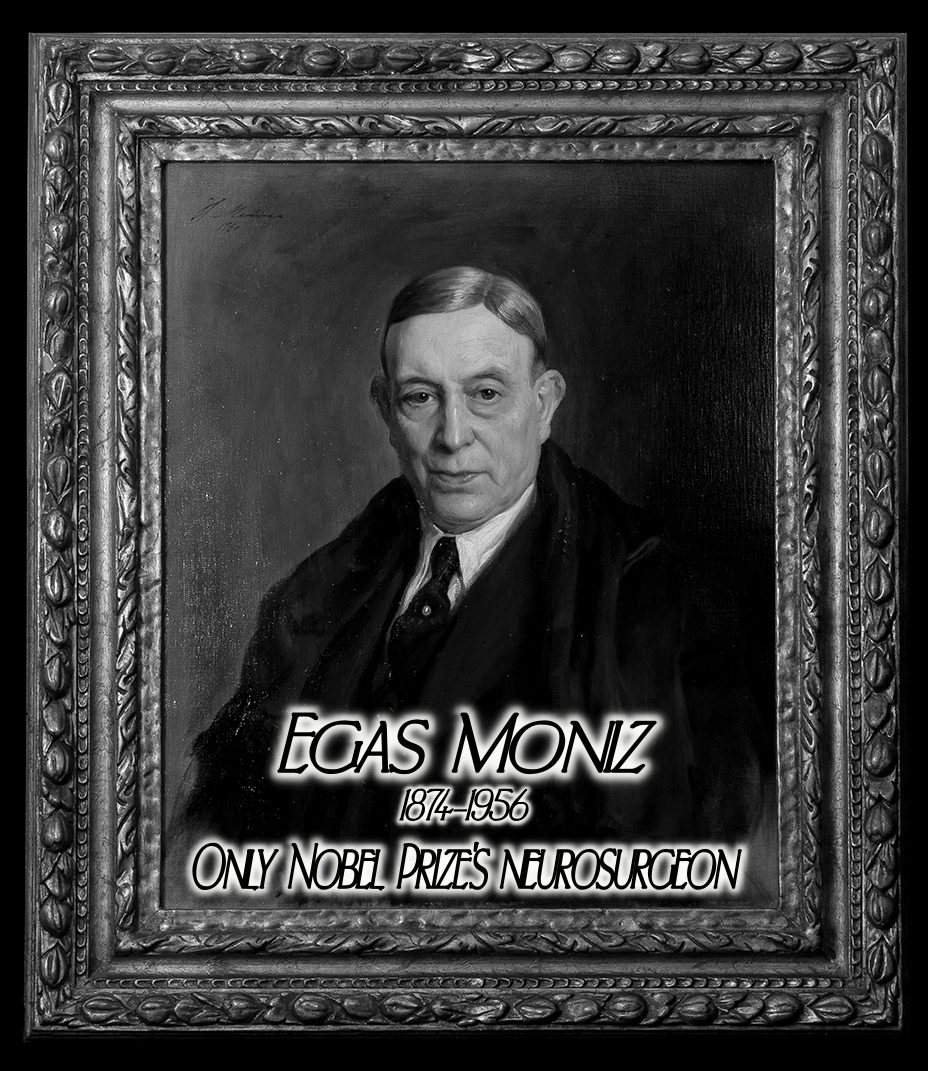
In the twenty years after 1935, surgeons in Europe and the Americas cut into the brains of tens of thousands of psychiatric patients in the hope of relieving them. The operation, called leucotomy in Portugal and Britain and lobotomy in the United States, won its inventor a Nobel Prize, was taken up by state hospitals as a solution to overcrowding, and was abandoned within a generation. Few treatments in medicine have fallen so far4,7.
Lisbon, 1935
António Egas Moniz was already a distinguished neurologist, known for inventing cerebral angiography, when he proposed in the mid-1930s that some mental illnesses were caused by fixed, abnormal connections between nerve cells, which might be broken by cutting the white matter of the frontal lobes. On 12 November 1935, at the Santa Marta Hospital in Lisbon, the neurosurgeon Pedro Almeida Lima carried out the first operation under his direction, on a patient sent from a Lisbon mental hospital4,7. They first destroyed tissue with injections of alcohol, then with a cutting instrument they called the leucotome4.
Moniz published results for twenty patients in 1936, claiming improvement in most4,6. Even then there were doubts. The psychiatrist who had supplied the patients said that those returned to him were "diminished", and dismissed Moniz's theory as "cerebral mythology"7. But the claims spread quickly to Italy, Brazil, Romania and the United States, in a decade when psychiatry had little to offer the long-stay patients filling its hospitals7.
Freeman and Watts
In Washington, the neurologist Walter Freeman and the neurosurgeon James Watts performed the first American operation on 14 September 1936. They renamed it lobotomy, standardised the cuts, and published widely: in 1939, observations on 48 patients; in 1942, a book on 200, of whom they counted 63 per cent improved, 23 per cent unchanged and 14 per cent worse or dead2,4. Freeman was a tireless publicist, and newspapers carried hopeful stories of patients restored to their families5,7.
In 1941 the two men operated on Rosemary Kennedy, then 23, at her father's request. The operation left her unable to speak intelligibly or live independently, and she spent the rest of her life in institutions, her condition concealed from the public for years9.
From 1946 Freeman went further. Wanting an operation that could be done in state hospitals without surgeons or operating theatres, he developed a "transorbital" lobotomy, reaching the frontal lobes through the eye socket, often with an electric shock in place of an anaesthetic. Watts objected, and their partnership ended in 19475,7. Freeman travelled from hospital to hospital demonstrating it. The number of lobotomies in the United States rose from about 150 in 1945 to more than 5,000 in 19495.
Britain and the Nobel Prize
Britain was, after the United States, one of the operation's main centres. In February 1947 the Board of Control published a survey, mainly the work of Dr Isabel Wilson, of the first 1,000 cases in English and Welsh hospitals: 652 of the patients were women, three in five had a diagnosis of schizophrenia, and 6 per cent had died, half of them from the operation, most often from haemorrhage1,10. The report described the aim of the operation in plain words:
Crudely described the purpose of the operation is to break the connection between the patient's thoughts and his emotions. It is to relieve mental tension, to take the sting out of experience and thus to favour improvement or to hasten recovery from mental disorder.1
Quotation checked against the 1947 text
About a third of the patients had been discharged; of the rest, it said, many had become "much more placid and easier to nurse". Its authors left open the question that mattered most:
The question as to whether or no these results are achieved at the cost of the loss of some finer mental qualities is not yet answered and further study is needed on this most important point.1
Quotation checked against the 1947 text
Two years later, in 1949, Moniz shared the Nobel Prize in Physiology or Medicine "for his discovery of the therapeutic value of leucotomy in certain psychoses"3. In all, about 40,000 people are thought to have been lobotomised in the United States and some 17,000 in Britain, with proportionally even more in Scandinavia; women were operated on more often than men1,6,7.
Outcomes and the end
The results were what the 1947 report had feared. Some patients became less tormented; many became apathetic, passive and childlike, lost initiative and judgement, or developed epilepsy, and some died4,7. Freeman operated on at least nineteen children, the youngest four years old5. The Soviet Union banned the operation in 1950 as contrary to the principles of humanity7.
What ended lobotomy was less a reckoning than a replacement. Chlorpromazine, on sale in the United States as Thorazine from 1954, calmed agitated patients without surgery, and was at first marketed as a kind of "chemical lobotomy"5. Its use fell steeply through the 1950s4,7. Freeman kept going: in 1967, at Herrick Memorial Hospital in Berkeley, a patient died of a brain haemorrhage after his last lobotomy, and he lost his hospital privileges5.
Key dates
- 12 November 1935 At the Santa Marta Hospital in Lisbon, Egas Moniz and the surgeon Pedro Almeida Lima carry out the first prefrontal leucotomy.
- 14 September 1936 Walter Freeman and James Watts perform the first prefrontal lobotomy in the United States, in Washington, DC.
- November 1941 Rosemary Kennedy, aged 23, is operated on by Freeman and Watts; she is left permanently disabled.
- 1946 Freeman performs his first 'transorbital' lobotomy, an operation that needs no operating theatre.
- February 1947 The Board of Control publishes its report on 1,000 cases of leucotomy in England and Wales.
- 1949 Moniz shares the Nobel Prize in Physiology or Medicine 'for his discovery of the therapeutic value of leucotomy in certain psychoses'; more than 5,000 lobotomies are performed in the United States that year.
- 1950 The Soviet Union bans lobotomy.
- 1967 Freeman performs his last lobotomy, in Berkeley, California; the patient dies and he loses his hospital privileges.
Sources
- Primary source Board of Control (England and Wales), Pre-frontal Leucotomy in 1,000 Cases, London: HMSO (1947). Quotations checked against this text.
- Primary source Walter Freeman, James W. Watts, An Interpretation of the Functions of the Frontal Lobe: Based upon Observations in Forty-Eight Cases of Prefrontal Lobotomy, Yale Journal of Biology and Medicine 11(5) (1939).
- Reference The Nobel Prize in Physiology or Medicine 1949: Egas Moniz, Facts, NobelPrize.org.
- Scholarship Miguel A. Faria, Violence, mental illness, and the brain – A brief history of psychosurgery: Part 1 – From trephination to lobotomy, Surgical Neurology International 4:49 (2013).
- Reference The Lobotomist (American Experience), PBS / WGBH (2008).
- Scholarship Raj Persaud, Review of Jack El-Hai, The Lobotomist, BMJ 330 (2005).
- Wikipedia Lobotomy, Wikipedia.
- Wikipedia Frances Farmer, Wikipedia.
- Wikipedia Rosemary Kennedy, Wikipedia.
- Primary source Board of Control (England and Wales), The Thirty-third Annual Report of the Board of Control for the Year 1946, London: HMSO (1947).
Cross-checked with Wikidata Q207684 and the English Wikipedia article.
Read next
 1938–present · Transformed
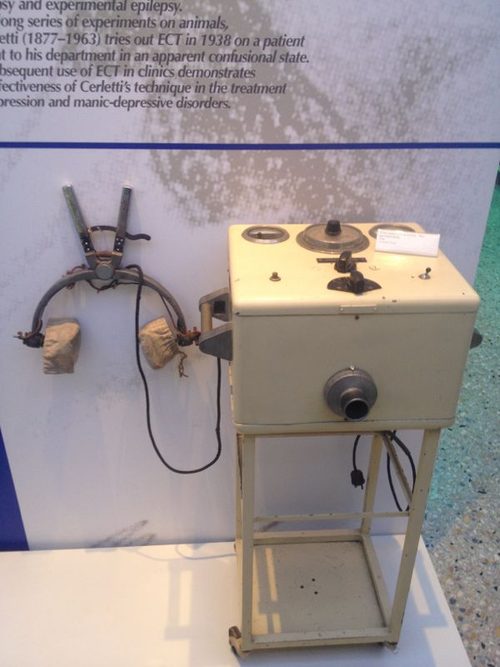
Electroconvulsive therapy, then and now
Ugo Cerletti and Lucio Bini first induced a seizure with electricity in Rome in April 1938. Unmodified ECT injured and frightened many; anaesthesia and muscle relaxants made it a treatment still used today.
 1952–present · Transformed
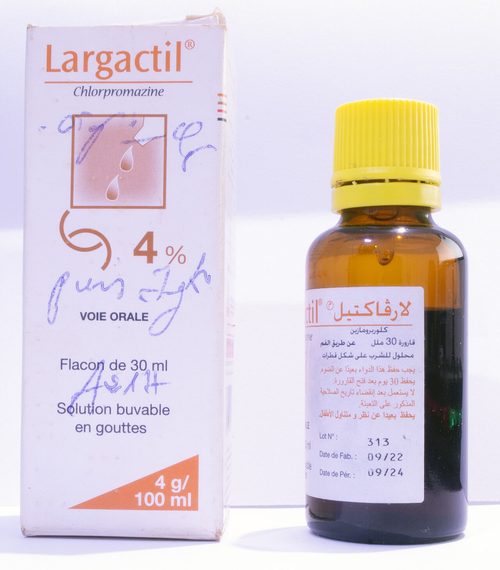
Chlorpromazine
A French drug tried on psychiatric patients in Paris in 1952. Chlorpromazine calmed psychosis without stupor, emptied wards and began the age of psychiatric drugs, with lasting side-effects.
1933–1960s · Abandoned
Insulin coma therapy
From the mid-1930s to the late 1950s, people diagnosed with schizophrenia were put into deep comas with insulin, day after day. A trial in 1957 found the insulin itself did nothing special.
 1934–1950s · Abandoned
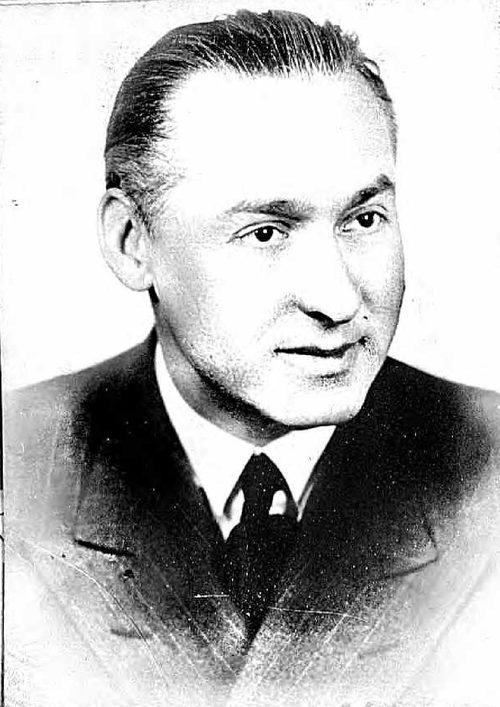
Metrazol convulsive therapy
In 1934 Ladislas Meduna began causing seizures with drugs to treat schizophrenia, first camphor and then cardiazol (Metrazol). Patients dreaded it, and within a decade electricity had replaced the drug.
 1845–1990
The biological turn
From Griesinger's claim in the 1840s that mental illness is brain disease, through the microscope, the shock therapies and the drug revolution, to DSM-III in 1980: how psychiatry repeatedly turned to the body.
 1955–2000 · Transformed
Deinstitutionalisation
From the mid-1950s Western countries emptied their great mental hospitals: US public hospitals fell from about 559,000 patients to under 72,000 in forty years. Whether patients were freed or abandoned is still argued.