
Diagnosis · 1374–1600s
Dancing mania
Outbreaks of compulsive dancing along the Rhine and Moselle between 1374 and the 1500s, blamed on saints and demons, later named a 'mania' by doctors. Their cause is still argued over.
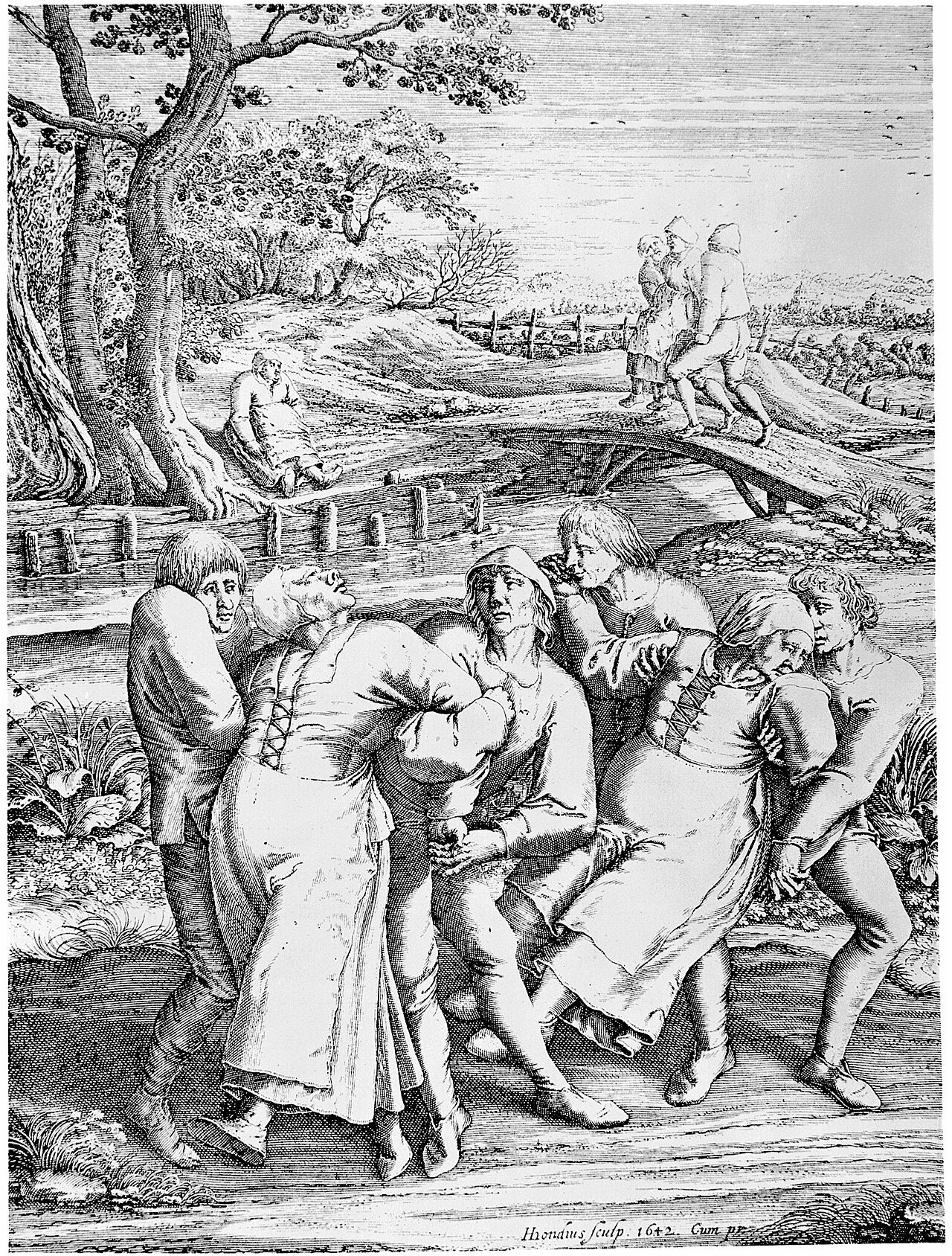
In the summer of 1374 people began to dance in the streets and churches of Aachen (Aix-la-Chapelle in older English books), and the dancing spread through the Rhineland and the Low Countries1,5. Over the next century and a half similar outbreaks appeared along the Rhine and the Moselle, the best documented in Strasbourg in 1518. Contemporaries blamed saints and demons. Nineteenth-century doctors called it a mania. Historians still disagree about what happened.
The outbreaks
The German physician Justus Hecker, whose book Die Tanzwuth (1832) made the outbreaks a subject for medicine, described the 1374 dancers from the chronicles1,5:
They formed circles hand in hand, and appearing to have lost all control over their senses, continued dancing, regardless of the by-standers, for hours together in wild delirium1
Quotation checked against the 1844 text
They danced until they collapsed. Chroniclers recorded that dancers shrieked the names of spirits, saw visions of heaven, and complained afterwards of pain and swelling, which bystanders tried to relieve by binding cloths tightly round their waists1. The dancers of 1374 were associated with St John and his festival; later outbreaks were attributed to St Vitus, a martyr believed to punish sinners with a dance and to cure those who came to his shrines1,6. In southern Italy a related tradition, tarantism, attributed frenzied dancing to the bite of a tarantula and treated it with music6.
The historian John Waller notes that the 1374 outbreak followed a severe flood on the Rhine, and that the region's later outbreaks also came in hard years3.
Strasbourg, 1518
The Strasbourg outbreak is unusually well recorded, in chronicles, sermons, physicians' notes and orders of the city council4,6. It began in mid-July 1518, when a woman named in most chronicles as Frau Troffea started dancing alone in her street. After several days she was sent to the shrine of St Vitus at Saverne, about thirty miles away, but others had begun to imitate her; one family chronicle reports that within a month some 400 people were affected4.
The council first took medical advice. Physicians declared the dancing a natural illness caused by overheated blood and advised that the sufferers dance it out. Guild halls were turned into dance floors, stages built in the markets, and musicians and strong healthy dancers hired to keep the afflicted moving. The treatment drew crowds and seemed to spread the dancing, and the council reversed course: it banned public music and dancing until September and sent the worst affected by wagon to Saverne, where priests gave them small crosses and red shoes anointed with holy oil4. By early September the outbreak had subsided6.
A disease of the Middle Ages
Physicians took an interest from early on. Paracelsus, who visited Strasbourg a few years later, classified dancing manias into three kinds and suggested that the first dancer had begun in order to annoy her husband4. By the seventeenth century the name had drifted. When the English physician Thomas Sydenham wrote of "St Vitus's dance" he meant something quite different, a movement disorder of children:
This is a kind of convulsion, which attacks boys and girls from the tenth year to the time of puberty.2
Quotation checked against the 1848 text
That condition is now called Sydenham's chorea, and it has nothing to do with the medieval epidemics except a borrowed name2,6. Hecker's book, translated into English by B. G. Babington in 1835 and published again in 1844, presented the medieval outbreaks as a "mental plague". He blamed a wretched and oppressed population along the Rhine, tormented, he thought, by guilt over crimes committed during the Black Death, and saw the St John's festival of 1374 as bringing a long-impending malady to a crisis1.
What it maps to now, and why that is uncertain
The most widely cited modern interpretation is Waller's. He argues that the dancers were in dissociative trance states, made possible by a shared belief that saints or demons could compel people to dance, and triggered by intolerable stress: famine, disease and fear. On this view the dancing plagues were outbreaks of mass psychogenic illness, related to the convent "possession" epidemics of the following centuries3.
The sources make any firm answer impossible. Nearly everything is known through chroniclers, many writing years later, who explained what they saw in religious terms. They did not record the questions a modern clinician would ask, and the people involved left no accounts of their own. Calling the dancers "hysterical", or "psychotic", or "poisoned" is a hypothesis about them, not a diagnosis (Can we diagnose the dead?; compare demonic possession and its critics and hysteria).
Key dates
- 1374 Dancing outbreaks spread from Aachen through the Rhineland and the Low Countries.
- 1518 Strasbourg's council hires musicians and sets up stages, then bans public dancing and sends dancers to the shrine of St Vitus at Saverne.
- July 1518 A woman begins dancing in a Strasbourg street; within weeks hundreds have joined her.
- 1832 Justus Hecker publishes Die Tanzwuth, presenting the outbreaks as a medieval disease of the mind.
- 1844 B. G. Babington's English translation of Hecker's Epidemics of the Middle Ages appears.
Sources
- Primary source J. F. C. Hecker, The Epidemics of the Middle Ages (trans. B. G. Babington), London: Sydenham Society (1844). Quotations checked against this text.
- Primary source Thomas Sydenham, The Works of Thomas Sydenham, vol. 2 (trans. R. G. Latham), London: Sydenham Society (1848). Quotations checked against this text.
- Scholarship John Waller, Dancing plagues and mass hysteria, The Psychologist (British Psychological Society) 22(7) (2009-07-16).
- Reference Ned Pennant-Rea, The Dancing Plague of 1518, The Public Domain Review (2018-07-10).
- Wikipedia Dancing mania, Wikipedia.
- Wikipedia Dancing plague of 1518, Wikipedia.
Cross-checked with Wikidata Q2140711 and the English Wikipedia article.
Read next
 Antiquity–19th century
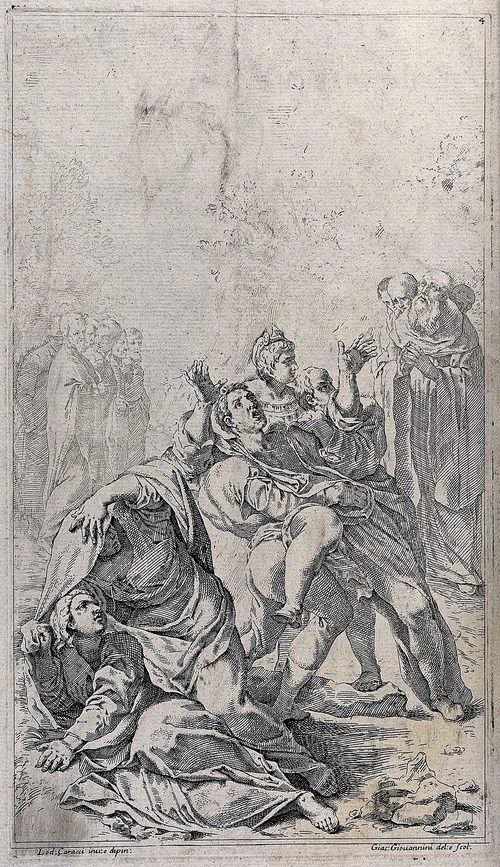
Demonic possession and its critics
Many cultures have explained fits, voices and despair as the work of spirits. How Europeans argued over possession from Hippocrates to Charcot, and why the story that medicine simply defeated superstition is too simple.
 1680s–1980
Hysteria
Named for the womb, hysteria became medicine's catch-all for symptoms it could not explain. Its history from Greek texts to Sydenham, Charcot and Freud, and why it was dropped in 1980.
 Essay · 6 min
Can we diagnose the dead?
Why this site never diagnoses historical figures, and hedges every modern equivalent it gives: the evidence was made for other purposes, diseases change their identities, and each age's diagnoses of the dead reflect its own medicine.
 1877–present
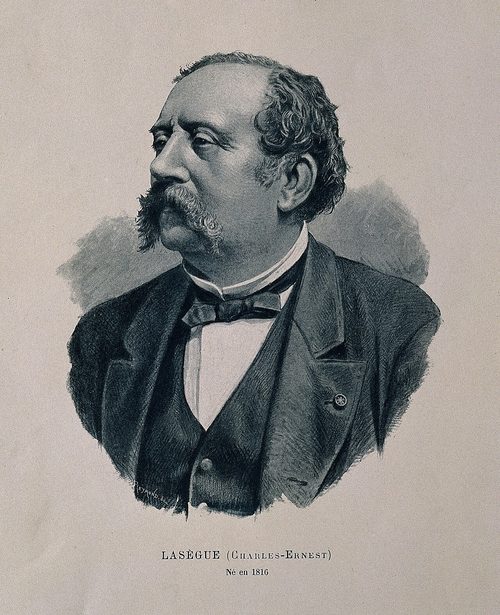
Folie à deux
Named in Paris in 1877 by Charles Lasègue and Jules Falret: a delusion passed from one person to another who shares their life. Its classic rules have not survived later study, but the name has.
 c. 400 BCE–1900s
Melancholia
For two thousand years melancholia meant fear and sorrow without cause, blamed on black bile. How physicians from Aretaeus to Kraepelin defined it, and how it became 'depression'.