
Diagnosis · 1877–present
Folie à deux
Named in Paris in 1877 by Charles Lasègue and Jules Falret: a delusion passed from one person to another who shares their life. Its classic rules have not survived later study, but the name has.
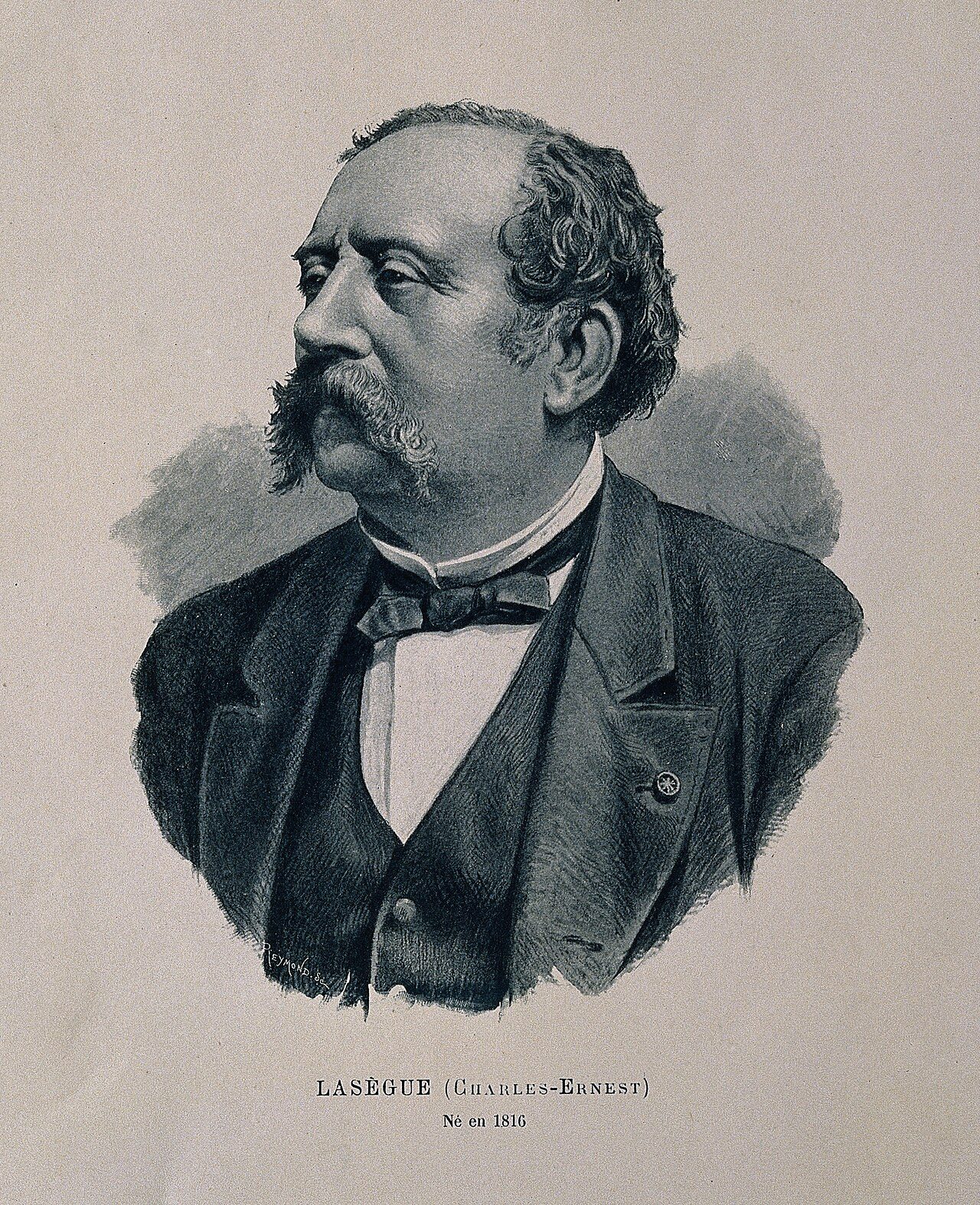
The paper that named folie à deux begins by insisting that it should almost never happen. In November 1877 two Paris physicians, Charles Lasègue and Jules Falret, opened their article in the Annales médico-psychologiques with a principle every asylum doctor knew: a person with delusions resists every argument against them. "If madness did not exclude persuasion," they wrote, "it would be merely an error instead of a disease" (our translation)1. By the same token, they argued, the mad could not persuade the sane. Asylum attendants were no more at risk than hospital nurses, and families were not endangered by living with a sick relative1. Their subject was the exception.
Lasègue and Falret's rules
The two doctors called it folie à deux, madness shared by two, or folie communiquée, and set out the conditions under which it occurred. In their summary (our translation), one of the pair is "the active element": more intelligent than the other, this person "creates the delusion and imposes it progressively on the second", who "resists at first, then yields little by little", while also helping to correct and organise the shared story, which both then repeat "in the same terms and in an almost identical way"1. The two must have lived together for a long time, sharing the same feelings, interests, fears and hopes, "outside any other external influence". And the delusion must be plausible, resting on past events or on fears and hopes for the future, because only plausibility allows one person's conviction to take root in another's mind1.
They found it commoner in women, allowed heredity a role only when the two were related, and noted that it also occurred between husband and wife. Their treatment was simple: separate the two. The second person often recovered once deprived of the support of the first, and was sometimes not "insane in the social and legal sense" at all: that person "does not need to be confined, while the companion is shut away"1.
Names and varieties
Others quickly multiplied the terms. Emmanuel Régis wrote a thesis on folie simultanée in 1880, for cases in which two predisposed people fell ill together4,2,6. Lasègue and Falret's own phrase folie imposée and Lehmann's folie induite marked other varieties2. In Britain Daniel Hack Tuke, who had described a husband and wife with the same delusions and hallucinations, and a case of folie à quatre, in the journal Brain in 1888, preferred "communicated insanity"2. His Dictionary of Psychological Medicine (1892) set out what experience seemed to show: such cases were "very rare"; more women than men were affected; persecutory delusions were the commonest form; and a person who could still pass as rational was the likelier to draw another in:
It is more likely that an insane person able to pass muster, as being in the possession of his intellect, should influence another in the direction of his delusion, than if he is outrageously insane.2
Quotation checked against the 1892 text
In the newspapers
By the 1890s the idea had reached the popular press. In April 1895 the American physician Charles W. Pilgrim explained it to readers of Popular Science Monthly after a run of newspaper stories about families in New York, Buffalo and Philadelphia who had become ill together3. He described two unmarried sisters, isolated, poor and overworked after their mother's death, in whom the elder's fears of persecution were taken up by the younger after weeks of resistance:
At last, however, the sane mind succumbed to the overpowering influence of the insane one, and she became her sister's second self in word, thought, and act.3
Quotation checked against the 1895 text
The sisters were admitted to hospital and placed on different wards. Within about four months the younger had given up all her delusions; the elder improved but did not fully recover3. Pilgrim was careful to deny that madness was contagious like smallpox, and used the case to argue for early hospital treatment3.
Later classifications
Twentieth-century manuals kept the idea under new names. The World Health Organization's ICD-10 called it "induced delusional disorder" and the American DSM-IV "shared psychotic disorder"6,5. DSM-5, published in 2013, dropped it as a separate diagnosis, judging the criteria inadequate; such cases are now classed as delusional disorder or under other psychotic disorders6.
What it maps to now, and why that is uncertain
Shared delusions are still seen, usually in pairs or families living in isolation, and psychiatrists still use the old French name6. But the historical cases cannot simply be relabelled. Lasègue and Falret's criteria built in assumptions about a healthy, passive secondary and a dominant primary that, as Arnone and colleagues note, shaped later psychiatric thought with little supporting evidence5. The boundary is also social. Modern definitions exclude beliefs that are ordinarily accepted in a person's culture or group, and nobody has fixed the number of believers at which a shared delusion becomes a shared belief6. Victorian writers placed religious revivals and the medieval dancing manias in the same family as folie à deux2,3; today those questions belong to the history of belief and mass behaviour as much as to psychiatry (Can we diagnose the dead?).
Key dates
- November 1877 Charles Lasègue and Jules Falret publish 'La folie à deux ou folie communiquée' in the Annales médico-psychologiques.
- 1880 Emmanuel Régis publishes his thesis on 'folie simultanée'.
- 1888 Daniel Hack Tuke describes cases of 'double insanity' in the journal Brain.
- April 1895 Charles W. Pilgrim explains 'communicated insanity' to readers of Popular Science Monthly.
- 2013 DSM-5 drops shared psychotic disorder as a separate diagnosis.
Sources
- Primary source Charles Lasègue, Jules Falret, La folie à deux ou folie communiquée (Annales médico-psychologiques, 5e série, t. 18, novembre 1877), Paris: Annales médico-psychologiques (1877-11).
- Primary source Daniel Hack Tuke (ed.), Communicated Insanity (in A Dictionary of Psychological Medicine, vol. 1), Philadelphia: P. Blakiston, Son & Co. (1892). Quotations checked against this text.
- Primary source Charles W. Pilgrim, Communicated Insanity, Popular Science Monthly 46 (April 1895) (1895-04). Quotations checked against this text.
- Primary source Emmanuel Régis, La folie à deux ou folie simultanée, Paris: J.-B. Baillière (1880).
- Scholarship Danilo Arnone, Anish Patel, Giles Ming-Yee Tan, The nosological significance of Folie à Deux: a review of the literature, Annals of General Psychiatry 5 (2006).
- Wikipedia Folie à deux, Wikipedia.
Cross-checked with Wikidata Q1435409 and the English Wikipedia article.
Read next
 1374–1600s
Dancing mania
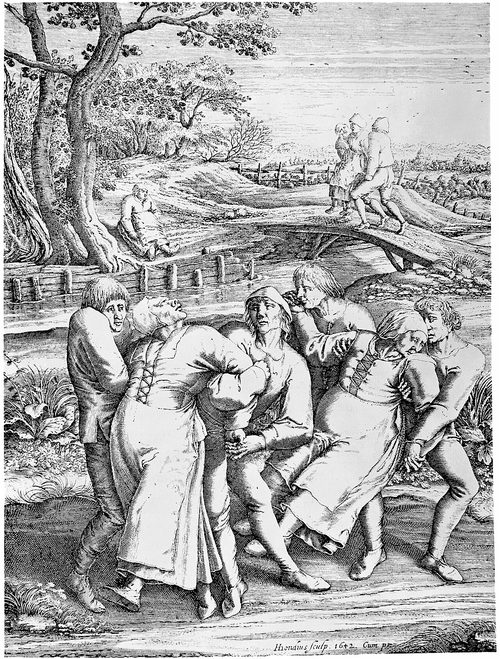
Outbreaks of compulsive dancing along the Rhine and Moselle between 1374 and the 1500s, blamed on saints and demons, later named a 'mania' by doctors. Their cause is still argued over.
 1810s–1870s
Monomania
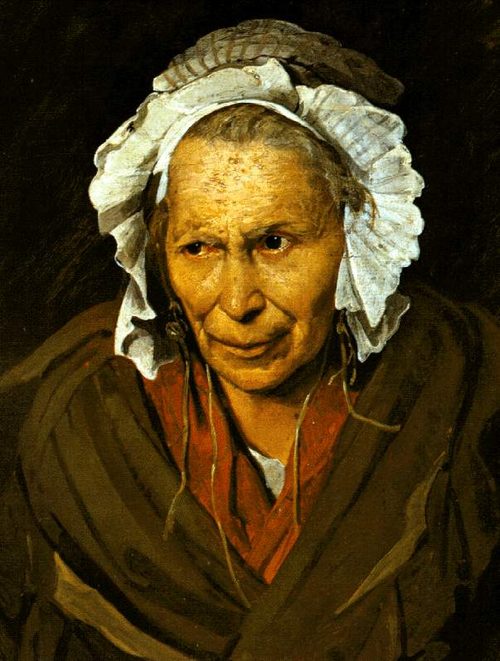
Esquirol's monomania described a mind sound in every way but one: a single fixed idea or irresistible impulse. It made alienists expert witnesses, then fell apart under criticism after 1854.
 1680s–1980
Hysteria
Named for the womb, hysteria became medicine's catch-all for symptoms it could not explain. Its history from Greek texts to Sydenham, Charcot and Freud, and why it was dropped in 1980.
 Essay · 6 min
Can we diagnose the dead?
Why this site never diagnoses historical figures, and hedges every modern equivalent it gives: the evidence was made for other purposes, diseases change their identities, and each age's diagnoses of the dead reflect its own medicine.
Essay · 6 min
How words for madness changed
From the Latin insania and furor to 'lunatic', 'alienist', 'mental hospital' and 'schizophrenia': why the words for madness kept changing, and why the change usually came from law and institutions rather than discovery.