
Diagnosis · 1600s–1800s
Hypochondria and the vapours
Before it meant fear of illness, hypochondria was a real disease of the gut and nerves, the male twin of hysteria and, with the vapours, the fashionable 'English malady' of the 1700s.
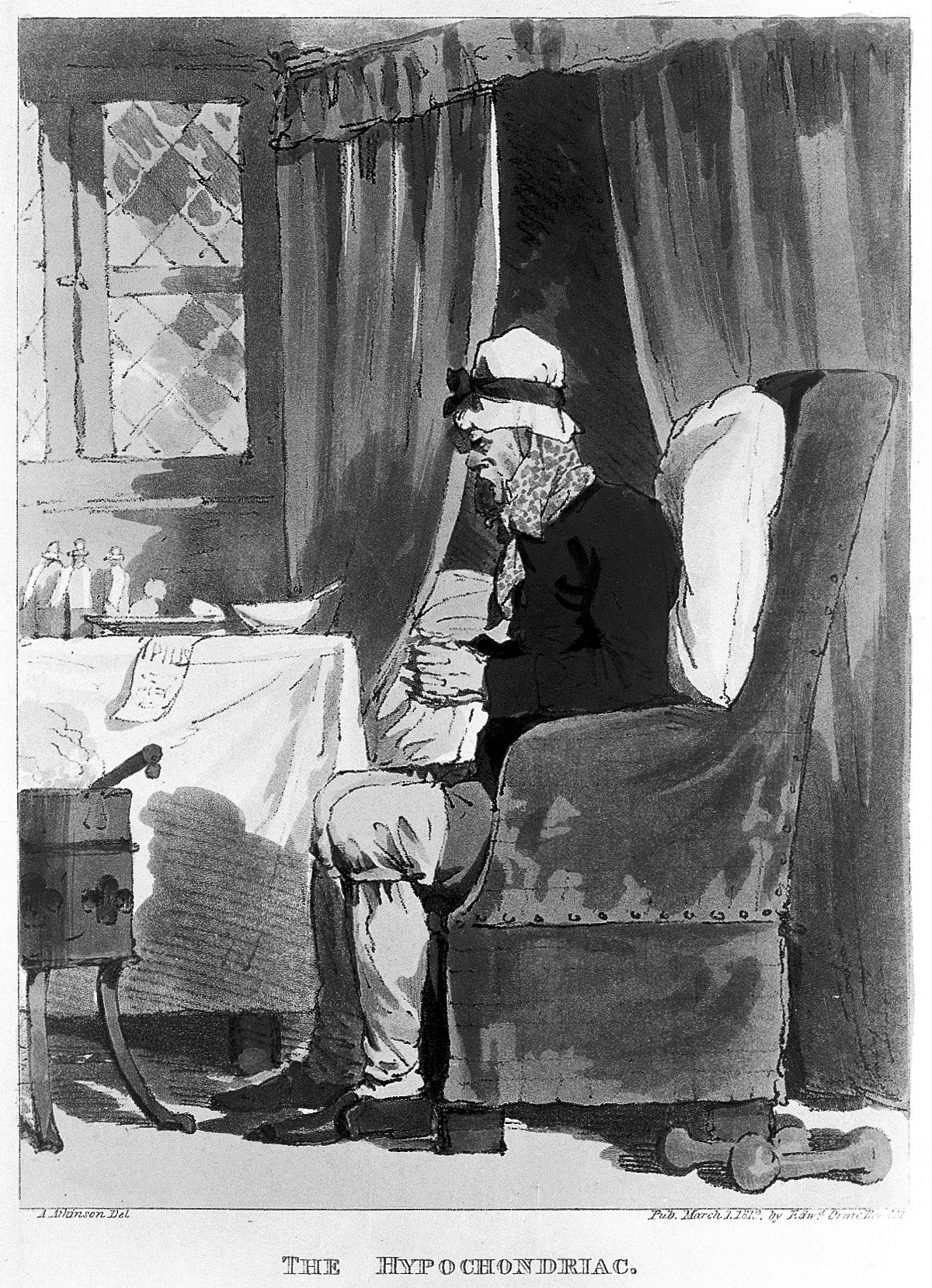
The hypochondrium is a place, not a feeling. In Greek anatomy it was the upper abdomen, the soft region "under the cartilage" of the lower ribs, and for centuries physicians located some of the most troublesome human misery there. When an eighteenth-century gentleman complained of "the hyp", he meant his digestion and his spirits at once, and his doctor took both seriously4,5.
Windy melancholy
The ancient idea was that the organs beneath the ribs could send up vapours to the brain, so that a disordered stomach became a disordered mind4,5. Robert Burton's Anatomy of Melancholy (1621) gave this "hypochondriacal or windy melancholy" a long section of its own, listing belching, heat in the bowels, "wind and rumbling in the guts", palpitations, giddiness, broken sleep and fear, and quoting an older physician on how confusing it all was1:
"In this hypochondriacal or flatuous melancholy, the symptoms are so ambiguous," saith Crato in a counsel of his for a noblewoman, "that the most exquisite physicians cannot determine of the part affected."1
Quotation checked against the 1621 text
Burton also gave the first extended account of the hypochondriac's dread of disease, the fear of catching whatever one has just read about, though for him it was one symptom among many, not the definition4.
Hysteria's twin
The decisive step came from Thomas Sydenham in London. In his letter on "the hysterical affection", dated 20 January 1682, he argued that the women's disease blamed on the womb and the men's disease blamed on the spleen were the same disorder, and that the womb was not its cause:
The affection which I have characterised in females as hysteria, and in males as hypochondriasis, arises (in my mind) from a disorder (ataxy) of the animal spirits.2
Quotation checked against the 1848 text
Thomas Willis had already argued that these complaints were convulsions of the nerves rather than vapours from the spleen4. That shift helped make hypochondria respectable: a disease of the nerves could be read as a sign of a delicate, refined constitution4. Through the eighteenth century "the spleen", "the vapours", "the hyp", "lowness of spirits" and "nervous disorders" became overlapping names for one fashionable complaint, the vapours being the term most often applied to women4,7. John Purcell's Treatise of Vapours, or Hysterick Fits appeared in 1707, Richard Blackmore's Treatise of the Spleen and Vapours in 17254,7.
The English malady
The best-known book was by George Cheyne, a Scottish physician practising at Bath. Cheyne explained his title in the preface to The English Malady (1733): foreigners, he wrote, mocked "nervous Distempers, Spleen, Vapours, and Lowness of Spirits" as the English disease. He blamed the damp air and changeable weather, the richness of English food, the wealth brought by trade, the "Inactivity and sedentary Occupations of the better Sort", and life in crowded, unhealthy towns, and he estimated that such disorders made up "almost one third of the Complaints of the People of Condition in England"3.
Cheyne included his own case at length. He had grown enormously heavy, at one point about thirty-two stone by later accounts, and had recovered on a diet of milk and vegetables, which he went on to prescribe to his patients3,6. His patients included the novelist Samuel Richardson, who also printed his books, and the poet Alexander Pope6. Treatment for nervous complaints of this kind combined regimen (diet, exercise, regular hours) with drugs such as the Peruvian bark and "steel", iron steeped in wine, both of which Sydenham had recommended2,3.
The sufferers were not only patients but writers. James Boswell wrote a series of essays as "The Hypochondriack" in the London Magazine between 1777 and 1783, and his friend Samuel Johnson, another sufferer, tied the complaint to idleness and an undisciplined life4.
From disease to suspicion
By the early nineteenth century the word was turning against its users. The Philadelphia physician Benjamin Rush observed in 1812 that patients were offended to be called hypochondriacs, because the name had come to suggest imaginary illness or malingering4. The old bodily hypochondria was absorbed into "nervousness", later into neurasthenia and melancholia, while the name narrowed to its modern meaning: persistent fear of having a serious illness4,5. In twentieth-century classifications hypochondriasis was a neurosis (DSM-I and DSM-II) and then a somatoform disorder (DSM-III, 1980); DSM-5 replaced it in 2013 with two new categories, somatic symptom disorder and illness anxiety disorder5.
What it maps to now, and why that is uncertain
Some eighteenth-century sufferers from "the hyp" or "the vapours" might today be diagnosed with depression or an anxiety disorder, and Brian Dillon notes that Boswell's use of the word already sounds close to the modern sense of anxiety about illness and death4. But the old diagnosis was explicitly a bodily one. Indigestion and other complaints that medicine of the time could not distinguish were part of it, and Cheyne's own account mixes obesity, fevers and low spirits in a single story3. The diagnosis also did social work, marking a patient as refined. Sydenham's insistence that men and women shared one disorder, and the later split into a respectable male "hyp" and a female "vapours", show how much the labels followed gender rather than symptoms; the parallel history is told under hysteria2,4,7.
Key dates
- 1621 Burton's Anatomy of Melancholy describes 'hypochondriacal or windy melancholy'.
- 1682 Sydenham treats hypochondriasis in men and hysteria in women as one disorder of the animal spirits.
- 1707 John Purcell publishes A Treatise of Vapours, or Hysterick Fits.
- 1733 George Cheyne publishes The English Malady.
- 1777 James Boswell begins his essays as 'The Hypochondriack' in the London Magazine (to 1783).
Sources
- Primary source Robert Burton, The Anatomy of Melancholy, Oxford: Henry Cripps (first edition); Project Gutenberg text (1621). Quotations checked against this text.
- Primary source Thomas Sydenham, Epistolary Dissertation to Dr William Cole, in The Works of Thomas Sydenham, vol. 2 (trans. R. G. Latham), London: Sydenham Society (1848). Quotations checked against this text.
- Primary source George Cheyne, The English Malady: or, a Treatise of Nervous Diseases of All Kinds, London: G. Strahan and J. Leake (1733).
- Scholarship Brian Dillon, Unwell: a short history of hypochondria, Cabinet, issue 22 (2006).
- Wikipedia Hypochondriasis, Wikipedia (2026).
- Wikipedia George Cheyne (physician), Wikipedia (2026).
- Wikipedia Vapours (mental condition), Wikipedia (2026).
Cross-checked with Wikidata Q105434 and the English Wikipedia article.
Read next
 c. 400 BCE–1900s
Melancholia
For two thousand years melancholia meant fear and sorrow without cause, blamed on black bile. How physicians from Aretaeus to Kraepelin defined it, and how it became 'depression'.
 1680s–1980
Hysteria
Named for the womb, hysteria became medicine's catch-all for symptoms it could not explain. Its history from Greek texts to Sydenham, Charcot and Freud, and why it was dropped in 1980.
 1869–1920s
Neurasthenia
George Beard's 'nervous exhaustion' of 1869 blamed modern life for tired, anxious, aching patients. It became the fashionable diagnosis of the 1880s, faded by 1920, and lived on in China.
 c. 400 BCE–1800s
The four humours
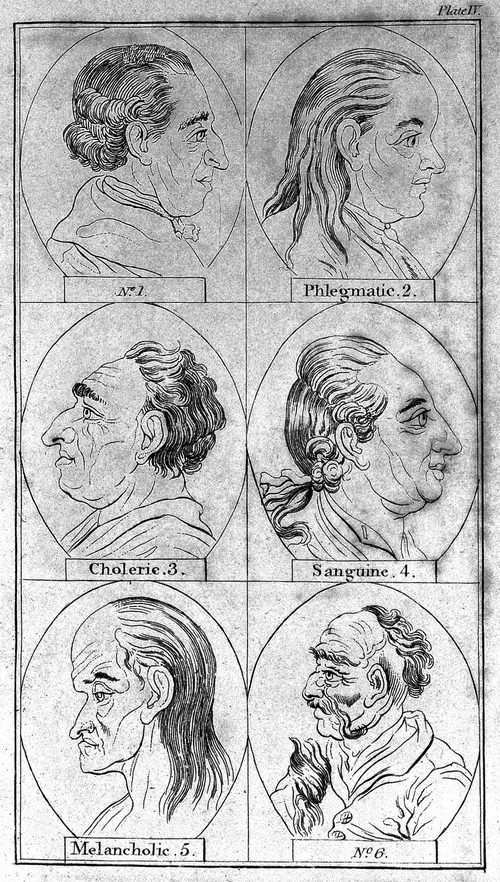
For two thousand years, European and Islamic medicine explained madness and melancholy by four bodily fluids. What the theory claimed about the mind, how it shaped treatment, and how it slowly lost its hold.
Essay · 6 min
How words for madness changed
From the Latin insania and furor to 'lunatic', 'alienist', 'mental hospital' and 'schizophrenia': why the words for madness kept changing, and why the change usually came from law and institutions rather than discovery.