
Diagnosis · 1810s–1870s
Monomania
Esquirol's monomania described a mind sound in every way but one: a single fixed idea or irresistible impulse. It made alienists expert witnesses, then fell apart under criticism after 1854.
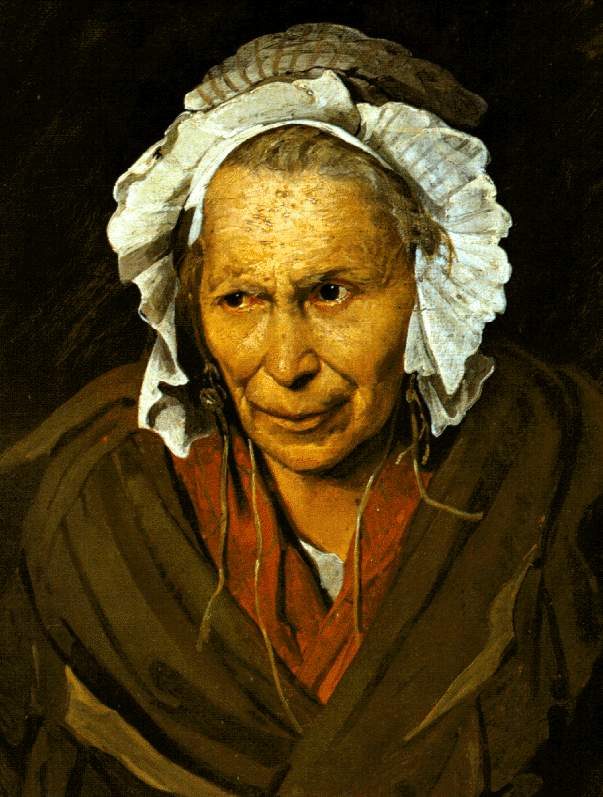
Jean-Étienne Esquirol, Pinel's most influential pupil, inherited an old idea and gave it a new name. Physicians had long described a "partial insanity", in which a person reasoned soundly on every subject but one. Esquirol thought the traditional word for it, melancholia, was compromised by its link to black bile and by its everyday meaning of sadness, so he coined a replacement:
This double consideration, has caused me to propose the word monomania; ... a term which expresses the essential character of that form of insanity, in which the delirium is partial, permanent, gay or sad.1
Quotation checked against the 1845 text
He set the idea out in an article for the Dictionnaire des sciences médicales in 1819 and in its fullest form in Des maladies mentales (1838), translated into English in 18451,3. It became, for about forty years, one of the most discussed diagnoses in European medicine and one of the most widely known outside it3,4.
A disease of the passions
Esquirol presented monomania as the characteristic madness of an advanced society. The more developed the mind, he argued, the more exposed it was:
There has been no advancement in the sciences, no invention in the arts, nor any important innovation, which has not served as a cause of monomania, or lent to it, its peculiar character.1
Quotation checked against the 1845 text
He called it "essentially a disease of the sensibility", rooted in the passions: thwarted love, fear, vanity, wounded pride, disappointed ambition1. He divided it into three kinds. In intellectual monomania the patient held a fixed false belief. In affective monomania the reasoning was intact but the feelings and character were perverted. In the third, "monomania without delirium, or instinctive monomania", the will itself was disordered: the patient was "drawn away from his accustomed course to the commission of acts to which neither reason nor sentiment determine", acts "involuntary, instinctive, irresistible"1. The sad variety of partial insanity he gave a separate name, "lypemania"1.
Around this frame Esquirol's circle described a growing list of particular monomanias: religious monomania, monomanias of pride and grandeur, an impulse to set fires (the later pyromania), an impulse to steal (the later kleptomania), and the most controversial, homicidal monomania, which the younger alienist Étienne-Jean Georget described as an abrupt "lesion of the will"1,6.
The courtroom diagnosis
Homicidal monomania mattered because of the law. Under the old rule, an accused person counted as legally insane only if wholly deprived of reason, something any juror could see. Monomania claimed that a defendant might plan, work and converse normally and still be driven by a hidden derangement that only an expert could detect3. The historian Jan Goldstein has argued that Esquirol's school promoted it precisely to win "a place for expert psychiatric testimony in the courts of law"3. In France the 1825 case of Henriette Cornier, a 26-year-old woman tried for the apparently motiveless killing of a small child she knew, made the concept a public argument among the leading alienists; her death sentence was commuted to life imprisonment with hard labour3.
In England, where James Cowles Prichard was developing the related idea of moral insanity, the influence reached a peak in two trials at the Old Bailey: Edward Oxford, aged eighteen, who fired pistols at Queen Victoria in 1840, and Daniel M'Naghten, who killed the Prime Minister's secretary, Edward Drummond, in 1843. Both were acquitted on grounds of insanity after testimony about partial delusions and hidden derangement3. The public and political reaction to the M'Naghten verdict was hostile; the answers given by a panel of judges to questions about the insanity defence, the "M'Naghten rules", returned the law to a narrow test of whether the accused knew what he was doing and that it was wrong3.
Fashion and decline
Outside the courts the word spread fast. The painter Théodore Géricault portrayed asylum patients under titles such as The Monomaniac of Envy (c. 1822)6. By 1851 Herman Melville could describe Ahab in Moby-Dick as driven by "monomania", a word his readers needed no help to understand2. The diagnosis entered asylum registers abroad, in Dublin from 1833; in the United States it was still one of the seven categories of mental illness used in the census of 18804,6.
Inside medicine it was failing. In 1854 Jean-Pierre Falret, physician at the Salpêtrière, published "De la non-existence de la monomanie", arguing that careful observation of the whole patient, rather than attention to isolated symptoms, never found a madness truly confined to one idea5,7. His essay is usually taken as the start of monomania's decline. Dermot Walsh's study of the records finds that it had disappeared from use in the hospitals of Paris by 1870; the last admission so diagnosed at Dublin's Richmond District Asylum was in 1878, though the Central Mental Hospital still used it in 18914.
What it maps to now, and why that is uncertain
Walsh suggests that monomania in its pure form comes closest to what is now called delusional disorder: a single, fixed false belief in an otherwise organised mind4. Some of the instinctive monomanias survive in name: kleptomania and pyromania are still used as diagnostic terms6. But Walsh also found that the case descriptions behind monomania diagnoses only occasionally correspond to delusional disorder as it is understood today, and that the Irish case books say little about why the label was chosen4. The legal use of the term makes retrospective reading harder still, since the same word served as a clinical description and as an argument for a defence.
Key dates
- 1819 Esquirol's article in the Dictionnaire des sciences médicales sets out monomania.
- 1825 The Paris case of Henriette Cornier makes 'homicidal monomania' a public controversy.
- 1838 Esquirol's Des maladies mentales gives monomania its fullest statement.
- 1843 The M'Naghten trial in London ends in acquittal on grounds of insanity, prompting the restrictive M'Naghten rules.
- 1854 Jean-Pierre Falret publishes 'De la non-existence de la monomanie'.
Sources
- Primary source Jean-Étienne Dominique Esquirol, Mental Maladies: A Treatise on Insanity (trans. E. K. Hunt), Philadelphia: Lea and Blanchard (1845). Quotations checked against this text.
- Primary source Herman Melville, Moby-Dick; or, The Whale, New York: Harper & Brothers (Project Gutenberg text) (1851).
- Scholarship David W. Jones, Moral insanity and psychological disorder: the hybrid roots of psychiatry, History of Psychiatry 28(3) (2017).
- Scholarship Dermot Walsh, The birth and death of a diagnosis: monomania in France, Britain and in Ireland, Irish Journal of Psychological Medicine 31(1) (2014).
- Scholarship Thomas Lepoutre and Tom Dening, 'De la non-existence de la monomanie', by Jean-Pierre Falret (1854): introduction and translation, History of Psychiatry 23(3) (2012).
- Wikipedia Monomania, Wikipedia (2026).
- Wikipedia Jean-Pierre Falret, Wikipedia (2026).
Cross-checked with Wikidata Q917061 and the English Wikipedia article.
Read next
 1835–1910s
Moral insanity
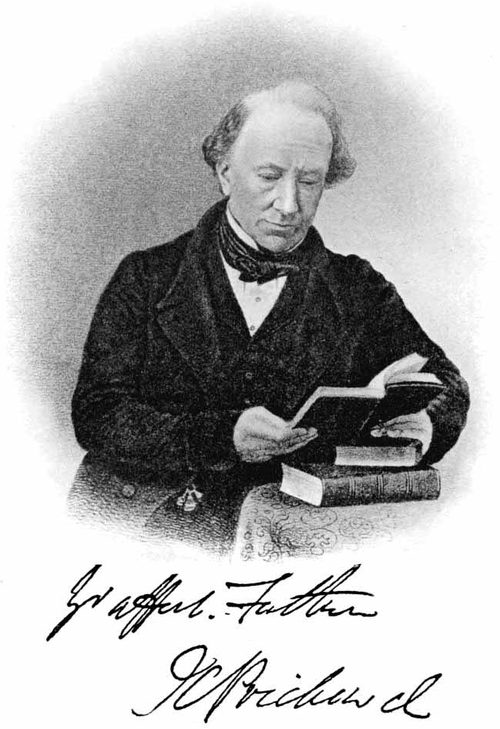
In 1835 J. C. Prichard named a madness of feeling and conduct with reason intact. Moral insanity reached the Old Bailey, provoked a backlash, and fed the later ideas of 'moral imbecility' and psychopathy.
 c. 400 BCE–1900s
Melancholia
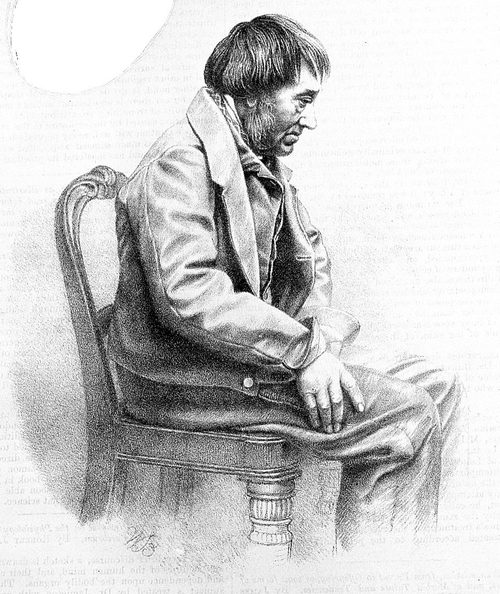
For two thousand years melancholia meant fear and sorrow without cause, blamed on black bile. How physicians from Aretaeus to Kraepelin defined it, and how it became 'depression'.
 c. 100 CE–1980
Mania
Mania once meant madness itself: raving, sleepless, sometimes joyful. How the word narrowed from Aretaeus to Kraepelin, and how it became one pole of manic-depressive illness.
 1877–present
Folie à deux
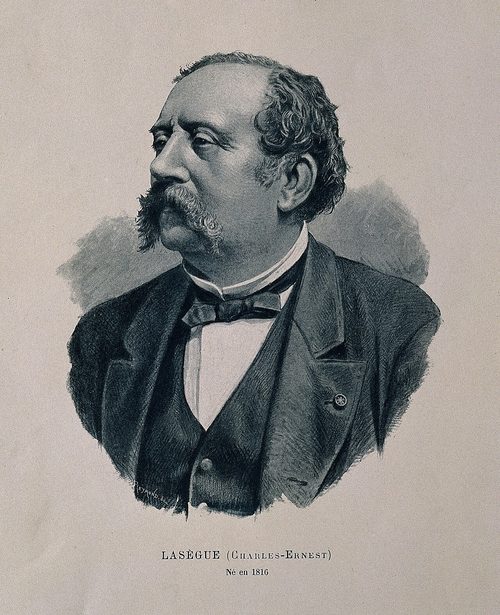
Named in Paris in 1877 by Charles Lasègue and Jules Falret: a delusion passed from one person to another who shares their life. Its classic rules have not survived later study, but the name has.
Essay · 6 min
How words for madness changed
From the Latin insania and furor to 'lunatic', 'alienist', 'mental hospital' and 'schizophrenia': why the words for madness kept changing, and why the change usually came from law and institutions rather than discovery.