
Person · 4 January 1746 – 19 April 1813
Benjamin Rush
Philadelphia physician and signer of the Declaration of Independence (1746–1813), called the 'father of American psychiatry', who treated madness by bleeding, purging and his restraining chair.
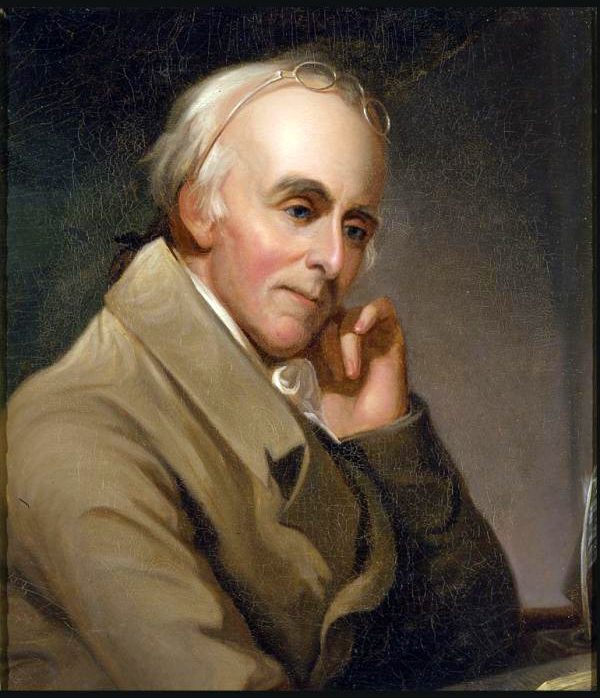
Rush's portrait still hangs, in a sense, over American psychiatry: his profile was placed at the centre of the seal of the American Psychiatric Association, whose own history of the seal calls him "the father of American Psychiatry" while conceding that his treatments were "considered erroneous and abandoned" by the time the association was founded in 18445. Both halves of that judgement are true.
Physician and revolutionary
Benjamin Rush was born on 4 January 1746 (24 December 1745 by the calendar then in use) at Byberry, outside Philadelphia3,5. After the College of New Jersey and an apprenticeship with the Philadelphia physician John Redman, he took his medical degree at Edinburgh in 1768 and returned to teach chemistry at the College of Philadelphia3,4. He threw himself into the Revolution, signed the Declaration of Independence in 1776, and served briefly as a surgeon-general of the Continental Army4,5. From 1783 until his death he was on the staff of the Pennsylvania Hospital, and he became the most famous medical teacher in the new republic3,5.
His medicine rested on a single theory: disease was a morbid excitement of the blood vessels, to be relieved by "depletion", bleeding and purging3. In the yellow fever epidemic of 1793, which killed between 4,000 and 5,000 Philadelphians, he bled and purged heavily and stayed in the city when many colleagues left; he was admired as a hero and attacked as reckless, and won a libel suit against the journalist William Cobbett, who accused him of killing his patients3,5.
Diseases of the Mind
Rush took charge of the hospital's insane patients and pressed for better accommodation for them5. In 1812 he published Medical Inquiries and Observations, upon the Diseases of the Mind, the first American textbook on the subject, which was reprinted several times3. Madness, he argued, followed his general theory:
I have thus mentioned the facts and arguments which prove what is commonly called madness to ... be a disease of the blood-vessels of the brain.1
Quotation checked against the 1812 text
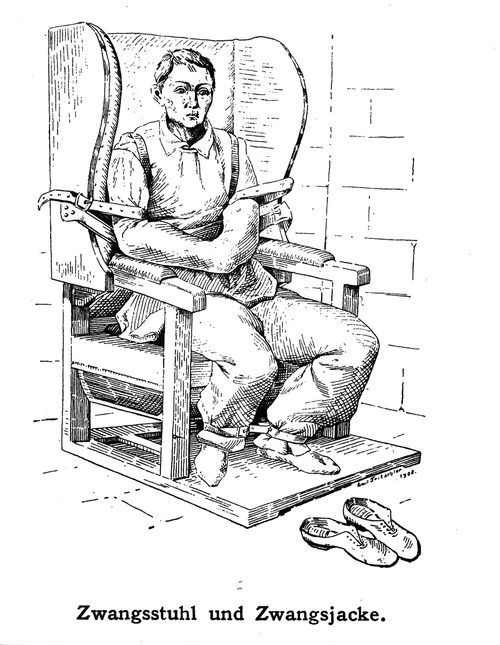
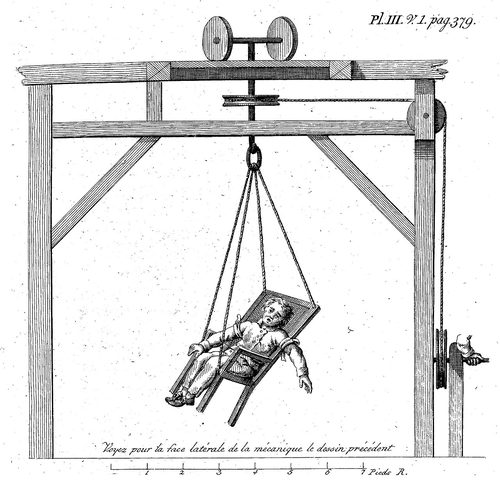
The treatment followed too: copious bloodletting, purging and emetics, purges, low diet, cold water to the head. For restless patients he designed the "tranquillizer", a chair that held the body, limbs and head fixed and, he claimed, reduced "the impetus of the blood towards the brain"; he also used a spinning "gyrator" (rotating chair)1,3. He listed punishments openly, including the withdrawal of food and the shower bath, and recommended fear as a remedy: "Terror acts powerfully upon the body, through the medium of the mind, and should be employed in the cure of madness"1. See restraint and the non-restraint movement.
The same book also contains ideas that look forward to moral treatment: kindness, amusements, and especially work.
It has been remarked, that the maniacs of the male sex in all hospitals, who assist in cutting wood, making fires, and digging in a garden, and the females who are employed in washing, ironing, and scrubbing floors, often recover1
Quotation checked against the 1812 text
He wrote at length on the "moral faculties" and their derangement, and on drunkenness as a disease rather than simply a sin, and he taught more than 3,000 students5.
Slavery and race
Rush published an attack on slavery in 1773 and later presided over the Pennsylvania abolition society3,5. In a paper read to the American Philosophical Society and printed in its Transactions in 1799, he argued that the dark skin of Africans was a hereditary form of leprosy. He meant it as an argument against claims of white superiority:
If the color of the negroes be the effect of a disease, instead of inviting us to tyrannise over them, it should entitle them to a double portion of our humanity2
Quotation checked against the 1799 text
But he drew a second conclusion in the same passage: that white people should keep up their prejudice against marriage with Black people, so as not to pass on the "disorder", and that science should seek a cure2. Turning a whole people's appearance into a disease, however kindly meant, belonged to the line of thought that later produced diagnoses such as drapetomania, whose inventor, Samuel Cartwright, had been one of Rush's last apprentices5.
Reputation
Rush died in Philadelphia on 19 April 1813 after a short fever, during which, true to his system, he had himself bled3. His successors kept his name and dropped his methods: within a generation the asylum doctors who founded the American association in 1844 had largely given up general bleeding and the tranquillizer for the routines of moral treatment5. He remains a founder in both senses, the first American to write systematically about mental disorder, and an example of how confidently a coherent theory can be applied to patients without evidence that it helps them.
Key dates
- 1768 Rush takes his medical degree at Edinburgh and returns to Philadelphia the next year as professor of chemistry.
- 1773 Rush publishes an address against slavery and the slave trade.
- 2 August 1776 Rush, a Pennsylvania delegate, signs the Declaration of Independence.
- 1783 Rush joins the staff of the Pennsylvania Hospital, where he serves until his death.
- 1793 In Philadelphia's yellow fever epidemic Rush treats patients by heavy bleeding and purging.
- 1799 The American Philosophical Society prints Rush's paper arguing that the dark skin of Africans is a form of leprosy.
- 1812 Rush publishes Medical Inquiries and Observations, upon the Diseases of the Mind, the first American textbook of psychiatry.
- 19 April 1813 Rush dies of a fever in Philadelphia.
Rush on this site
Sources
- Primary source Benjamin Rush, Medical Inquiries and Observations, upon the Diseases of the Mind, Philadelphia: Kimber & Richardson (1812). Quotations checked against this text.
- Primary source Benjamin Rush, Observations Intended to Favour a Supposition That the Black Color (As It Is Called) of the Negroes Is Derived from the Leprosy, Transactions of the American Philosophical Society 4 (1799). Quotations checked against this text.
- Museum or archive Benjamin Rush (1746–1813), University of Pennsylvania University Archives and Records Center, Penn People.
- Reference Benjamin Rush (signers of the Declaration of Independence), Independence Hall Association, ushistory.org.
- Wikipedia Benjamin Rush, Wikipedia.
Cross-checked with Wikidata Q656478 and the English Wikipedia article.
Read next
 Antiquity–1850s · Abandoned
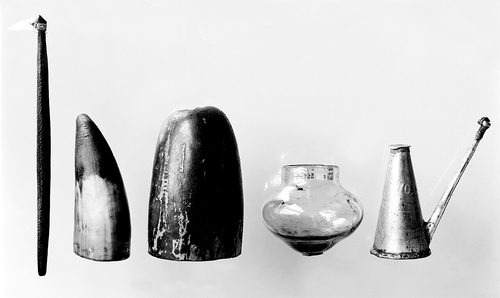
Bloodletting, purging and emetics
For two thousand years doctors bled, purged and vomited people with mania and melancholy. How depletion worked in theory, how it was done at Bethlem and in Philadelphia, and how it faded in the nineteenth century.
 1700s–1890s · Transformed
Restraint and the non-restraint movement
Chains, strait-waistcoats and restraint chairs were the ordinary equipment of asylums until the late 1830s, when Lincoln and then Hanwell abolished them. Britain made non-restraint a doctrine; much of the world did not.
 1796–1830s · Abandoned
Swinging and rotating chairs
Around 1800, doctors strapped patients into chairs and beds that spun at speed, to induce giddiness, vomiting and sleep. Erasmus Darwin's idea, Joseph Mason Cox's swing, and why it was abandoned within a generation.
 1790s–1870s · Transformed
Moral treatment
Moral treatment, developed at Bicêtre in Paris and the York Retreat in the 1790s, tried to cure madness through kindness, routine, work and self-control rather than chains and drugs. It shaped a century of asylums.
 1851–1860s
Drapetomania
A 'disease' invented in 1851 by the Louisiana physician Samuel Cartwright to explain why enslaved people ran away. It was medicalised racism in defence of slavery, and was mocked even in its own day.
 1835–1910s
Moral insanity
In 1835 J. C. Prichard named a madness of feeling and conduct with reason intact. Moral insanity reached the Old Bailey, provoked a backlash, and fed the later ideas of 'moral imbecility' and psychopathy.