
Treatment · 1790s–1870s
Moral treatment
Moral treatment, developed at Bicêtre in Paris and the York Retreat in the 1790s, tried to cure madness through kindness, routine, work and self-control rather than chains and drugs. It shaped a century of asylums.
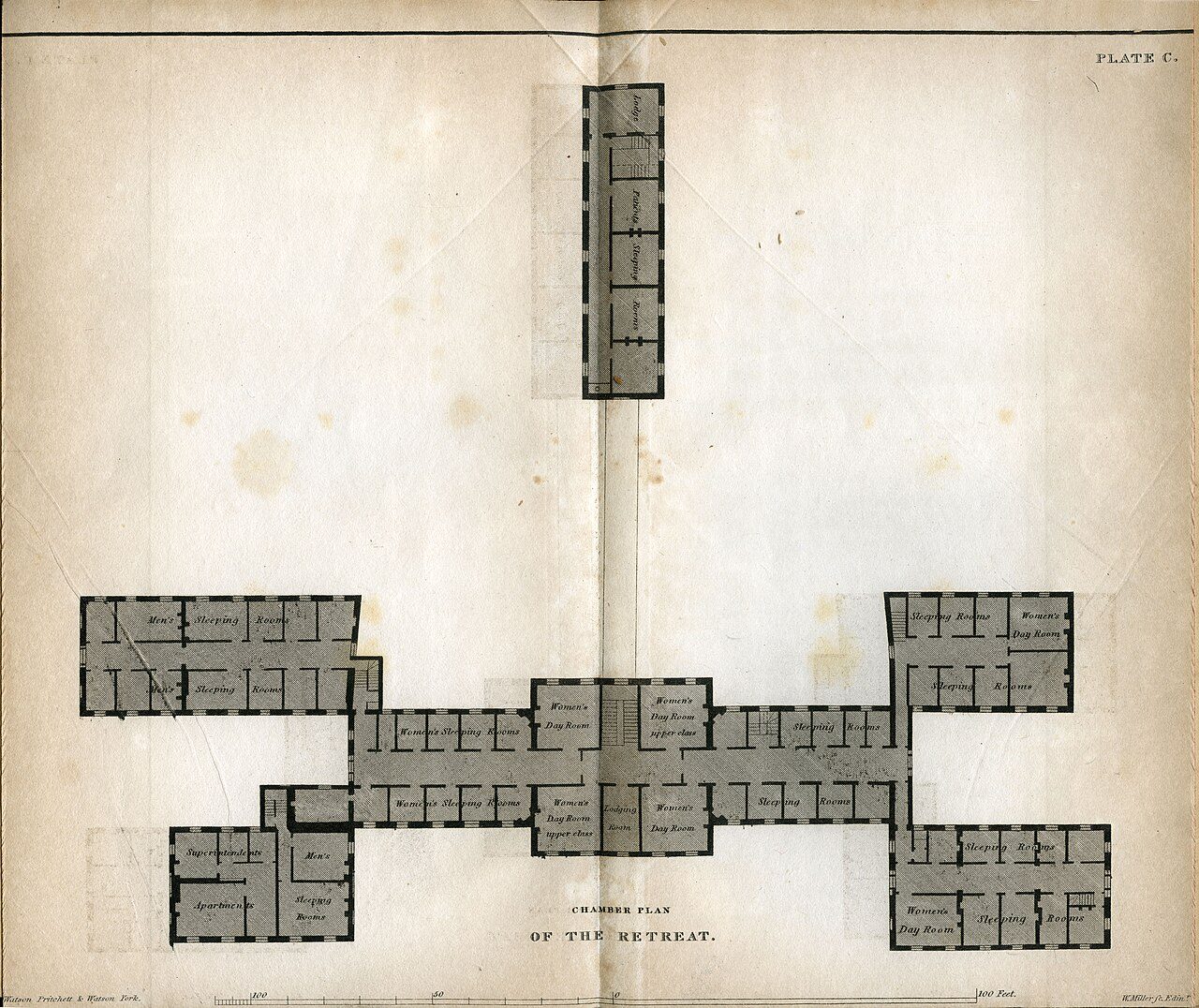
"Moral" in "moral treatment" did not mean what it means now. In the French traitement moral and its English borrowing, the word meant something closer to "psychological": treatment that worked on the mind and the passions through the patient's surroundings, habits and relationships, rather than on the body through bleeding, purges and drugs. It also carried the everyday sense of moral, because its aim was to restore a person's capacity to govern themselves7,4.
The approach emerged in the 1790s in two places independently. Its claims were large, its influence enormous, and its record more mixed than its admirers believed7.
Paris: Pussin and Pinel
At the Bicêtre hospital outside Paris, the section for mentally ill men was run from the 1780s by Jean-Baptiste Pussin, who had been treated at Bicêtre for scrofula before joining its staff and becoming governor of the insane, with his wife Marguerite Jubline. Philippe Pinel became physician there in 17937,8. Pinel watched how Pussin managed patients with a mixture of firmness, kindness and attention to each person's delusions, and wrote much of it into his Treatise on Insanity (1801; English translation 1806). He was candid that the strait-waistcoat, not liberty, had replaced the chains:
But since the strait-waistcoat has been substituted for chains, and limited liberty for absolute confinement; the exhalation of their harmless effervescence during the day, has at night been succeeded by a state of comparative calmness and tranquility.1
Quotation checked against the 1806 text
York: the Retreat
In England the impulse was religious. After a Quaker widow, Hannah Mills, died in the York Asylum in 1790 (Samuel Tuke gave 1791) in circumstances that suggested neglect, the merchant William Tuke led the Society of Friends in founding its own house. The Retreat opened in May 1796 for about thirty patients, in a building designed to look like a home rather than a prison4,7. Its methods were described in 1813 by Tuke's grandson Samuel, whose Description of the Retreat made the phrase "moral treatment" familiar in English4.
Tuke's account rejected chains and beatings outright, though not all restraint. Its central idea was that patients retained more self-control than their keepers assumed, and that it could be strengthened. Fear was allowed only within limits; more important was the patient's wish to be thought well of:
It is probably from encouraging the action of this principle, that so much advantage has been found in this Institution, from treating the patient as much in the manner of a rational being, as the state of his mind will possibly allow.2
Quotation checked against the 1813 text
Regular work was the chief means. "Of all the modes by which the patients may be induced to restrain themselves," Tuke wrote, "regular employment is perhaps the most generally efficacious"2. Women sewed, knitted and helped with the housework; patients walked in the garden and grounds and made excursions into the city and the countryside; reading and religious observance were encouraged, without excess2,4. Visitors were impressed: the architect William Stark spoke of a "government of humanity and consummate skill"4.
Spread and the curable asylum
Moral treatment became the founding philosophy of the public asylums built across Britain, Europe and North America in the nineteenth century. In Britain it fed directly into the campaign against restraint and the non-restraint movement6. In the United States it shaped the hospitals that Dorothea Dix campaigned for and that Thomas Kirkbride designed, with their careful classification of patients, grounds, workshops and entertainments7.
It also bred great optimism. If madness was a disorder of habits and passions, it could be cured, especially if treated early. American superintendents of the 1830s and 1840s published recovery rates of 80 or 90 per cent for recent cases, and in 1840 Luther Bell of the McLean Asylum wrote that his records showed "all cases, certainly recent ... recover under a fair trial"3.
Decline
The promise did not survive the growth of the asylum. Moral treatment depended on small numbers, a resident superintendent who knew every patient and a high ratio of staff. As public asylums swelled to hundreds and then thousands of patients, many of them poor, chronic, elderly or ill with diseases such as general paralysis of the insane, the method decayed into routine and custody7.
The statistics fell too. In The Curability of Insanity (1887), the American psychiatrist Pliny Earle showed that the famous cure rates had been produced by counting the same person's repeated discharges as separate recoveries and by leaving out deaths; one superintendent had even reached "100 per cent" by subtracting the one patient who died3. By the late nineteenth century pessimism about heredity and degeneration had replaced the hope of cure7.
Moral treatment's reputation has risen and fallen since. Michel Foucault saw it as a new form of control that replaced chains with guilt and constant observation; others have defended it as the most humane care of its time, and later traditions of occupational therapy and therapeutic communities have claimed descent from it7.
Key dates
- April 1790 Hannah Mills, a Quaker widow, dies at the York Asylum in circumstances that suggest neglect, prompting William Tuke to plan a Quaker asylum (Samuel Tuke dated it 1791).
- 1793 Philippe Pinel becomes physician at Bicêtre, where Jean-Baptiste Pussin is in charge of the insane.
- May 1796 The Retreat opens near York for members of the Society of Friends.
- 1801 Pinel's Traité médico-philosophique sur l'aliénation mentale describes 'traitement moral'.
- 1813 Samuel Tuke publishes his Description of the Retreat.
- 1840 The superintendent of the McLean Asylum claims that nearly all recent cases recover under fair trial.
- 1887 Pliny Earle's The Curability of Insanity exposes the inflated cure statistics of the moral-treatment era.
Sources
- Primary source Philippe Pinel, A Treatise on Insanity (trans. D. D. Davis), Sheffield: W. Todd (1806). Quotations checked against this text.
- Primary source Samuel Tuke, Description of the Retreat, an Institution near York, for Insane Persons of the Society of Friends, York: W. Alexander (1813). Quotations checked against this text.
- Primary source Pliny Earle, The Curability of Insanity: A Series of Studies, Philadelphia: J. B. Lippincott (1887). Quotations checked against this text.
- Scholarship R. H. S. Mindham, The Retreat at York of 1796 – psychiatry in pictures, The British Journal of Psychiatry 218(5) (2021).
- Museum or archive Natasha Ruiz-Gómez, The painter, the psychiatrist and a fashion for hysteria, Wellcome Collection (2020-03-04).
- Scholarship Akihito Suzuki, The politics and ideology of non-restraint: the case of the Hanwell Asylum, Medical History 39(1) (1995).
- Wikipedia Moral treatment, Wikipedia.
- Wikipedia Philippe Pinel, Wikipedia.
Cross-checked with Wikidata Q1947139 and the English Wikipedia article.
Read next
 1700s–1890s · Transformed
Restraint and the non-restraint movement
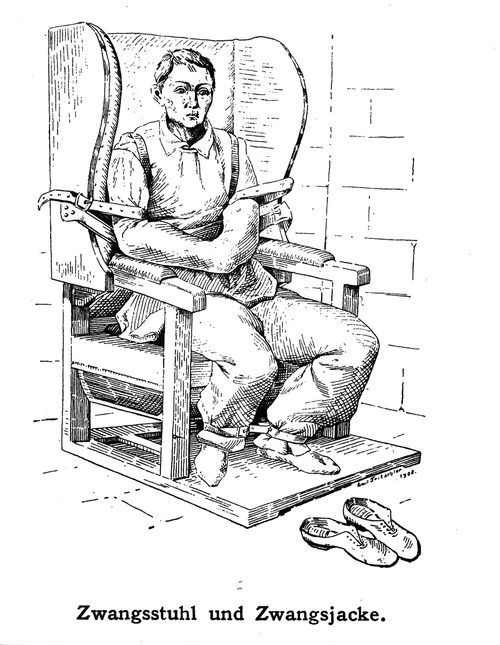
Chains, strait-waistcoats and restraint chairs were the ordinary equipment of asylums until the late 1830s, when Lincoln and then Hanwell abolished them. Britain made non-restraint a doctrine; much of the world did not.
 Essay · 7 min
The rise and fall of the asylum
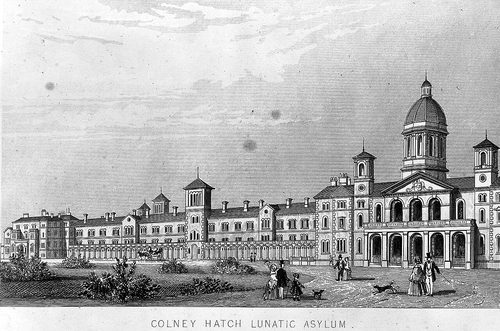
How the public asylum grew from a few small madhouses into hospitals of thousands, and was then closed: an argument that its failures came from its success at taking in the people no other institution would hold.
 Essay · 8 min
Counting the confined: asylum populations, 1800–2000
Asylum numbers in England and the United States rose for a century and then fell by three-quarters or more. What the official counts measured was how long people stayed, not how many fell ill, as their own compilers warned.
 1835–1910s
Moral insanity
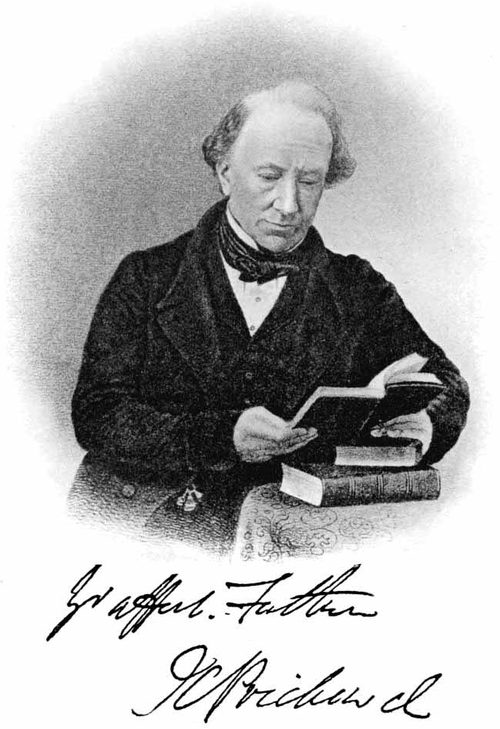
In 1835 J. C. Prichard named a madness of feeling and conduct with reason intact. Moral insanity reached the Old Bailey, provoked a backlash, and fed the later ideas of 'moral imbecility' and psychopathy.
 1700s–1950s · Abandoned
Hydrotherapy
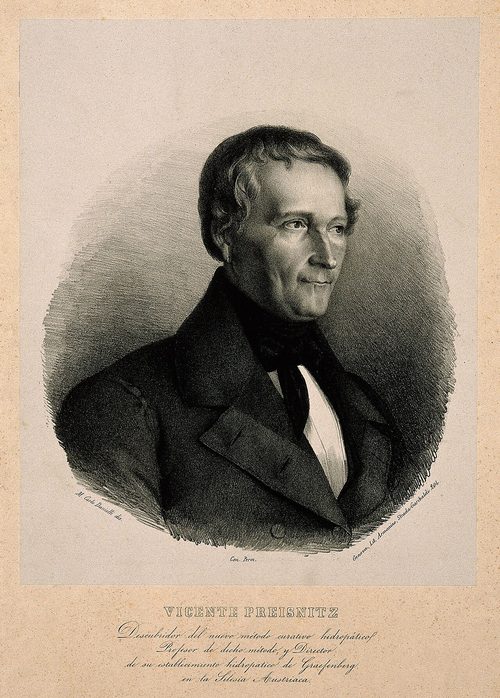
Water was one of psychiatry's oldest tools: shock baths and shower baths in the early asylum, wet packs from 1860, and continuous baths lasting hours or days in the early twentieth century, until drugs replaced them.
Pages that mention Moral treatment
- Essay Counting the confined: asylum populations, 1800–2000
- Essay How words for madness changed
- Essay The patients who wrote back
- Essay The rise and fall of the asylum
- Person Benjamin Rush
- Person Dorothea Dix
- Person Elizabeth Packard
- Person Jean-Baptiste Pussin
- Person Jean-Étienne Esquirol
- Person John Conolly
- Person Philippe Pinel
- Person Thomas Story Kirkbride
- Person William Tuke
- Place Bethlem Hospital ("Bedlam")
- Place Bicêtre and the unchaining
- Place Geel and family care
- Place Hanwell Asylum
- Place The Kirkbride asylums
- Place The Narrenturm, Vienna
- Place The Salpêtrière
- Place The York Retreat
- Place The asylum on Blackwell's Island
- Theory Degeneration theory
- Theory Phrenology
- Treatment Bloodletting, purging and emetics
- Treatment Hydrotherapy
- Treatment Restraint and the non-restraint movement
- Treatment Swinging and rotating chairs