
Treatment · 1700s–1890s
Restraint and the non-restraint movement
Chains, strait-waistcoats and restraint chairs were the ordinary equipment of asylums until the late 1830s, when Lincoln and then Hanwell abolished them. Britain made non-restraint a doctrine; much of the world did not.
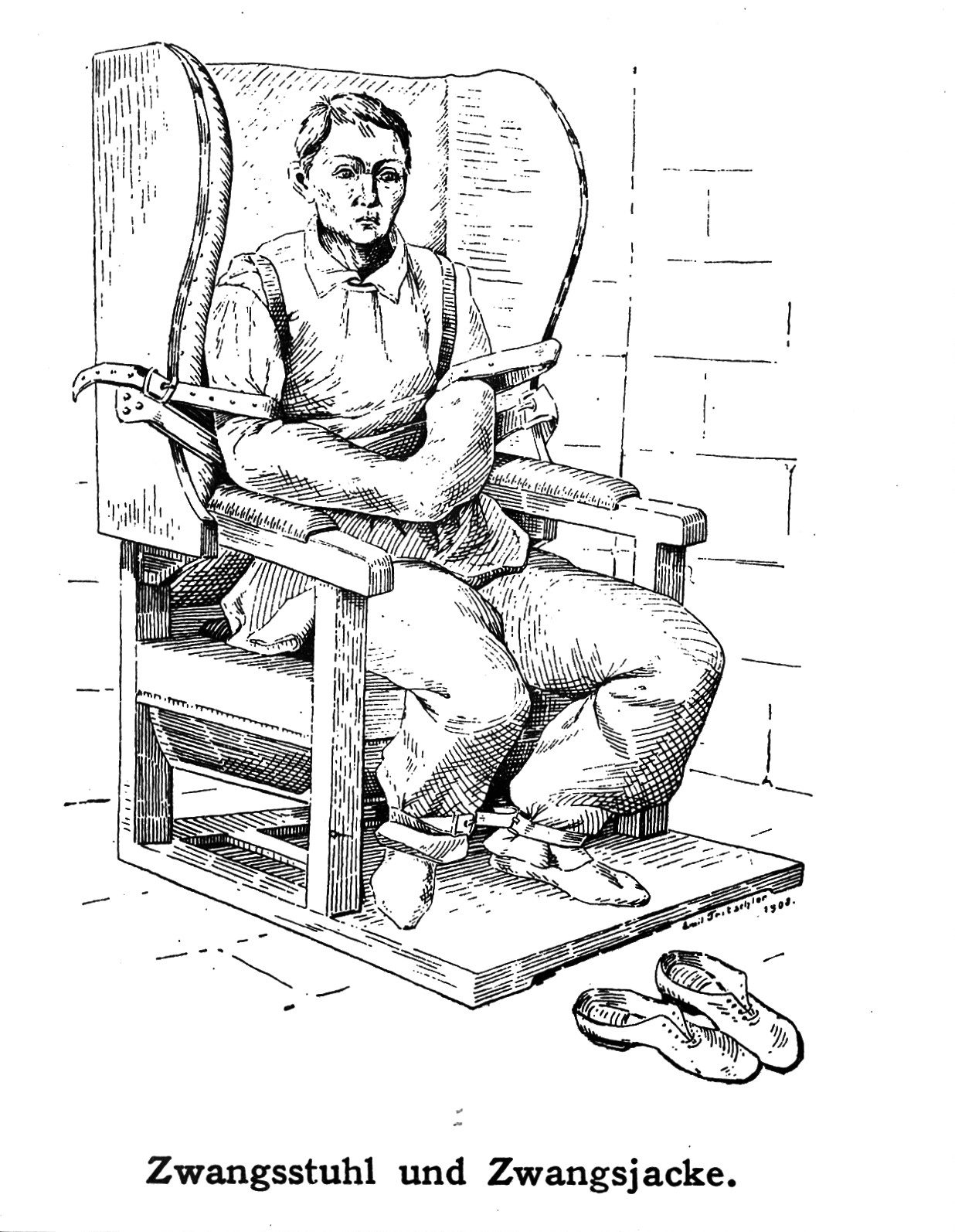
For most of the asylum's history, holding a patient still was not a failure of treatment but part of it. Chains, leg-locks, handcuffs, strait-waistcoats, belts and specially built chairs were the ordinary equipment of private "madhouses" and public hospitals, and doctors defended them as medically useful. Within a few years at the end of the 1830s, two English asylums showed that they could be done without entirely, and in Britain "non-restraint" became a professional creed5,6.
The case for restraint
Restraint was justified as protection, against injury to the patient, to other patients and to keepers, and also as treatment. The American physician Benjamin Rush designed a chair he called the "tranquillizer", which held the body and head fixed, and argued in 1812 that it calmed the circulation and the brain:
Confinement by means of a strait waistcoat, or of a chair which I have called a tranquillizer. He submits to them both with less difficulty than to human force, and struggles less to disengage himself from them.1
Quotation checked against the 1812 text
Rush also listed restraint, with the shower bath and withdrawal of food, among punishments for patients who damaged property or attacked their keepers1. The reformers of the 1790s did not abolish restraint so much as soften it. At Bicêtre, Philippe Pinel reported that the strait-waistcoat had replaced chains and that the wards had become calmer for it, a change in which the hospital's governor, Jean-Baptiste Pussin, played a leading part2. At the York Retreat, Samuel Tuke wrote in 1813, "neither chains nor corporal punishments are tolerated", but patients who were violent were still restrained and separated10.
The worst cases came to light in places without such scruples. In 1814 visitors to Bethlem found a patient who had spent over a decade fixed to the wall by an iron collar and frame, with chains only twelve inches long3. The exposure helped launch the parliamentary inquiries of 1815–16, but the question of whether restraint could be given up altogether was not seriously put for another twenty years.
Lincoln
The first full experiment took place at the Lincoln Lunatic Asylum, a small charitable institution of about a hundred patients. Its physician, Edward Parker Charlesworth, had spent years reducing the instruments in use; after a patient died in 1829 strapped to his bed in a strait-waistcoat, the asylum required an attendant to stay in the room whenever restraint was used at night, which made it far less convenient to use5. Irons were destroyed and strait-waistcoats torn up5. Robert Gardiner Hill, house surgeon from 1835, took the last step. In 1837 he declared restraint unnecessary, and on 21 June 1838 he told an audience at the Lincoln Mechanics' Institution:
I assert then in plain and distinct terms, that in a properly constructed building, with a sufficient number of suitable attendants, restraint is never necessary, never justifiable, and always injurious, in all cases of Lunacy whatever.4
Quotation checked against the 1839 text
Hill's figures showed instances of restraint at Lincoln falling from 2,364 in 1830 to 313 in 1835, and then to none9. The system depended on close supervision of attendants, and the strain contributed to his resignation in 18409.
Hanwell
What Lincoln did with a hundred patients, John Conolly did with eight hundred. He visited Lincoln in May 1839, took charge of the Middlesex County Asylum at Hanwell on 1 June, and began demanding a daily return of patients restrained. The number fell from at most 18 a day in July to none:
after the twentieth of September no restraints were employed at all.5
Quotation checked against the 1856 text
Conolly became the face of non-restraint in Britain and abroad, and his 1856 book claimed that mechanical restraint had since been excluded from almost every public asylum in England, Scotland and Ireland5. It was not achieved by kindness alone. The system needed more and better-trained attendants, constant occupation, and seclusion: a disturbed patient could be shut alone in a padded room until calm, which Conolly regarded as an essential substitute and others thought open to the same objections as restraint6,5.
A British creed
Non-restraint did not travel well. Conolly complained in 1856 that it was "warmly opposed" across much of Europe, and official French reports condemned it5. In Vienna the Narrenturm still used its wall chains into the 1840s and replaced them with strait-waistcoats and bed straps rather than abolishing restraint11. American superintendents, as Nancy Tomes has shown, continued to use mechanical restraint relatively freely through the century, and the "restraint controversy" became a matter of national pride on both sides of the Atlantic7.
By the 1890s even British authors admitted second thoughts. A leading dictionary of psychiatry warned against "the fanaticism which makes a fetish of the non-restraint system" and pointed out that holding a patient down with attendants' hands was also restraint:
Thus, whether a violent patient should be held down by the strong hands of attendants, or secured in bed by certain appliances, involved a question of the kind of material employed and not a principle, seeing that both practices were examples of restraint.6
Quotation checked against the 1892 text
The Lunacy Act of 1890 formally recognised restraint and laid down rules for recording it6. The Commissioners in Lunacy had already required wet-sheet packs, used in hydrotherapy, to be logged as restraint6. The argument the non-restraint movement began, about whether and when it is ever right to hold a person still against their will, has never been closed.
Key dates
- 1812 Benjamin Rush describes his 'tranquillizer' chair for restraining patients.
- 2 May 1814 Reformers find a patient at Bethlem held in an iron frame and chains, a case that shocks Parliament.
- 1829 A patient at the Lincoln Asylum dies strapped to his bed in a strait-waistcoat; a rule follows that an attendant must stay in the room whenever restraint is used at night.
- 21 June 1838 Robert Gardiner Hill lectures in Lincoln that restraint is 'never necessary, never justifiable, and always injurious'.
- 20 September 1839 At Hanwell, John Conolly ends all use of mechanical restraint among about 800 patients.
- 1856 Conolly publishes The Treatment of the Insane without Mechanical Restraints.
- 1890 The Lunacy Act recognises restraint and lays down rules for its use.
Sources
- Primary source Benjamin Rush, Medical Inquiries and Observations, upon the Diseases of the Mind, Philadelphia: Kimber & Richardson (1812). Quotations checked against this text.
- Primary source Philippe Pinel, A Treatise on Insanity (trans. D. D. Davis), Sheffield: W. Todd (1806). Quotations checked against this text.
- Primary source House of Commons Select Committee on Madhouses, Report, together with the Minutes of Evidence, from the Committee appointed to consider of provision being made for the better regulation of Madhouses in England, London: House of Commons (1815). Quotations checked against this text.
- Primary source Robert Gardiner Hill, Total Abolition of Personal Restraint in the Treatment of the Insane, London: Simpkin, Marshall (1839). Quotations checked against this text.
- Primary source John Conolly, The Treatment of the Insane without Mechanical Restraints, London: Smith, Elder (1856). Quotations checked against this text.
- Primary source ed. Daniel Hack Tuke, Treatment (General) (in A Dictionary of Psychological Medicine, vol. 2), London: J. & A. Churchill (1892). Quotations checked against this text.
- Scholarship Akihito Suzuki, The politics and ideology of non-restraint: the case of the Hanwell Asylum, Medical History 39(1) (1995).
- Scholarship Jonathan Andrews, Review of Masters of Bedlam (Scull, MacKenzie and Hervey), Reviews in History, Institute of Historical Research (1997-03).
- Wikipedia Robert Gardiner Hill, Wikipedia.
- Primary source Samuel Tuke, Description of the Retreat, an Institution near York, for Insane Persons of the Society of Friends, York: W. Alexander (1813). Quotations checked against this text.
- Wikipedia Narrenturm, Wikipedia (German).
Cross-checked with Wikidata Q357003 and the English Wikipedia article.
Read next
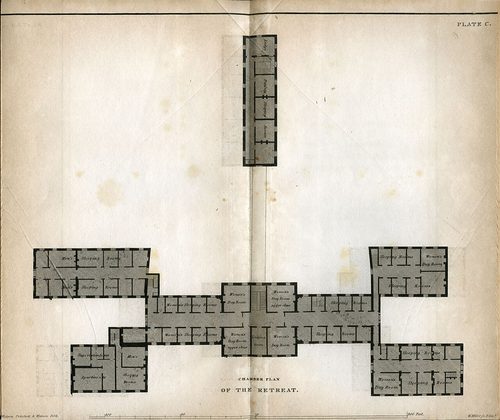 1790s–1870s · Transformed
Moral treatment
Moral treatment, developed at Bicêtre in Paris and the York Retreat in the 1790s, tried to cure madness through kindness, routine, work and self-control rather than chains and drugs. It shaped a century of asylums.
 1700s–1950s · Abandoned
Hydrotherapy
Water was one of psychiatry's oldest tools: shock baths and shower baths in the early asylum, wet packs from 1860, and continuous baths lasting hours or days in the early twentieth century, until drugs replaced them.
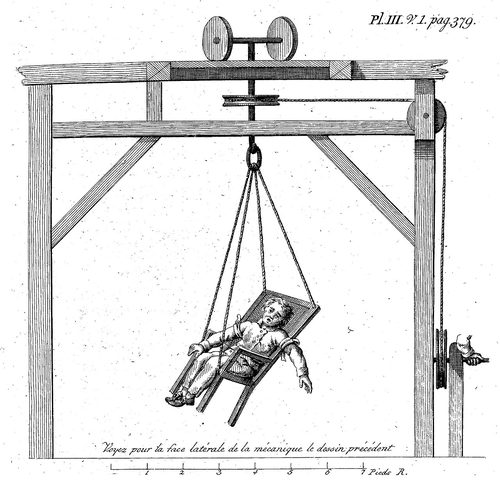 1796–1830s · Abandoned
Swinging and rotating chairs
Around 1800, doctors strapped patients into chairs and beds that spun at speed, to induce giddiness, vomiting and sleep. Erasmus Darwin's idea, Joseph Mason Cox's swing, and why it was abandoned within a generation.
 Essay · 7 min
The rise and fall of the asylum
How the public asylum grew from a few small madhouses into hospitals of thousands, and was then closed: an argument that its failures came from its success at taking in the people no other institution would hold.
 Essay · 7 min
Who got locked up, and why
Asylum populations were never a simple sample of the mentally ill. Poverty, family, the Poor Law, sex, migration, race, age and bodily disease all decided who was confined, and historians still argue over how much each counted.
Pages that mention Restraint and the non-restraint movement
- Essay The patients who wrote back
- Person Benjamin Rush
- Person Clifford Beers
- Person Dorothea Dix
- Person Franco Basaglia
- Person Jean-Baptiste Pussin
- Person John Conolly
- Person Philippe Pinel
- Person Silas Weir Mitchell
- Person Thomas Story Kirkbride
- Person William Tuke
- Place Bethlem Hospital ("Bedlam")
- Place Bicêtre and the unchaining
- Place Geel and family care
- Place Hanwell Asylum
- Place The Narrenturm, Vienna
- Place The Salpêtrière
- Place The York Retreat
- Treatment Hydrotherapy
- Treatment Moral treatment
- Treatment Swinging and rotating chairs