
Treatment · 1796–1830s
Swinging and rotating chairs
Around 1800, doctors strapped patients into chairs and beds that spun at speed, to induce giddiness, vomiting and sleep. Erasmus Darwin's idea, Joseph Mason Cox's swing, and why it was abandoned within a generation.
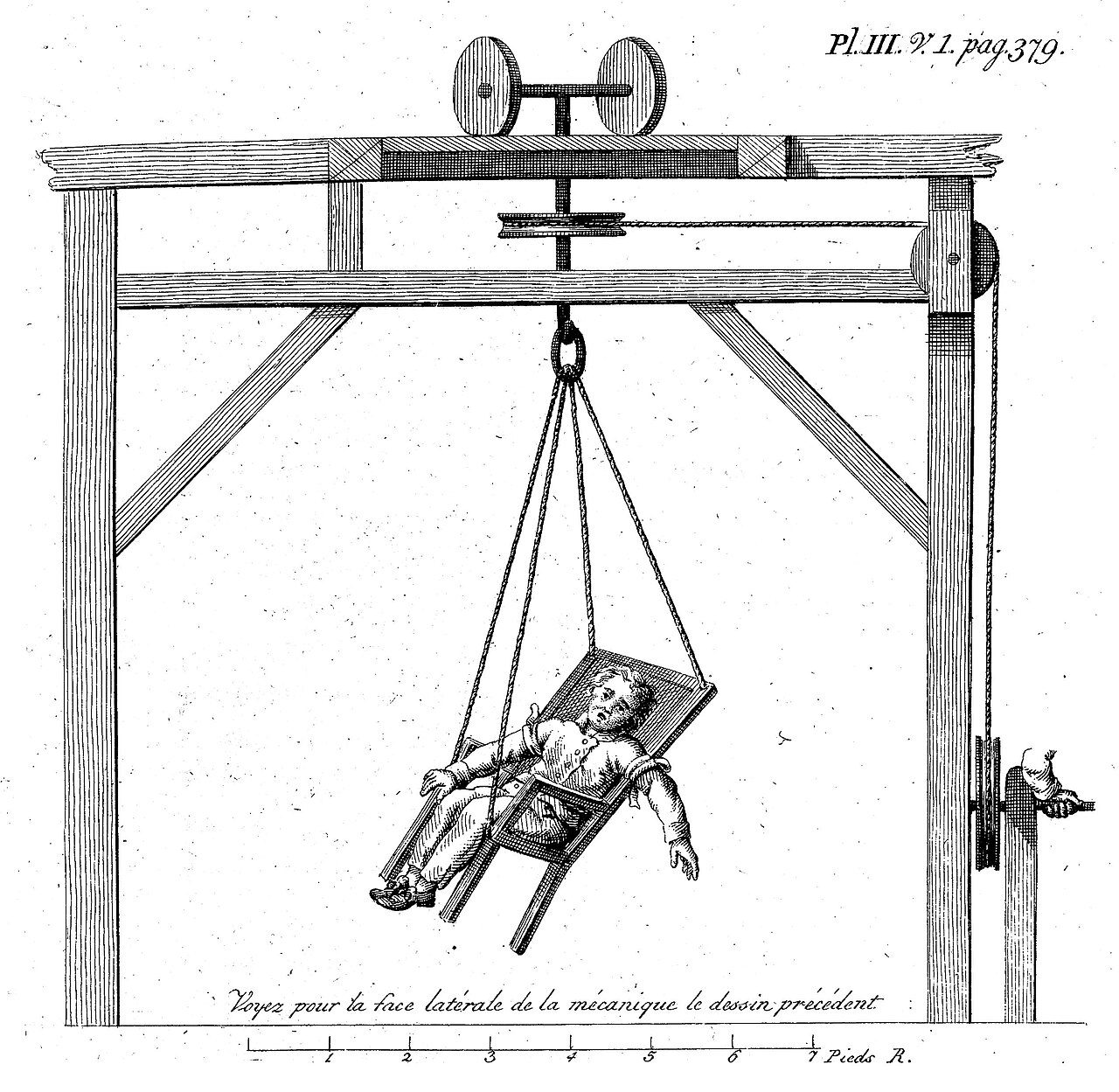
For about thirty years, from the late 1790s to the 1820s, some of the best-regarded asylum doctors in Britain, Ireland, Germany and the United States spun their patients round. The patient sat strapped into a chair, or lay bound on a small bed, hung from a vertical shaft; an attendant, or later a windlass, turned it faster and faster. What followed was predictable and was the point: pallor, giddiness, nausea, vomiting, and then, the doctors reported, a deep and quiet sleep1,6.
An idea from Erasmus Darwin
The physician, poet and naturalist Erasmus Darwin set out the idea in the second volume of Zoonomia (1796). His main target was not madness but fever. He had heard from the canal engineer James Brindley of a man who lay across a millstone as it began to turn and fell asleep, and he reasoned that spinning a patient with the head outermost would drive blood into the head, gently compress the brain and calm "the violent actions of the heart and arteries"2. He recommended the experiment to "some hospital physician", and described the machine:
For this purpose a perpendicular shaft armed with iron gudgeons might have one end pass into the floor, and the other into a beam in the cieling, with an horizontal arm, to which a small bed might be readily suspended.2
Quotation checked against the 1796 text
In his section on madness Darwin mentioned rotation only in passing, listing "the vertigo occasioned by a circulating swing, or by a sea-voyage" after bleeding, emetics and purges among ways to relieve the patient2. The reasoning belonged to the old medicine of humours and evacuations: anything that emptied the stomach and bowels and slowed the pulse might draw off the disorder1,5.
Cox's swing
It was Joseph Mason Cox who put the machine to work on the insane. Cox had inherited Fishponds, a private madhouse near Bristol, and in 1804 published Practical Observations on Insanity, which went through several editions and was published in France, Germany and the United States10. He gave swinging its own section:
This is both a moral and medical mean in the treatment of maniacs.1
Quotation checked against the 1806 text
The simplest version was a Windsor chair hung from a ceiling hook by four ropes, the patient "secured in a strait waistcoat" and strapped at the waist and legs; for a more complete "rotatory swing" Cox quoted Darwin's shaft and bed, crediting him with the idea1. Cox listed the effects frankly: vertigo, pallor, nausea, vomiting and often loss of bladder control, followed by sleep that he thought better than any opiate1. He also valued the fear it caused. He thought its power might be "amazingly increased" if used in the dark with unusual noises and smells, warned that "such Herculean remedies" needed the physician present, and wrote that the memory of the swing made a threat enough:
the physician will often only have to threaten its employment to secure compliance with his wishes, while no species of punishment is more harmless or efficacious.1
Quotation checked against the 1806 text
That sentence is the heart of the historical debate. In the language of the time, a "moral" remedy acted on the mind and the passions, and fear was a legitimate tool; the same years saw the rise of moral treatment, which tried to govern patients by kindness and routine rather than terror1,6.
Cork, Philadelphia and Berlin
The swing spread quickly. William Saunders Hallaran, physician to the Cork Lunatic Asylum, built one as soon as he had read Cox's first edition. His machine, described in 1810, was worked by a windlass and was
capable of being turned an hundred times in a minute3
Quotation checked against the 1810 text
with a platform divided so that four people could be secured in it at once3. Hallaran claimed that it gave him "a supreme authority over the most turbulent", that a disorderly ward became remarkable for its quiet, and that a patient who had just begun a relapse could sometimes be stopped with it; he also gave it for sleep, at a slow pace, for long periods3,7. He noticed something that undermined the physiology: some of the asylum's residents rode it for amusement, when permitted, without any effect at all3,7.
In Philadelphia, Benjamin Rush had a version built at the Pennsylvania Hospital, which he called a "gyrater". He recorded its effect on the pulse (in one patient it rose from 84 to 120 beats a minute in two minutes) and suggested that a board turned on a pivot, with the patient's head at one end, would act more strongly still4. In Germany, Ernst Horn installed a rotating machine at the asylum of the Berlin Charité in 1807, and others, such as Peter Joseph Schneider, described rotating beds turned forty to sixty times a minute by several attendants9. Horn himself wrote in 1818 that a healthy person could not bear it for more than a few minutes9.
Why it was abandoned
The objections came from inside the profession. Esquirol had a model made in France and listed the dangers: nosebleeds, fainting, prostration, fears of apoplexy5. In his treatise of 1838 he asked why such skilful men had tried "to introduce into practice an agent so dangerous", and recorded the outcome:
The rotatory machine is now every where abandoned.5
Quotation checked against the 1845 text
By then the movement against restraint and the non-restraint movement was gathering force, and a machine that tied patients down in order to make them sick fitted badly with it. The chair did not disappear from science. Students of the senses used rotating chairs to study vertigo and eye movements, and a century later the rotating chair returned to the clinic as the Bárány chair, a test of the balance organs of the inner ear6,8. Wade and his co-authors concluded that its benefits proved "scientific rather than medical"6.
Key dates
- 1796 Erasmus Darwin's Zoonomia, volume 2, proposes whirling a patient on a suspended bed, and lists the vertigo of a 'circulating swing' among remedies for madness.
- 1804 Joseph Mason Cox, keeper of the Fishponds madhouse near Bristol, publishes Practical Observations on Insanity, recommending the swing as 'a moral and medical mean'.
- 1810 William Saunders Hallaran describes the circulating swing at the Cork Lunatic Asylum, turned by a windlass and able to hold four people.
- 1812 Benjamin Rush describes the 'gyrater' he had built at the Pennsylvania Hospital.
- 1838 Esquirol writes that the rotating machine 'is now every where abandoned'.
Sources
- Primary source Joseph Mason Cox, Practical Observations on Insanity (2nd ed.), London: C. and R. Baldwin (1806). Quotations checked against this text.
- Primary source Erasmus Darwin, Zoonomia; or, The Laws of Organic Life, vol. 2, London: J. Johnson (1796). Quotations checked against this text.
- Primary source William Saunders Hallaran, An Enquiry into the Causes Producing the Extraordinary Addition to the Number of Insane, Cork: Edwards and Savage (1810). Quotations checked against this text.
- Primary source Benjamin Rush, Medical Inquiries and Observations, upon the Diseases of the Mind, Philadelphia: Kimber and Richardson (1812). Quotations checked against this text.
- Primary source Jean-Étienne Dominique Esquirol, Mental Maladies: A Treatise on Insanity (trans. E. K. Hunt), Philadelphia: Lea and Blanchard (1845). Quotations checked against this text.
- Scholarship Nicholas J. Wade, Ulf Norrsell and Alex Presly, Cox's chair: 'a moral and a medical mean in the treatment of maniacs', History of Psychiatry 16(1): 73–88 (2005).
- Scholarship C. S. Breathnach, Hallaran's circulating swing, History of Psychiatry 21(1): 79–84 (2010).
- Scholarship Lotta Winter, Tillmann H. C. Kruger and others, Cox's chair revisited: can spinning alter mood states?, Frontiers in Psychiatry 4: 132 (2013).
- Wikipedia Drehmaschine (Psychiatrie), Wikipedia (German) (2026).
- Wikipedia Joseph Mason Cox, Wikipedia (2026).
Cross-checked with Wikidata Q1138289.
Read next
 Antiquity–1850s · Abandoned
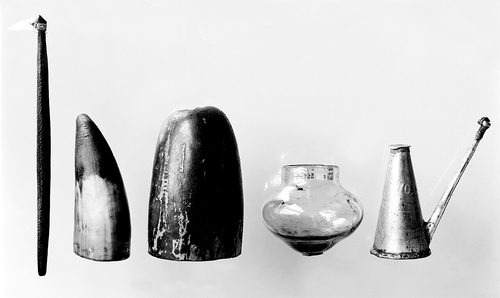
Bloodletting, purging and emetics
For two thousand years doctors bled, purged and vomited people with mania and melancholy. How depletion worked in theory, how it was done at Bethlem and in Philadelphia, and how it faded in the nineteenth century.
 1700s–1890s · Transformed
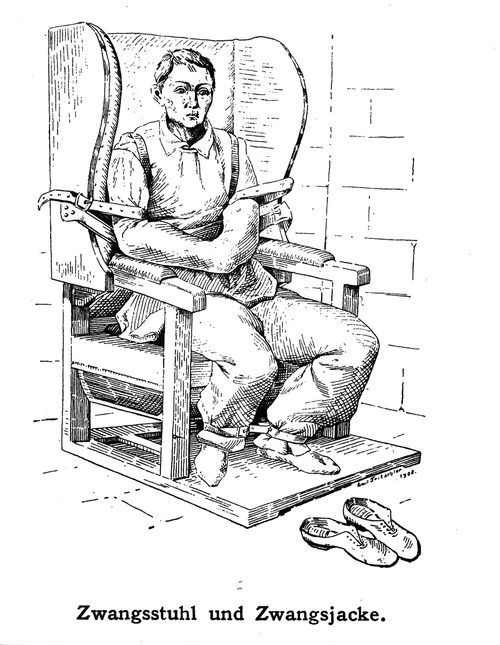
Restraint and the non-restraint movement
Chains, strait-waistcoats and restraint chairs were the ordinary equipment of asylums until the late 1830s, when Lincoln and then Hanwell abolished them. Britain made non-restraint a doctrine; much of the world did not.
 1790s–1870s · Transformed
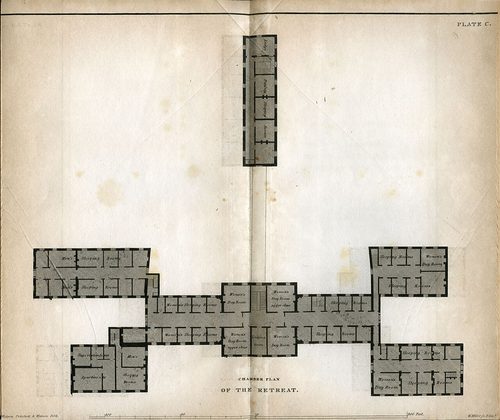
Moral treatment
Moral treatment, developed at Bicêtre in Paris and the York Retreat in the 1790s, tried to cure madness through kindness, routine, work and self-control rather than chains and drugs. It shaped a century of asylums.
 1700s–1950s · Abandoned
Hydrotherapy
Water was one of psychiatry's oldest tools: shock baths and shower baths in the early asylum, wet packs from 1860, and continuous baths lasting hours or days in the early twentieth century, until drugs replaced them.
 c. 400 BCE–1800s
The four humours
For two thousand years, European and Islamic medicine explained madness and melancholy by four bodily fluids. What the theory claimed about the mind, how it shaped treatment, and how it slowly lost its hold.