
Treatment · 1700s–1950s
Hydrotherapy
Water was one of psychiatry's oldest tools: shock baths and shower baths in the early asylum, wet packs from 1860, and continuous baths lasting hours or days in the early twentieth century, until drugs replaced them.
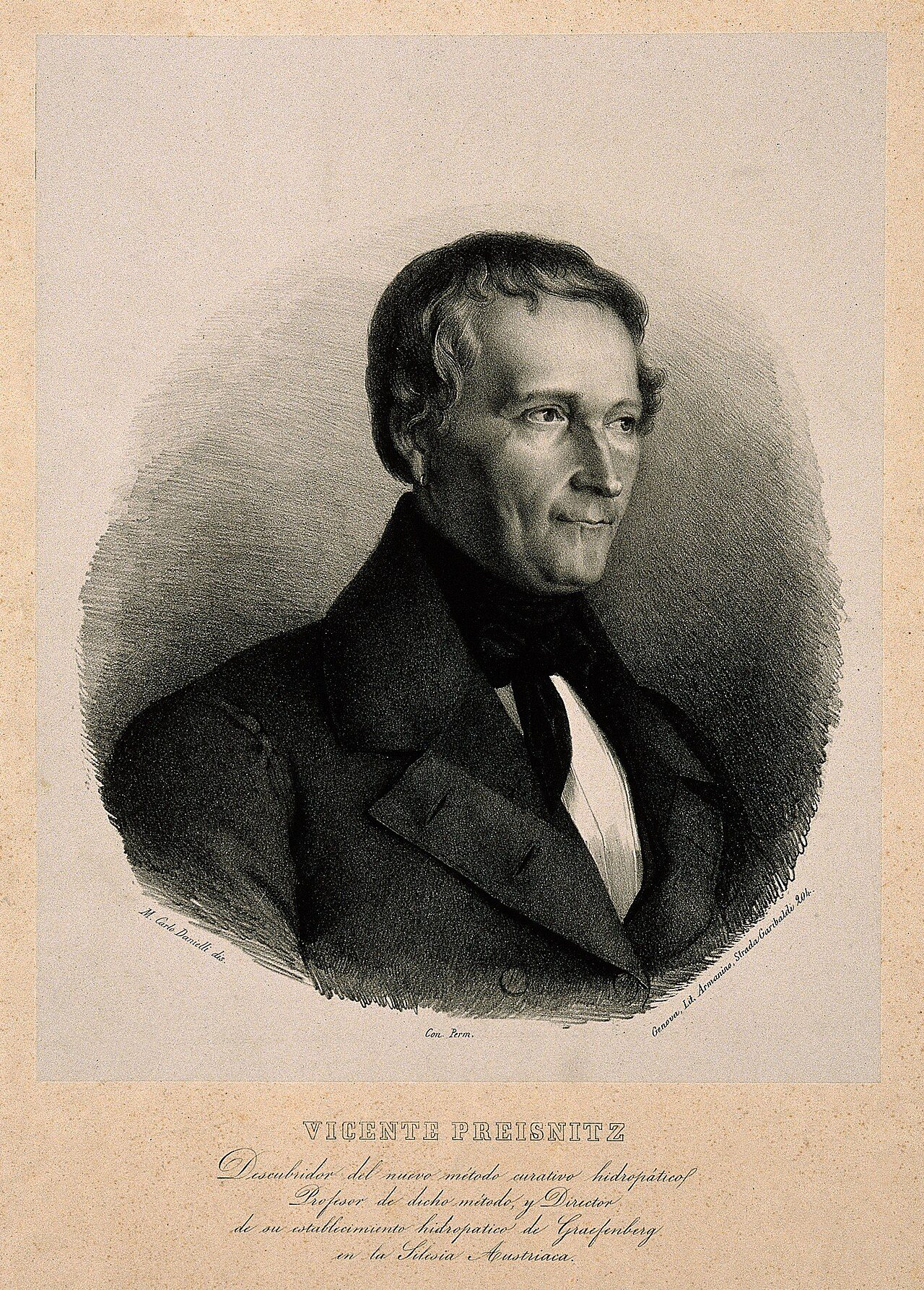
Water was cheap, it was everywhere, and it could be made to do almost anything a physician wanted: shock or soothe, cool a "heated" brain or rouse a sluggish one, punish or calm. For two centuries it was one of the commonest treatments in the asylum, and its history follows psychiatry's changing ideas of what madness was and what treatment was for1,6.
Shock and surprise
Eighteenth- and early nineteenth-century physicians often thought of mania as a state of excess heat and agitation in the brain and nerves. Cold water poured on the head was meant to "lessen the heat of madness"; warm baths were given to quiet overwrought nerves and bring sleep6. Alongside these, many asylum doctors valued water as a shock. The "bath of surprise" plunged a patient without warning into cold water, sometimes by a trapdoor in a dark passage. The Belgian physician Joseph Guislain, writing in 1826, designed an iron cage that dropped from a bridge into a stream, and preferred it to earlier methods of ducking patients from a rope or into a net1,6.
By the 1890s the editors of the standard British dictionary of psychiatry looked back on these methods without sympathy. Any benefit, they wrote, "must have been due to moral rather than physical effects", and the treatment had been "viewed more in the light of punishment than as medical treatment"1. Earlier writers had said much the same openly. In 1812 Benjamin Rush, who also designed a restraining chair, listed the shower bath, "continued for fifteen or twenty minutes", among the means of coercion for patients who damaged property or attacked their keepers, alongside the strait-waistcoat and the withdrawal of food3.
The shower bath and the wet pack
In British asylums the shower bath remained in use into the 1850s. In 1856 a patient at the Surrey County Asylum died after a shower bath of twenty minutes. It was never proved that the bath caused the death, but the Commissioners in Lunacy restricted the practice, setting a limit of a few minutes1.
A gentler-seeming method came from outside medicine. The wet-sheet pack, wrapping a patient tightly in cold wet sheets and blankets, had been popularised by the Silesian farmer Vincenz Priessnitz at his water-cure establishment at Gräfenberg, which drew patients from across Europe from the 1820s8,1. Charles Lockhart Robertson introduced it at the Sussex County Asylum in 18601. Its users praised its calming effect, but the dictionary of 1892 recorded a worry that went to the heart of the method:
There can be no doubt, however, that in using it in the treatment of the insane great care has to be observed in its prescription, or it may degenerate into a punitive agent, and it may easily be regarded as such by the patient1
Quotation checked against the 1892 text
The Commissioners in Lunacy agreed. From 1872 every use of the pack had to be entered in each asylum's medical journal under the heading "Restraint"1. In the era of non-restraint described under restraint and the non-restraint movement, a sheet that held a patient still was recognised as another way of tying them down.
The continuous bath
The great age of psychiatric hydrotherapy came around 1900, when baths moved from shock to sedation. In the "prolonged" or "continuous" bath, an agitated patient was kept for hours, sometimes for days, in warm water that ran in and drained away to hold the temperature steady. Emil Kraepelin described alternating baths and warm packs, day and night, for the most severe states of excitement:
By such a regulated continuous change between pack and bath the most severe states of excitement are usually so far moderated after a few days that the simple bath treatment, or even, if at first only temporarily, rest in bed is possible.2
Quotation checked against the 1919 text
Kraepelin was candid about the difficulties: patients jumped out, and sedative drugs were used to keep them in the water2. In the United States, hydrotherapy spread rapidly through state and private hospitals in the first two decades of the twentieth century, encouraged by Simon Baruch of New York, who trained staff such as Emmett Cooper Dent of the Manhattan State Hospital4,7. Baths and packs often took the place of straps and camisoles for agitated patients4. At Bloomingdale Hospital in New York, the number of prolonged baths rose from 3,226 for 126 patients in 1921 to 8,181 for 206 patients in 19294.
The figures also show who received them. By 1944 the same hospital gave 3,907 prolonged baths to 137 women and few to men, who were judged less disturbed; the men's pack room had been refitted for electric shock treatment4.
Decline
Hydrotherapy needed many trained staff for each patient. As staffing costs rose, and as chlorpromazine and other drugs arrived in the 1950s, it became cheaper to give a pill than run a bath. By the 1970s, unused hydrotherapy suites in American mental hospitals were relics5.
Key dates
- 1812 Benjamin Rush lists the shower bath among means of coercion and punishment for asylum patients.
- 1826 Joseph Guislain describes 'baths of surprise' for plunging patients into water without warning.
- 1856 A patient dies after a twenty-minute shower bath at the Surrey County Asylum; the Commissioners in Lunacy restrict shower baths.
- 1860 Lockhart Robertson introduces the wet-sheet pack at the Sussex County Asylum.
- 1872 The Commissioners in Lunacy order every use of the wet pack to be recorded as restraint.
- 1929 Bloomingdale Hospital in New York records 8,181 prolonged baths given to 206 patients.
Sources
- Primary source ed. Daniel Hack Tuke, Baths (in A Dictionary of Psychological Medicine, vol. 1), London: J. & A. Churchill (1892). Quotations checked against this text.
- Primary source Emil Kraepelin, Dementia Praecox and Paraphrenia (trans. R. Mary Barclay), Edinburgh: E. & S. Livingstone (1919). Quotations checked against this text.
- Primary source Benjamin Rush, Medical Inquiries and Observations, upon the Diseases of the Mind, Philadelphia: Kimber & Richardson (1812). Quotations checked against this text.
- Museum or archive Oskar Diethelm Library, Weill Cornell Medicine, Hydrotherapy: American hospitals, Oskar Diethelm Library.
- Museum or archive Oskar Diethelm Library, Weill Cornell Medicine, Hydrotherapy: Decline in use, Oskar Diethelm Library.
- Museum or archive Oskar Diethelm Library, Weill Cornell Medicine, Hydrotherapy: Bath of surprise, Oskar Diethelm Library.
- Museum or archive Oskar Diethelm Library, Weill Cornell Medicine, Hydrotherapy: Emmett Cooper Dent, Oskar Diethelm Library.
- Wikipedia Hydrotherapy, Wikipedia.
Cross-checked with Wikidata Q622676 and the English Wikipedia article.
Read next
 1700s–1890s · Transformed
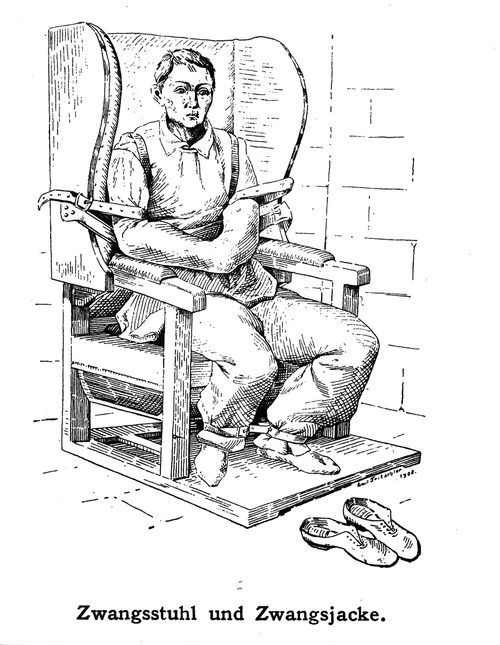
Restraint and the non-restraint movement
Chains, strait-waistcoats and restraint chairs were the ordinary equipment of asylums until the late 1830s, when Lincoln and then Hanwell abolished them. Britain made non-restraint a doctrine; much of the world did not.
 1796–1830s · Abandoned
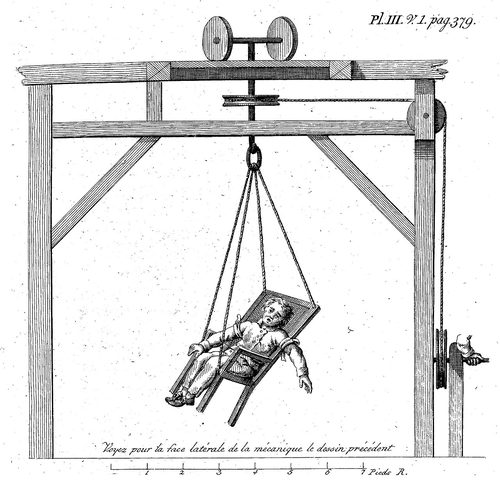
Swinging and rotating chairs
Around 1800, doctors strapped patients into chairs and beds that spun at speed, to induce giddiness, vomiting and sleep. Erasmus Darwin's idea, Joseph Mason Cox's swing, and why it was abandoned within a generation.
 1790s–1870s · Transformed
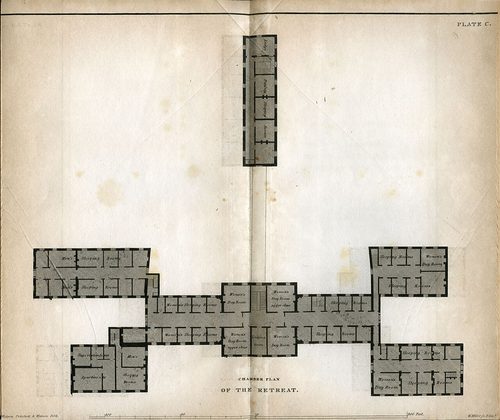
Moral treatment
Moral treatment, developed at Bicêtre in Paris and the York Retreat in the 1790s, tried to cure madness through kindness, routine, work and self-control rather than chains and drugs. It shaped a century of asylums.
 1890s–1950s
Dementia praecox
Emil Kraepelin's 'early dementia' of the 1890s: a psychosis of youth he thought led to lasting decline. Contested from the start, it was renamed schizophrenia and reshaped twentieth-century psychiatry.
 1952–present · Transformed
Chlorpromazine
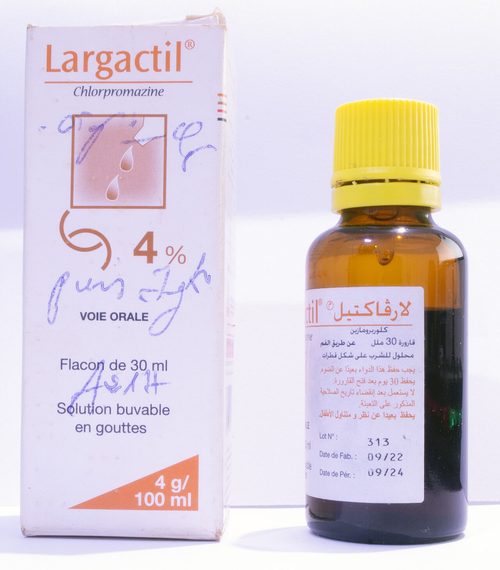
A French drug tried on psychiatric patients in Paris in 1952. Chlorpromazine calmed psychosis without stupor, emptied wards and began the age of psychiatric drugs, with lasting side-effects.
 1938–present · Transformed
Electroconvulsive therapy, then and now
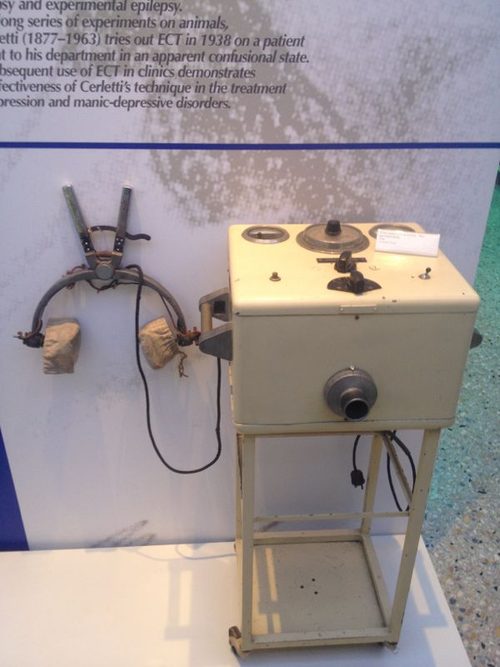
Ugo Cerletti and Lucio Bini first induced a seizure with electricity in Rome in April 1938. Unmodified ECT injured and frightened many; anaesthesia and muscle relaxants made it a treatment still used today.