
Treatment · Antiquity–1850s
Bloodletting, purging and emetics
For two thousand years doctors bled, purged and vomited people with mania and melancholy. How depletion worked in theory, how it was done at Bethlem and in Philadelphia, and how it faded in the nineteenth century.
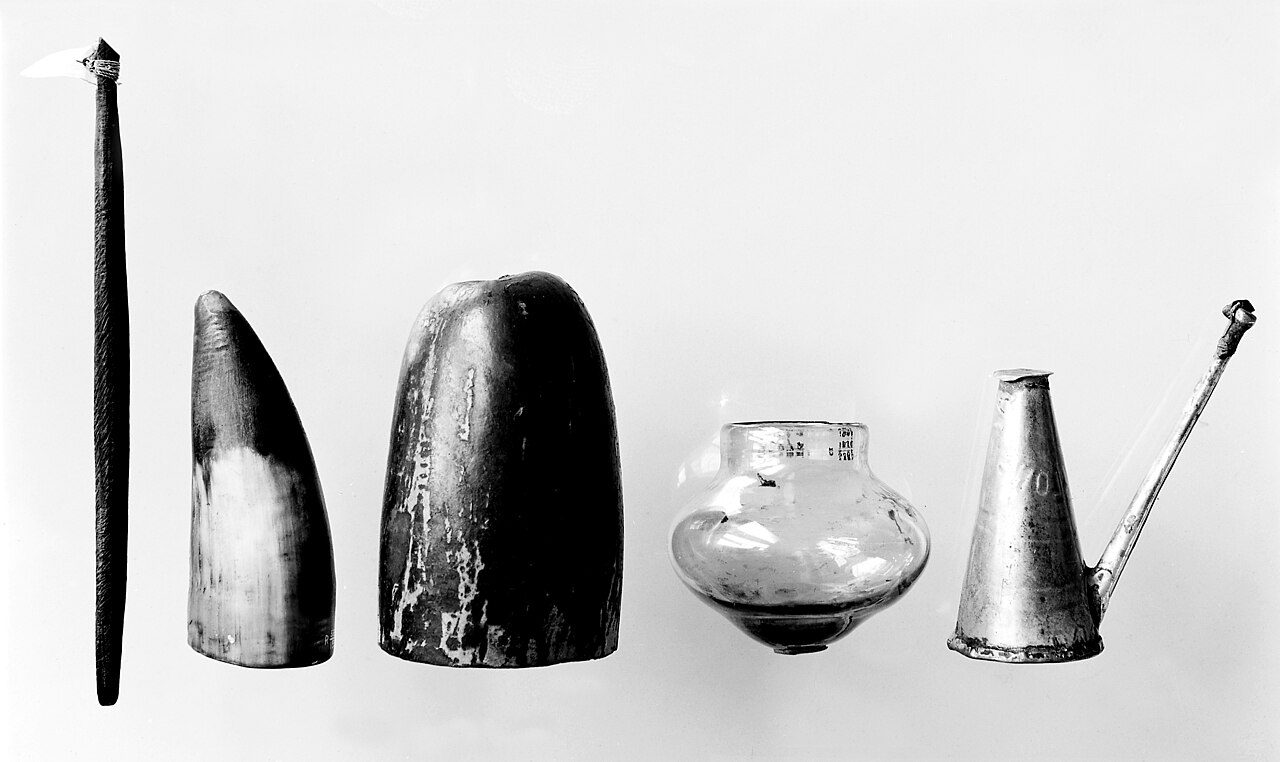
In the summer of 1815 a committee of the House of Commons asked Thomas Monro, physician to Bethlem Hospital, how the patients there were treated. Medicine was given, he explained, from May to September, and not in winter, "because the house is so excessively cold". Asked what that medicine was, he answered in a single line5:
We apply generally bleeding, purging, and vomit; those are the general remedies we apply.5
Quotation checked against the 1815 text
Patients who needed bleeding were bled on one day of the week, purged on another, and vomited on a third5. To the committee, which was investigating abuses, the routine looked mechanical. To Monro it was ordinary medicine, and in a sense he was right: depletion, the drawing off of blood and the emptying of the stomach and bowels, had been the commonest treatment for madness since antiquity.
Why doctors bled the mad
The reasoning came from the humoral medicine of the Hippocratic writers and Galen. Health was a balance of fluids; mania was often blamed on hot, excessive blood or yellow bile reaching the brain, melancholia on black bile. Drawing blood, purging the bowels and inducing vomiting all removed matter from a body that had too much of it, or that held the wrong kind1,9. The hellebore purge was so closely tied to madness that Burton could still ask whether "all the hellebore in the Anticyrae", the Greek towns famous for the plant, would cure the follies of his day1.
There was never full agreement. Robert Burton, surveying a century of learned opinion in 1621, noted that "Galen, and many others, make a doubt of bleeding at all" in melancholy that began in the brain, while other authorities prescribed veins opened in the forehead and nose, cupping glasses on the shoulders, or leeches on the head1. A history in Tuke's Dictionary of Psychological Medicine (1892) recalls that the Roman physician Asclepiades had rejected bleeding for the insane altogether, adding, "Would that his opinion had prevailed in more recent times"10.
Bethlem and its apothecary
The fullest picture of practice comes from Bethlem Hospital ("Bedlam"). Its apothecary, John Haslam, published his Observations on Insanity in 1798. He considered bleeding "the most beneficial remedy that has been employed" for strong patients early in the illness, preferred taking blood from the shaved scalp with six or eight cupping glasses, and had bled more than two hundred patients by opening a vein2. He was much less sure of vomiting. The hospital had long given curable patients four or five emetics each spring, but on consulting his case book he had not found that "patients have been particularly benefited" by them, and in some cases paralysis had followed within hours2. He thought purgatives safe, rejecting the old belief that the insane were hard to purge2.
Pinel's protest and Rush's defence
In Paris, Philippe Pinel did not forbid the lancet, but he condemned its routine use. His treatise of 1801, translated into English in 1806, opened its section on bleeding with a sentence that was quoted for decades:
The blood of maniacs is sometimes so lavishly spilled, and with so little discernment, as to render it doubtful whether the patient or his physician has the best claim to the appellation of a madman.3
Quotation checked against the 1806 text
Pinel thought bleeding could help in particular cases, but that used "without rule or bounds" it could turn a curable mania into permanent dementia, and that in melancholy it was "still less to be recommended"3. His pupil Esquirol used local bleeding with leeches only now and then, and observed that Pinel "employs it very little"7.
In Philadelphia, Benjamin Rush took the opposite view. A leading advocate of heroic depletion in fevers, he applied the same logic to madness, which he located in the blood vessels of the brain. His Medical Inquiries and Observations, upon the Diseases of the Mind (1812) advised drawing large quantities at the first attack, ideally with the patient standing, and promised:
The effects of this early and copious bleeding are wonderful in calming mad people.4
Quotation checked against the 1812 text
Among his successes Rush listed a private patient at the Pennsylvania Hospital who lost about 470 ounces of blood in 47 bleedings between June 1810 and April 18114.
How depletion faded
By 1844 Isaac Ray could write that general bleeding, "once considered indispensable in acute mania", was "now seldom used in any American hospital"; Tuke's Dictionary reckoned that within twenty years of Rush's book it had been practically abolished in American asylums10. The same years saw the spread of moral treatment, which preferred to act on the mind through routine, occupation and kindness. Leeches and cupping lingered for particular symptoms, and purgatives much longer, but by the end of the century the verdict was settled:
Certain it is that the indiscriminate bleeding which was practised up to the early part of this century and even later, was injurious.6
Quotation checked against the 1892 text
Key dates
- 1621 Robert Burton's Anatomy of Melancholy surveys the learned disagreement over bleeding in melancholy.
- 1798 John Haslam, apothecary at Bethlem, reports bleeding more than two hundred patients and doubts the hospital's spring emetics.
- 1801 Philippe Pinel's Treatise on Insanity attacks the lavish bleeding of maniacs.
- 1812 Benjamin Rush recommends copious bleeding for madness and reports a patient bled about 470 ounces in 47 bleedings.
- 1815 Thomas Monro tells a House of Commons committee that Bethlem bleeds, purges and vomits its patients in the warmer months.
- 1835 Pierre Louis publishes his numerical study of bloodletting in inflammatory diseases.
Sources
- Primary source Robert Burton, The Anatomy of Melancholy, Oxford (1621). Quotations checked against this text.
- Primary source John Haslam, Observations on Insanity, London: F. and C. Rivington (1798). Quotations checked against this text.
- Primary source Philippe Pinel, A Treatise on Insanity (trans. D. D. Davis), Sheffield: W. Todd (1806). Quotations checked against this text.
- Primary source Benjamin Rush, Medical Inquiries and Observations, upon the Diseases of the Mind, Philadelphia: Kimber and Richardson (1812). Quotations checked against this text.
- Primary source House of Commons, Report, together with the Minutes of Evidence, from the Committee on Madhouses in England, London (1815). Quotations checked against this text.
- Primary source Daniel Hack Tuke (ed.), A Dictionary of Psychological Medicine, vol. 2, London: J. and A. Churchill (1892). Quotations checked against this text.
- Primary source Jean-Étienne Dominique Esquirol, Mental Maladies: A Treatise on Insanity (trans. E. K. Hunt), Philadelphia: Lea and Blanchard (1845). Quotations checked against this text.
- Scholarship Anna Drakman, The Open Body Closed: A Rationale for the Abandonment of Bloodletting, Based on Nineteenth-Century Swedish Medicine, Social History of Medicine 38(2): 270–290 (2025).
- Wikipedia Bloodletting, Wikipedia (2026).
- Primary source Daniel Hack Tuke (ed.), A Dictionary of Psychological Medicine, vol. 1 (entries on history and on America), London: J. and A. Churchill (1892). Quotations checked against this text.
Cross-checked with Wikidata Q356405 and the English Wikipedia article.
Read next
 c. 400 BCE–1800s
The four humours
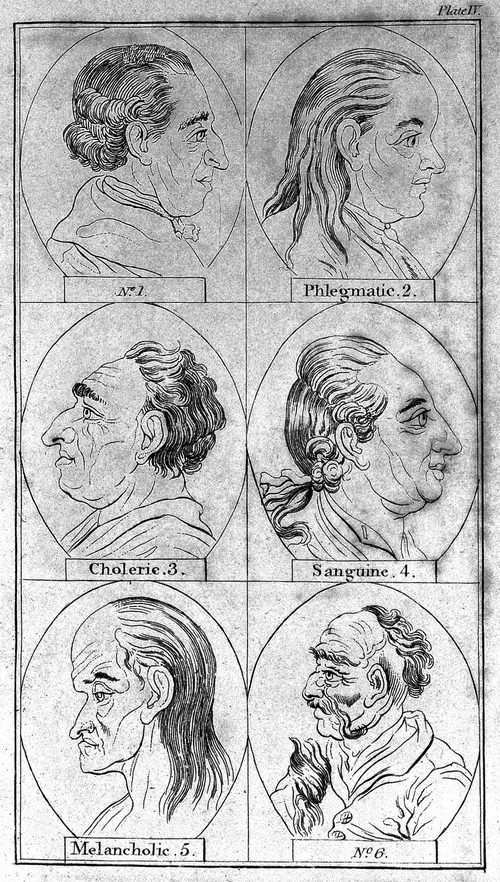
For two thousand years, European and Islamic medicine explained madness and melancholy by four bodily fluids. What the theory claimed about the mind, how it shaped treatment, and how it slowly lost its hold.
 c. 400 BCE–1900s
Melancholia
For two thousand years melancholia meant fear and sorrow without cause, blamed on black bile. How physicians from Aretaeus to Kraepelin defined it, and how it became 'depression'.
 c. 100 CE–1980
Mania
Mania once meant madness itself: raving, sleepless, sometimes joyful. How the word narrowed from Aretaeus to Kraepelin, and how it became one pole of manic-depressive illness.
 1796–1830s · Abandoned
Swinging and rotating chairs
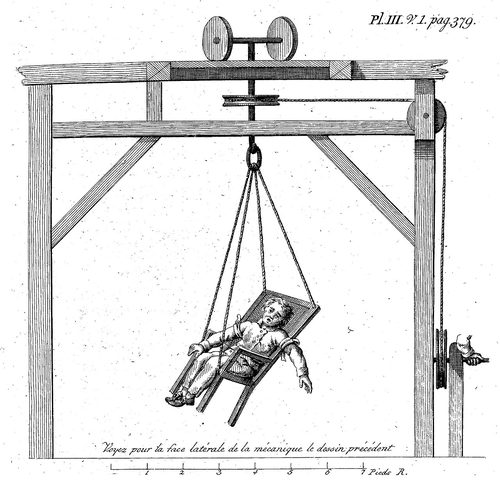
Around 1800, doctors strapped patients into chairs and beds that spun at speed, to induce giddiness, vomiting and sleep. Erasmus Darwin's idea, Joseph Mason Cox's swing, and why it was abandoned within a generation.
 1790s–1870s · Transformed
Moral treatment
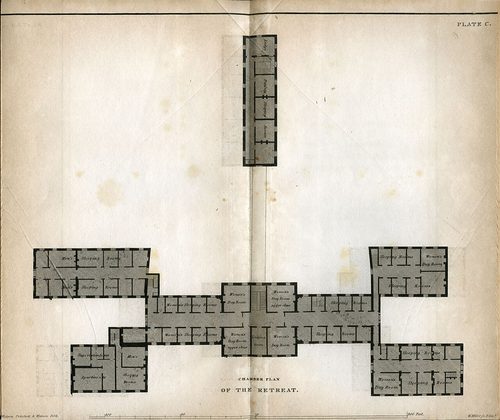
Moral treatment, developed at Bicêtre in Paris and the York Retreat in the 1790s, tried to cure madness through kindness, routine, work and self-control rather than chains and drugs. It shaped a century of asylums.