
Place · January 1941 – March 1945
Hadamar and the Nazi killing of patients
A psychiatric hospital in Hesse that became one of six Nazi killing centres. About 10,000 patients were gassed there in 1941 and some 4,400 killed by drugs and starvation in 1942–45. It is now a memorial.
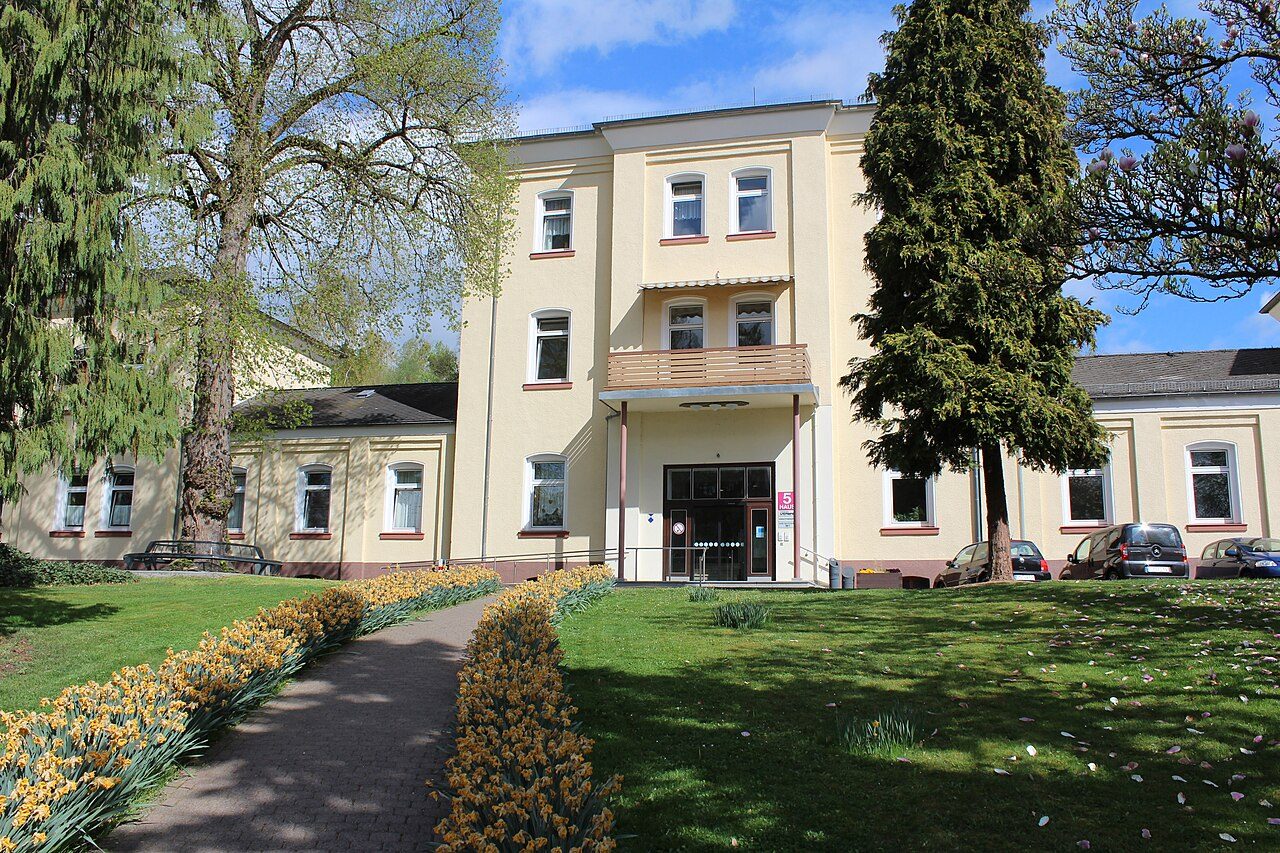
The hospital on the Mönchberg above the small Hessian town of Hadamar was built in 1883 as a correctional workhouse and became a state psychiatric hospital in 19064. In 1941 it was turned into a place for killing the kind of people it had been built to hold. Nearly 15,000 people died there between January 1941 and March 1945: people with mental illnesses and disabilities, old and young, men, women and children, from much of Germany and from other countries in Europe1,3. Today it is a memorial.
The "euthanasia" programme
What the Nazi state called "euthanasia" was the murder of people it judged "unworthy of life". It grew out of the eugenics and psychiatry and racial hygiene of the previous decades and out of a wartime wish to free hospital beds and resources2. The killing of disabled children in specially designated hospital wards began in 1939. In the autumn of that year Hitler signed a secret authorisation, backdated to 1 September 1939, the day the war began, protecting the doctors and officials who would kill adult patients in institutions2. The operation was run from offices at Tiergartenstraße 4 in Berlin, from which it took its post-war name, Aktion T46.
Physicians authorised by the programme selected patients for death, largely on paper; inability to work and "disruptive" behaviour weighed heavily5,6. Six killing centres were set up, at Brandenburg, Grafeneck, Bernburg, Sonnenstein, Hartheim in Austria and finally Hadamar, which replaced Grafeneck2,5. Patients were taken in grey buses, often by way of "transit" hospitals so that families lost track of them, and killed with carbon monoxide in gas chambers disguised as shower rooms. Families received urns and death certificates giving false causes of death2,5.
Hadamar in 1941
In late 1940 part of the Hadamar hospital was leased to a T4 front organisation and fitted with a gas chamber and crematorium in its cellar5. From January to August 1941 about 10,000 people were killed there, most of them from hospitals in Hesse-Nassau, Westphalia, the Rhineland, Hanover, Baden and Württemberg1,5. Among them were several hundred Jewish patients taken from dozens of institutions in February 1941 and killed simply because they were Jewish5.
On 13 August 1941 Antonius Hilfrich, the Bishop of Limburg, in whose diocese Hadamar lay, wrote to the Reich Minister of Justice. His letter, later an exhibit at Nuremberg, described what the town could see:
Several times a week buses arrive in Hadamar with a considerable number of such victims. School children of the vicinity know this vehicle and say: "There comes the murder-box again." After the arrival of the vehicle, the citizens of Hadamar watch the smoke rise out of the chimney7
Quotation checked against the 1946 text
The population, he wrote, could not grasp that acts punishable by death under the German criminal code were being carried out systematically5,7. Bishop Clemens August von Galen had already condemned the killings from the pulpit, and on 24 August 1941 Hitler ordered the gassings stopped. By then about 70,000 people had died in the six centres, by T4's own count2,5.
1942–1945
The killing did not stop; it changed method. From August 1942 Hadamar, run again by the regional authority under the physician Adolf Wahlmann and the administrator Alfons Klein, received transports of patients and killed most of them with overdoses of drugs and by deliberate starvation, carried out by nurses as well as doctors1,5. The dead were buried in mass graves in a cemetery on the hospital grounds5. About 4,400 people died in this second phase1. They included children classed by the regime as "half-Jewish", taken from welfare homes from 1943, and from 1944 several hundred Soviet and Polish forced labourers diagnosed with tuberculosis1,5. The killings ended only when American troops arrived on 26 March 19455. Across Germany and the annexed territories, the "euthanasia" programme in all its phases is estimated to have killed about 250,000 people2.
Trials
The Americans found the cemetery and the hospital records, and filmed the exhumations1. Because international law then allowed them to try only crimes against Allied nationals, the US military commission at Wiesbaden in October 1945, the first mass atrocity trial in the American zone, tried seven Hadamar staff for the murder of the forced labourers alone. All were convicted. Klein and two male nurses were hanged in March 1946; Wahlmann, because of his age, received life imprisonment, and the chief nurse 25 years1. In March 1947 a German court in Frankfurt tried 25 staff for the killing of German patients and convicted eleven; the two death sentences, on the doctors Wahlmann and Bodo Gorgaß, were commuted, and the last prisoner was released in 19561,5.
The memorial
Remembrance came slowly. A relief was placed in the hospital's entrance hall in 1953, and in 1964 the cemetery was redesigned as a place of mourning5. In 1983 students mounted a first exhibition in the cellars where the gas chamber had been; a permanent exhibition opened in 19915. The Gedenkstätte Hadamar, run by the regional welfare association of Hesse, remembers those persecuted and murdered, keeps an archive and a database of victims, and works with schools and with people with learning disabilities3,5. A psychiatric hospital, the Vitos clinic, still works on the Mönchberg; the killing centre occupied what is now its oldest building5.
Key dates
- 1883 The main building on the Mönchberg at Hadamar is built as a correctional workhouse; from 1906 it serves as a state psychiatric hospital.
- 1939 Hitler signs a secret authorisation for the killing of institutionalised patients, backdated to 1 September 1939; the programme is later called 'Aktion T4'.
- January 1941 Hadamar, fitted with a gas chamber and crematorium, begins killing patients brought by bus from hospitals in western and south-western Germany.
- 24 August 1941 The central gassing programme is halted after protests, among them by Catholic bishops; about 10,000 people have been killed at Hadamar.
- August 1942 Killing resumes at Hadamar under its own staff, by lethal doses of drugs and deliberate starvation.
- 26 March 1945 American troops reach Hadamar.
- 15 October 1945 A US military commission in Wiesbaden convicts seven Hadamar staff of murdering Soviet and Polish forced labourers; three are later hanged.
- March 1947 A German court in Frankfurt convicts eleven Hadamar staff for the murder of German patients.
- 1983 A first exhibition in the cellars of the former killing centre begins the Hadamar memorial.
Also on this site
Sources
- Museum or archive The Hadamar Trial, United States Holocaust Memorial Museum, Holocaust Encyclopedia.
- Museum or archive Euthanasia Program and Aktion T4, United States Holocaust Memorial Museum, Holocaust Encyclopedia.
- Museum or archive Gedenkstätte Hadamar, Gedenkstätte Hadamar (Landeswohlfahrtsverband Hessen).
- Museum or archive Geschichte, Gedenkstätte Hadamar.
- Wikipedia Tötungsanstalt Hadamar, Wikipedia (German).
- Wikipedia Aktion T4, Wikipedia.
- Primary source Office of United States Chief of Counsel for Prosecution of Axis Criminality, Nazi Conspiracy and Aggression, Volume III: translation of document 615-PS (letter of the Bishop of Limburg to the Reich Minister of Justice, 13 August 1941), Washington: US Government Printing Office (1946). Quotations checked against this text.
Cross-checked with Wikidata Q470564 and the English Wikipedia article.
Read next
 1883–1970s
Eugenics and psychiatry
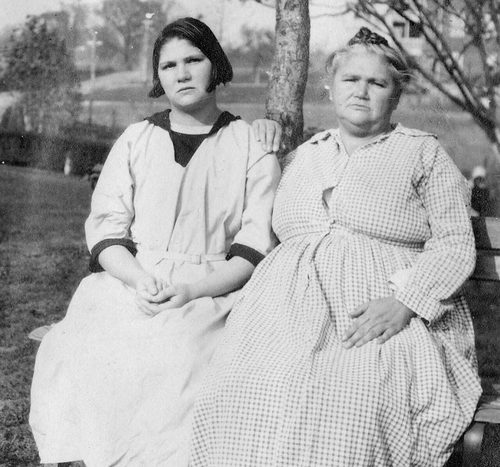
Eugenics promised to reduce mental illness by preventing 'unfit' people from having children. How psychiatrists helped build sterilisation laws in the United States and Europe, Buck v. Bell, and the road to the Nazi killing of patients.
 1857–1914
Degeneration theory
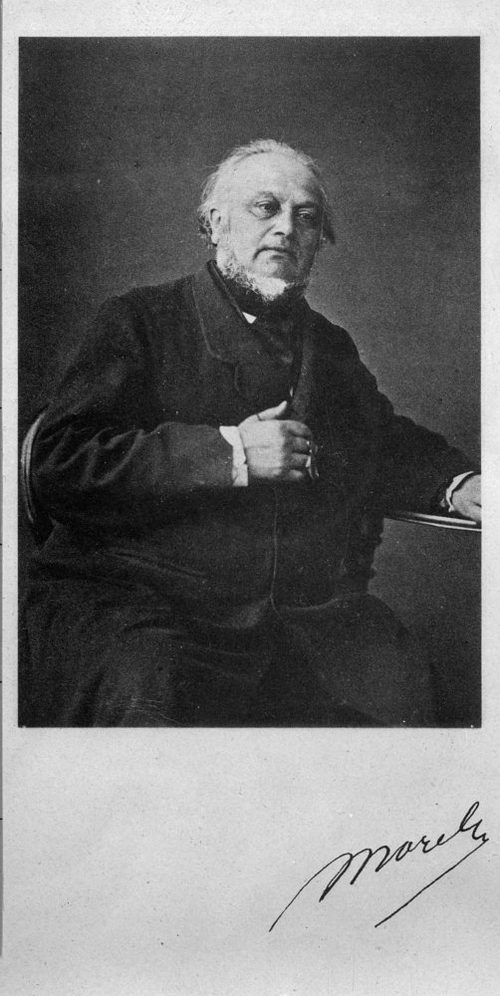
From the 1850s many psychiatrists believed that madness was the sign of a family in hereditary decline, worsening with each generation. How Morel's theory spread, what it explained for asylum doctors, and where it led.
 Essay · 7 min
Who got locked up, and why
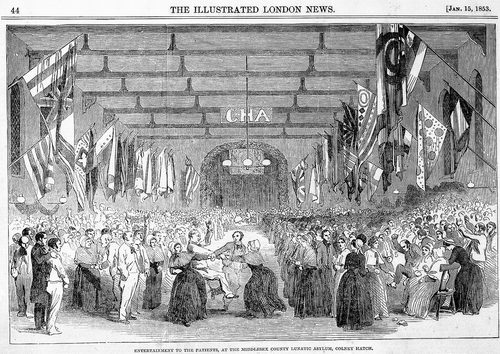
Asylum populations were never a simple sample of the mentally ill. Poverty, family, the Poor Law, sex, migration, race, age and bodily disease all decided who was confined, and historians still argue over how much each counted.
 Essay · 8 min
Counting the confined: asylum populations, 1800–2000
Asylum numbers in England and the United States rose for a century and then fell by three-quarters or more. What the official counts measured was how long people stayed, not how many fell ill, as their own compilers warned.
 Essay · 7 min
War and the mind: from nostalgia to PTSD
Nostalgia, irritable heart, shell shock, exhaustion, PTSD: each war named soldiers' breakdown anew, and each name was a ruling on cause, and so on who deserved a pension, treatment or punishment.