
Essay · 1844–1994
Counting the confined: asylum populations, 1800–2000
Asylum numbers in England and the United States rose for a century and then fell by three-quarters or more. What the official counts measured was how long people stayed, not how many fell ill, as their own compilers warned.
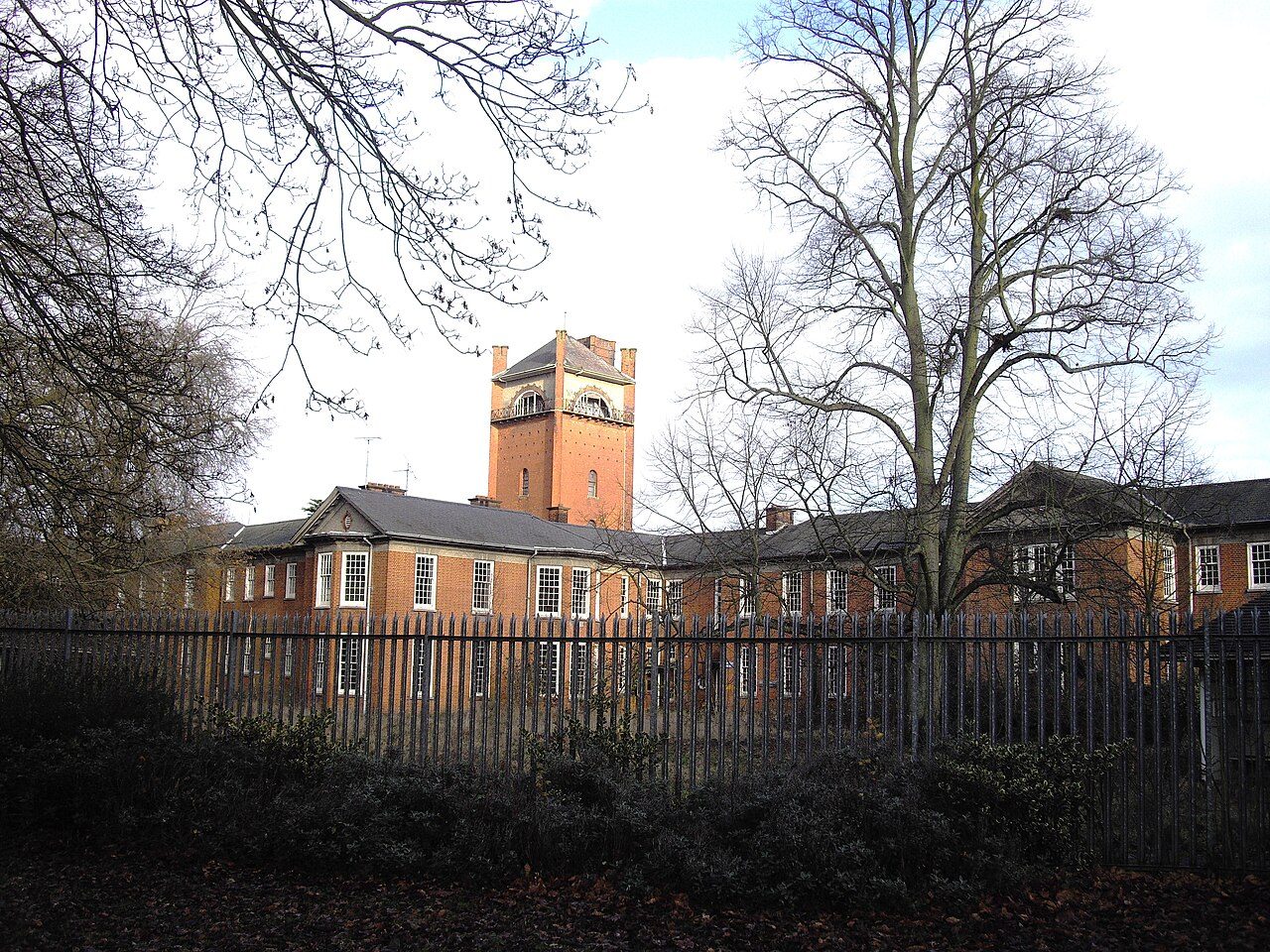
Every year from 1859 until the Second World War, the officials who inspected the asylums of England and Wales printed a number: how many people were "under care" as insane on the first day of January. The number went up almost every year for eighty years. In 1925 the Board of Control, which had inherited the count, felt obliged to explain what it meant, and what it did not:
The number has no necessary connection with the incidence of mental disorders in the general population ; it is merely the net balance as between the admissions and the combined deaths and discharges.3
Quotation checked against the 1926 text
That warning is the key to every statistic in this essay. Asylum populations in Britain and the United States rose for a century and then fell by three-quarters or more in forty years. Neither movement was mainly a change in how many people became ill. Both were changes in how long people stayed, and in which institution was made to hold them. The asylum census was a measure of accumulation.
Before the series begins
Nobody counted the people confined for madness in eighteenth-century England, when most were kept at home or in small private madhouses (see The rise and fall of the asylum). The first national count was made by the Metropolitan Commissioners in Lunacy for 1 January 1844. They found 11,272 people in asylums, hospitals and licensed houses, and 20,893 "insane persons" known to the authorities altogether; 9,339 of these were paupers held in workhouses "and elsewhere"1,2. The commissioners thought even this was "considerably below the actual amount"1.
They were already worried about what the public asylums were filling with. Parishes, to save a little money, kept poor patients in the workhouse until they became unmanageable and only then sent them on:
These places (even such of them as are upon the most extended scale) are, we regret to say, filled with incurable patients, and are thus rendered incapable of receiving those whose malady might still admit of cure.1
Quotation checked against the 1844 text
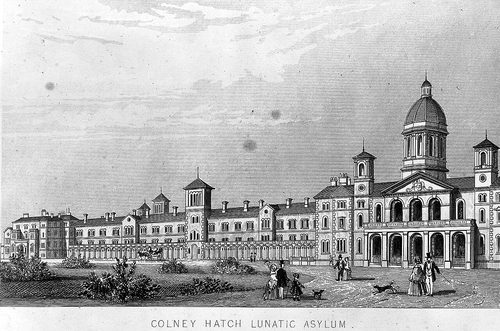
In 1845 Parliament created a permanent Lunacy Commission, one of whose first objects, it later recalled, was to make local authorities build asylums for the pauper insane, most of whom were still without them2. In 1847 the 21 county asylums of England and Wales held 5,486 people, an average of about 260 each, close to the 250 patients that Thomas Kirkbride would recommend as the most a superintendent could know personally. By 1 January 1914 there were 97 county and borough asylums holding 105,504 people, an average of more than a thousand2. The largest, such as Hanwell, held far more.
A century of accumulation
The annual series shows the shape of the rise. The 36,762 people known to be under care in 1859 became 69,885 in 1879, 105,086 in 1899 and 140,237 in 1914, an increase of 281.5 per cent while the population grew by 89.5 per cent2. As a proportion of the population the figure doubled, from 18.67 to 37.59 for every 10,000 people2.
What did not rise in step was the rate at which people came in for the first time. The commissioners kept a record of first admissions from 1898, when they were 4.92 for every 10,000 people; in 1913 they were 4.992. In those fifteen years the number under care went on climbing. People were not becoming ill faster; they were staying, and the patients of one decade were still there in the next. The Board of Control's figures show the asylums steadily taking over from other places: the share of all known "insane persons" held in county and borough asylums rose from 62.5 per cent in 1889 to 80.6 per cent in 1926, while the share in workhouses and other Poor Law institutions fell from 14.5 to 8.5 per cent3. Part of the growth of the asylum was a transfer from the workhouse.
Several kinds of people stayed. Many had chronic illnesses that moral treatment did not cure, the "incurable patients" the commissioners had complained of in 18441. Many were old: by the 1950s former Poor Law hospitals had been turned into mental hospitals "for aged and chronic patients"4. Many were dying: general paralysis of the insane, the late stage of syphilis, killed most of its patients within a few years of admission but filled wards while it lasted. And the asylum was the one public institution obliged to take whoever was certified.
The American count
American numbers come from the census, which counted "insane" people inside and outside institutions in 1880 and 1890, and in 1904 counted only patients in hospitals. In 1880 there were 40,942 patients in hospitals for the insane, 81.6 for every 100,000 people; in 1890, 74,028 (118.2); on 31 December 1903, 150,151 patients in 328 hospitals (186.2)7. The census office would not read this as a rise in illness:
These figures are, of course, for the most part merely illustrative of the larger utilization of hospitals for the treatment of the insane and not direct proof of a corresponding increase of insanity.7
Quotation checked against the 1906 text
The report gave reasons: states had built hospitals faster, some had forbidden the keeping of insane people in almshouses, and in 1880, when physicians had helped the enumerators, 51,017 people counted as insane had been living outside hospitals7. The asylum of Dorothea Dix's campaigns, and the Kirkbride buildings that housed it, were absorbing a population that had always existed. From the start of the 1930s to 1955 the residents of state and county mental hospitals rose again, from 332,000 to 559,0008. In 1955 about 340 people in every 100,000 Americans lived in a public mental hospital, by our arithmetic from Torrey's figures9.
The turn
In both countries the fall began in the mid-1950s, and in both the number of admissions went on rising while the number of residents fell. In England and Wales the mental hospitals took 55,856 admissions in 1950 and 78,586 in 1955; yet the number of patients in them fell by 1,047 during 1955, to 139,4404. In 1980 the government told Parliament that only about 9,000 of the 175,000 or so people admitted each year now stayed longer than a year, and that the resident population had fallen "continuously" as the long-stay patients of earlier years were discharged or died5. In the United States, admissions to state and county hospitals rose through the 1950s, 1960s and early 1970s while their resident population fell from 558,922 in 1955 to 132,164 in 1980 and 109,939 in 19868. The hospitals had become places people passed through.
The American fall was not steady. Residents declined by only 4.2 per cent between 1955 and 1960 and 11.3 per cent between 1960 and 1965, and then by 29.0, 42.7 and 31.7 per cent in the next three five-year periods8.
The numbers at a glance
The figures below come from different series, which counted different things; they show the direction of change, not exactly comparable totals.
- England and Wales, 1 January 1844: 11,272 in asylums, hospitals and licensed houses; 20,893 known "insane persons" in all1,2.
- England and Wales, 1 January 1859: 36,762 under care (18.67 per 10,000)2.
- England and Wales, 1 January 1914: 140,237 under care (37.59 per 10,000)2.
- England and Wales, 1 January 1926: 133,883 notified insane under care3.
- England and Wales, 31 December 1955: 150,856 under treatment for mental illness, 139,440 of them in mental hospitals4.
- England, 31 December 1954 and 1978: about 143,500 and 78,200 inpatients in psychiatric hospitals and units5.
- United States, 1880, 1890 and 1903: 40,942, 74,028 and 150,151 patients in hospitals for the insane7.
- United States, 1955: 558,922 residents of state and county mental hospitals8; Torrey gives 558,239 in public psychiatric hospitals9.
- United States, 1980 and 1986: 132,164 and 109,939 residents8.
- United States, 1994: 71,619 in public psychiatric hospitals9.
What the totals hide
The disagreements in that list are instructive. For England's peak, the Board of Control counted 140,487 patients in mental hospitals at the end of 1954, excluding former Poor Law hospitals used for "aged and chronic patients"; the government's later census estimate for England alone was 143,500; Barbara Taylor, citing Sarah Payne, gives a high of 152,000 psychiatric beds in 1954, falling to 43,000 by the early 1990s4,5,6. In 1955 the hospitals held 17,965 more patients than their official accommodation, so beds and patients were not the same thing4. In 1960 England had 130 mental hospitals; by 1993 it had 416.
The falling totals also hide where people went. The American count of state hospital residents leaves out nursing homes, which by the late 1980s housed about 1.5 million people, of whom between 30 and 75 per cent, depending on definitions, had a serious psychiatric disorder or dementia8. Torrey reckoned that if the 1955 rate had held, 885,010 Americans would have been in public mental hospitals in 1994 rather than 71,6199. Whether the difference measures liberation or neglect is the subject of deinstitutionalisation; who was counted in the first place, and why, is the subject of Who got locked up, and why.
What the long series does establish is the point the Board of Control made in 1925. A population of residents is a stock, filled by admissions and drained by discharges and deaths. For a century the asylums of England and America drained slowly, because they kept the chronically ill, the old and the dying; from the 1950s they drained fast, because stays became short and long-term care moved to other buildings. The illness in the population may have changed far less than either curve suggests.
Key dates
- 1 January 1844 The Metropolitan Commissioners in Lunacy count 11,272 people in the asylums, hospitals and licensed houses of England and Wales, and 20,893 'insane persons' known in all.
- 1 January 1859 The Commissioners in Lunacy begin their annual series: 36,762 people known to be under care in England and Wales.
- 31 December 1903 A US census finds 150,151 patients in 328 American hospitals for the insane, double the number of 1890.
- 1 January 1914 Notified 'insane persons' under care in England and Wales reach 140,237, 37.59 for every 10,000 people.
- 1955 US state and county mental hospitals hold about 559,000 residents, their highest number; in England and Wales the mental hospital population falls by 1,047.
- 1986 US state and county mental hospitals hold 109,939 residents, 81 per cent fewer than in 1955.
Sources
- Primary source Metropolitan Commissioners in Lunacy, Report of the Metropolitan Commissioners in Lunacy to the Lord Chancellor, London: Bradbury and Evans (1844). Quotations checked against this text.
- Primary source Commissioners in Lunacy (England and Wales), Sixty-eighth Report of the Commissioners in Lunacy to the Lord Chancellor, London: HMSO (1914). Quotations checked against this text.
- Primary source Board of Control (England and Wales), Twelfth Annual Report of the Board of Control for the year 1925, London: HMSO (1926). Quotations checked against this text.
- Primary source Board of Control (England and Wales), Annual Report of the Board of Control to the Lord Chancellor for the year 1955, London: HMSO (1956).
- Official Sir George Young, Department of Health and Social Security, Psychiatric Hospitals (In-patients), written answer, HC Deb 3 April 1980 vol 982 cc390-1W, Hansard (UK Parliament) (1980-04-03).
- Scholarship Barbara Taylor, The demise of the asylum in late twentieth-century Britain: a personal history, Transactions of the Royal Historical Society 21 (2011).
- Primary source U.S. Bureau of the Census, Insane and Feeble-Minded in Hospitals and Institutions, 1904, Washington: Government Printing Office (1906). Quotations checked against this text.
- Scholarship David Mechanic, David A. Rochefort, Deinstitutionalization: an appraisal of reform, Annual Review of Sociology 16 (1990).
- Scholarship E. Fuller Torrey, Out of the Shadows: Confronting America's Mental Illness Crisis (excerpt), PBS Frontline / John Wiley & Sons (1997).
- Scholarship Robert Ellis, The Asylum, the Poor Law, and a Reassessment of the Four-Shilling Grant: Admissions to the County Asylums of Yorkshire in the Nineteenth Century, Social History of Medicine 19(1) (2006).
Read next
 Essay · 7 min
The rise and fall of the asylum
How the public asylum grew from a few small madhouses into hospitals of thousands, and was then closed: an argument that its failures came from its success at taking in the people no other institution would hold.
 1955–2000 · Transformed
Deinstitutionalisation
From the mid-1950s Western countries emptied their great mental hospitals: US public hospitals fell from about 559,000 patients to under 72,000 in forty years. Whether patients were freed or abandoned is still argued.
 Essay · 7 min
Who got locked up, and why
Asylum populations were never a simple sample of the mentally ill. Poverty, family, the Poor Law, sex, migration, race, age and bodily disease all decided who was confined, and historians still argue over how much each counted.
 1820s–1940s
General paralysis of the insane
The deadliest diagnosis in the Victorian asylum: grandiose delusions, failing speech and paralysis, usually fatal within a few years. In 1913 it was proved to be a late form of syphilis.
 1952–present · Transformed
Chlorpromazine
A French drug tried on psychiatric patients in Paris in 1952. Chlorpromazine calmed psychosis without stupor, emptied wards and began the age of psychiatric drugs, with lasting side-effects.