
Theory · 1857–1914
Degeneration theory
From the 1850s many psychiatrists believed that madness was the sign of a family in hereditary decline, worsening with each generation. How Morel's theory spread, what it explained for asylum doctors, and where it led.
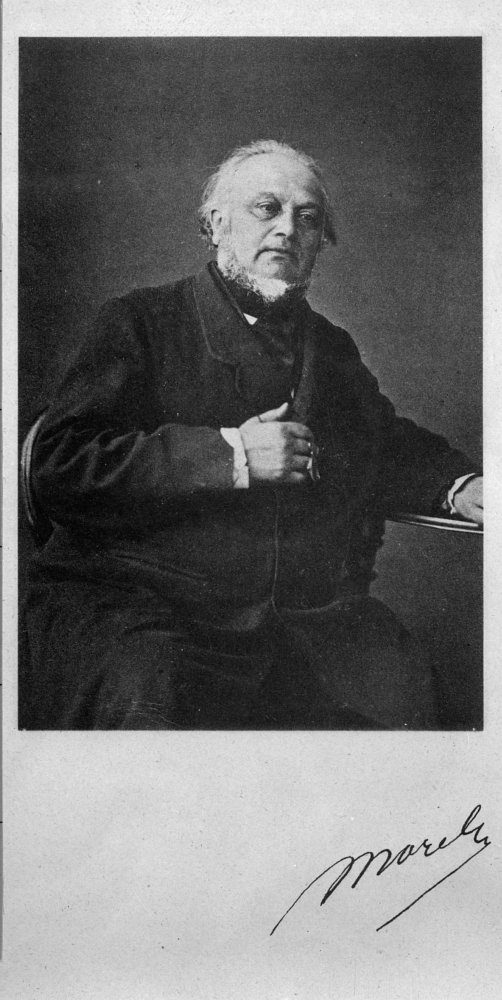
A youth was once admitted to the asylum at Rouen in what its director described as a state of stupidity and near-idiocy. The director, Bénédict-Augustin Morel, traced the family back four generations and found what he thought was a law of nature. The great-grandfather had drunk heavily and been killed in a tavern brawl; the grandfather was a hereditary drunkard who had attacks of mania and ended in general paralysis; the father was sober but hypochondriacal, with delusions of persecution; the boy himself had his first attack of mania at sixteen and was sinking into "complete idiocy", with little prospect of children1. The English psychiatrist Henry Maudsley retold the case in 1870 as a model of "the natural course of degeneracy when it goes on through generations"1. For half a century, this kind of family history was among the most persuasive stories in psychiatry.
Morel's theory
Morel was born in Vienna to French parents in 1809 and directed the asylum of Saint-Yon at Rouen from 1856 until his death in 18733. His Traité des dégénérescences of 1857 argued that the human species had a primitive, healthy type from which families could fall away. The causes were many: alcohol and other poisons, poor diet, disease, unhealthy soils and climates (he studied cretinism in the Meurthe region), and immoral or miserable ways of life2,3. Once acquired, the damage was inherited and accumulated. The usual sequence ran from nervous temperament and vice in the first generation through epilepsy, hysteria and other nervous diseases to insanity, and finally to idiocy and sterility, at which point nature extinguished the line2,6.
The 1892 Dictionary of Psychological Medicine, edited by Daniel Hack Tuke, still opened its entry with Morel's definition2:
A diseased deviation from a primitive type. However simple in its origin, it includes the elements of transmissibility of such a nature that the contained germ becomes more and more unable to fulfil its function in humanity.2
Quotation checked against the 1892 text
The theory was Lamarckian, assuming that characteristics acquired in life could be inherited, and it was pre-Darwinian6. It was also, at first, a reforming idea. If drink, poverty and bad housing caused hereditary decline, then public health, temperance and better conditions for the poor could stop it, and Morel campaigned for such measures3.
Why psychiatrists embraced it
Degeneration answered a pressing question. The great asylums founded with such hope in the early nineteenth century were filling with chronic patients who did not recover, and the confident promises of cure under moral treatment looked hollow. A hereditary, progressive disease explained why. The historian Ian Dowbiggin has argued that French alienists adopted hereditarian theories in large part to account for psychiatry's failure to meet expectations while preserving their claim to medical expertise5. In asylum casebooks "hereditary predisposition" became a standard heading, and the notion of a "third generation" in which the taint broke out in full shaped how doctors read families4.
The idea spread fast. In France Valentin Magnan refined it into a classification of dégénérés, emphasising alcohol, and especially absinthe, and listing the physical and mental "stigmata" by which degeneration could supposedly be recognised2,6. In Italy Cesare Lombroso described the "born criminal" as an atavistic throwback whose skull and face betrayed his nature6. In Britain Maudsley, who had begun by arguing that degenerate lines simply died out, grew bleaker; he wrote of people born
weighted with a destiny against which they have neither the will nor the power to contend ; they are the step-children of nature, and groan under the worst of all tyrannies — the tyranny of a bad organization.1
Quotation checked against the 1870 text
German psychiatry absorbed degeneration too. Emil Kraepelin drew heavily on it, worried in later life about the degeneration of the German people, though he doubted that individual degenerates could be identified by visible stigmata6. Morel's own term démence précoce, an early-onset dementia of the young, was later taken up in Kraepelin's dementia praecox3.
From asylum to society
By the 1890s degeneration had escaped psychiatry. Max Nordau's best-seller Entartung (1892) diagnosed modern art and literature as symptoms of a degenerate age, and anxiety about the poor physique of army recruits during the Boer War made "national deterioration" a political issue in Britain6. Sigmund Freud met Nordau in Paris in 1885, was unimpressed, and remained hostile to the degeneration concept6.
The theory faded as a scientific idea around the First World War. Studies of heredity after the rediscovery of Gregor Mendel's work in 1900 had no place for a progressive, Lamarckian decline across generations, and the pattern Morel described could not be demonstrated4,6. But the fear it expressed, of a population weakened from within by the "unfit", passed directly into eugenics and psychiatry, which proposed to prevent degeneration not by improving conditions but by stopping certain people from having children4,6.
Key dates
- 1857 Bénédict-Augustin Morel publishes his Traité des dégénérescences physiques, intellectuelles et morales de l'espèce humaine.
- 1870 Henry Maudsley's lectures Body and Mind introduce Morel's 'degenerate varieties' to British readers.
- 1876 Cesare Lombroso's L'uomo delinquente describes the 'born criminal' marked by physical stigmata.
- 1892 Max Nordau's Entartung (Degeneration) turns the idea into a best-selling critique of modern art and society.
- 1892 Tuke's Dictionary of Psychological Medicine defines degeneration as 'a diseased deviation from a primitive type'.
Sources
- Primary source Henry Maudsley, Body and Mind: An Inquiry into Their Connection and Mutual Influence, London: Macmillan (1870). Quotations checked against this text.
- Primary source Daniel Hack Tuke (ed.), A Dictionary of Psychological Medicine, vol. 1 (entry 'Degeneration'), London: J. and A. Churchill (1892). Quotations checked against this text.
- Scholarship Eleni Rosiou, Markos Sgantzos and others, Bénédict Augustin Morel (1809–1873): the originator of the degenerative theory of the heredity of mental disorders and the pioneer of the biological approach to psychiatry, Cureus 16(9) (2024).
- Scholarship Sarah Chaney, Sarah Marks and Rebecca Wynter, 'Almost nothing is firmly established': a history of heredity and genetics in mental health science, Wellcome Open Research 9: 23 (2024).
- Scholarship Ian R. Dowbiggin, Inheriting Madness: Professionalization and Psychiatric Knowledge in Nineteenth-Century France, University of California Press (1991).
- Wikipedia Social degeneration, Wikipedia (2026).
Cross-checked with Wikidata Q559003 and the English Wikipedia article.
Read next
 1883–1970s
Eugenics and psychiatry
Eugenics promised to reduce mental illness by preventing 'unfit' people from having children. How psychiatrists helped build sterilisation laws in the United States and Europe, Buck v. Bell, and the road to the Nazi killing of patients.
 1890s–1950s
Dementia praecox
Emil Kraepelin's 'early dementia' of the 1890s: a psychosis of youth he thought led to lasting decline. Contested from the start, it was renamed schizophrenia and reshaped twentieth-century psychiatry.
 1835–1910s
Moral insanity
In 1835 J. C. Prichard named a madness of feeling and conduct with reason intact. Moral insanity reached the Old Bailey, provoked a backlash, and fed the later ideas of 'moral imbecility' and psychopathy.
 1820s–1940s
General paralysis of the insane
The deadliest diagnosis in the Victorian asylum: grandiose delusions, failing speech and paralysis, usually fatal within a few years. In 1913 it was proved to be a late form of syphilis.
 1845–1990
The biological turn
From Griesinger's claim in the 1840s that mental illness is brain disease, through the microscope, the shock therapies and the drug revolution, to DSM-III in 1980: how psychiatry repeatedly turned to the body.
 1680s–1980
Hysteria
Named for the womb, hysteria became medicine's catch-all for symptoms it could not explain. Its history from Greek texts to Sydenham, Charcot and Freud, and why it was dropped in 1980.