
Treatment · 1949–present
Lithium
John Cade's 1949 report that lithium calmed mania was nearly buried by fear of poisoning. Mogens Schou's trials, and a bitter dispute with London critics, made it the first drug shown to prevent relapse.
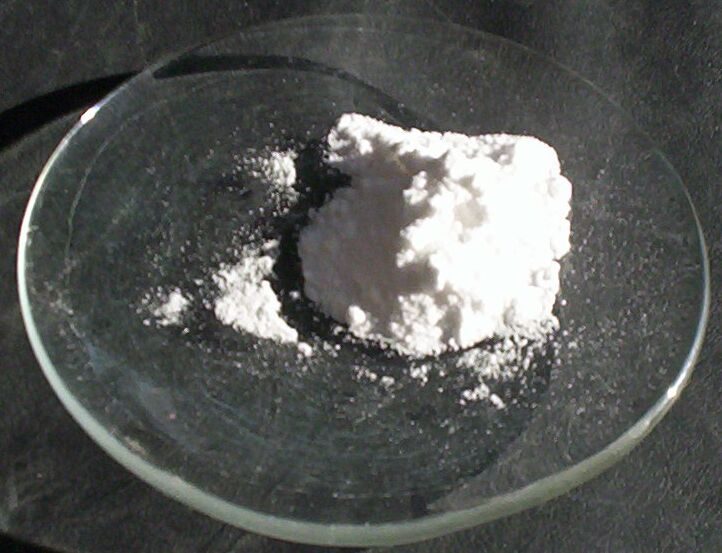
Lithium is a light metal and its salts are about as simple as a medicine can be: a mineral compound that no company could patent. It was nearly lost to psychiatry twice, once through neglect and once through fear of poisoning, and it became accepted only after one of the sharpest scientific quarrels in the field's history2,4.
Before Cade
Lithium came into medicine in the nineteenth century as a treatment for gout, after Alfred Garrod and others found that its salts dissolved uric acid in the laboratory. Because uric acid was then blamed for many ills, including "brain gout", a few physicians used it for mood disorders: William Hammond in New York gave it for mania in the 1870s, and Frederik Lange in Denmark for melancholic depression in the 1880s and 1890s2,3. The idea faded with the uric acid theory. Lithium lived on in spring waters, patent remedies and, for a time, a lemon soda advertised as "lithiated"4.
Then it acquired a deadly reputation. In the 1940s American heart patients on salt-restricted diets were sold lithium chloride as a substitute for table salt; there were cases of severe poisoning and deaths, and in February 1949 the sale of lithium was banned in the United States2,6.
Bundoora, 1949
In that same year John Cade, a psychiatrist at the Bundoora Repatriation Hospital, a veterans' hospital outside Melbourne, published a three-page paper with no control group that changed psychiatry. Cade had been injecting guinea pigs with extracts of patients' urine, looking for a toxin he believed caused mania. Lithium urate, used because it dissolved well, seemed to make the animals placid6. He took lithium himself to test its safety and then gave lithium citrate or carbonate to ten patients with mania, three of whom had been continuously ill for years3,6.
Eight improved, most strikingly; Cade described several as "practically normal", and some went home and back to work. He also tried it in six patients with dementia praecox, in half of whom excitement lessened without other change, and in patients with depression, who were unaffected; he concluded that lithium acted on mania specifically3. But the doses that worked were close to the doses that poisoned. Cade's first patient, after his recovery, later died of lithium toxicity, and Cade turned away from the treatment4,6. It was saved by work in Melbourne in 1951, when C. H. Noack and Edward Trautner used the new flame photometer to measure lithium in the blood and found the range in which it could be given safely to more than a hundred patients2,4.
Schou's trials
In Denmark, Erik Strömgren, head of the university psychiatric clinic at Risskov near Aarhus, read Cade's paper and in 1952 suggested that his colleague Mogens Schou test it properly. Schou allocated manic patients to lithium or placebo by tossing a coin, one of the earliest controlled trials in psychiatry, and the results, published in a British journal in 1954, confirmed Cade1,2. Schou concluded that lithium offered a useful alternative to ECT, since "many patients can be kept in a normal state by administration of a maintenance dose"2.
That phrase pointed to the larger question. Schou had noticed that a patient kept on lithium to prevent manic episodes stopped having depressive ones as well. In 1959 Geoffrey Hartigan in England and Poul Baastrup in Denmark each wrote to him with the same observation. In 1967 Baastrup and Schou reported 88 patients at Glostrup Psychiatric Hospital who had spent far less time ill while on lithium; they called it the first drug shown to have a clear-cut preventive action against one of the major psychoses2,4. Schou had by then coined the term "mood stabiliser"4.
"Another therapeutic myth?"
At the Maudsley Hospital in London the claim was received with hostility. Sir Aubrey Lewis is reported to have called lithium treatment "dangerous nonsense". In 1968 Michael Shepherd, a pioneer of controlled trials in British psychiatry, wrote that claims for prevention rested on "dubious scientific methodology", and with Barry Blackwell published a critique in The Lancet under the title "Prophylactic lithium: another therapeutic myth?"2,3. Shepherd also said in public that Schou was a "believer" who had put his own brother on the drug; Schou confirmed that a brother with lifelong recurrent depression had responded to it2.
Approval and after
Lithium was registered in France in 1961, Britain in 1966, Germany in 1967 and Italy in 1970, but in the United States the 1949 deaths and the lack of a commercial sponsor delayed it2. Some American psychiatrists prescribed it without permission; in 1970 the Food and Drug Administration approved it for acute mania, making the United States, as Shorter notes, the fiftieth country to do so, and in 1974 for maintenance treatment2,4.
Its drawbacks did not disappear. Lithium has a narrow margin between a useful and a toxic blood level, so patients need regular blood tests, and long-term use can affect the kidneys and thyroid; those burdens, and the marketing of newer "mood stabilisers", reduced its use for a time3. Later studies found that people with bipolar disorder taking lithium had lower rates of suicide, although such evidence is hard to gather in controlled trials5. It remains in use: the NHS describes lithium as a medicine for mood disorders such as mania and bipolar disorder7.
Key dates
- 1949 John Cade reports in the Medical Journal of Australia that lithium salts calmed ten patients with mania at a veterans' hospital in Melbourne.
- February 1949 Lithium salts are banned from sale in the United States after deaths among heart patients using lithium chloride as a table-salt substitute.
- 1954 Mogens Schou and colleagues in Aarhus publish one of the first placebo-controlled drug trials in psychiatry, of lithium in mania.
- 1967 Poul Baastrup and Mogens Schou report that long-term lithium reduced relapses in 88 patients with recurrent mood disorders at Glostrup.
- 1968 Barry Blackwell and Michael Shepherd of the Maudsley Hospital ask in The Lancet whether prophylactic lithium is 'another therapeutic myth'.
- 1970 A double-blind discontinuation trial led by Baastrup and Schou finds relapses in 21 patients switched to placebo and none of those kept on lithium; the US Food and Drug Administration approves lithium for acute mania.
Sources
- Primary source Mogens Schou, N. Juel-Nielsen, Erik Strömgren, H. Voldby, The treatment of manic psychoses by the administration of lithium salts, Journal of Neurology, Neurosurgery and Psychiatry 17(4) (1954).
- Scholarship Edward Shorter, The history of lithium therapy, Bipolar Disorders 11 (Suppl 2) (2009).
- Scholarship Gin S. Malhi, Erica Bell, British contributions to the therapeutic use of John Cade's lithium, The British Journal of Psychiatry 225 (2024).
- Scholarship Edward Shorter, Introduction to Lithium in psychiatry in historical perspective (commentary on Thomas A. Ban), International Network for the History of Neuropsychopharmacology.
- Scholarship Leonardo Tondo, Ross J. Baldessarini, History of Suicide Prevention with Lithium Treatment, Pharmaceuticals 18(2) (2025).
- Wikipedia Lithium (medication), Wikipedia.
- Official Lithium: a medicine to treat mood disorders such as mania and bipolar disorder, NHS.
Cross-checked with Wikidata Q152763 and the English Wikipedia article.
Read next
 c. 100 CE–1980
Mania
Mania once meant madness itself: raving, sleepless, sometimes joyful. How the word narrowed from Aretaeus to Kraepelin, and how it became one pole of manic-depressive illness.
 c. 400 BCE–1900s
Melancholia
For two thousand years melancholia meant fear and sorrow without cause, blamed on black bile. How physicians from Aretaeus to Kraepelin defined it, and how it became 'depression'.
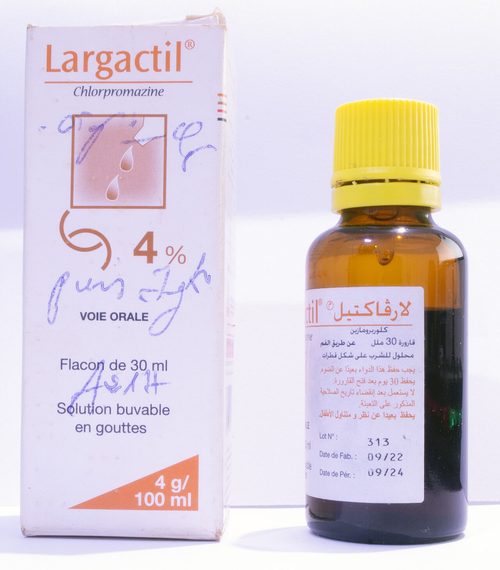 1952–present · Transformed
Chlorpromazine
A French drug tried on psychiatric patients in Paris in 1952. Chlorpromazine calmed psychosis without stupor, emptied wards and began the age of psychiatric drugs, with lasting side-effects.
 1952–1970s · Transformed
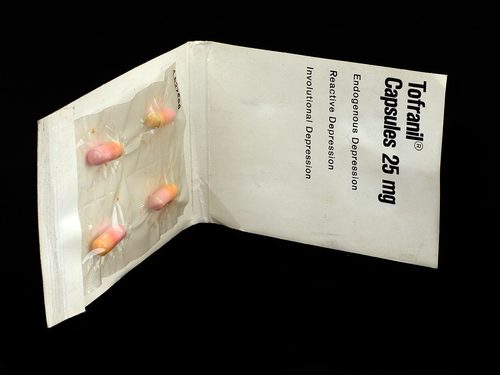
The first antidepressants
Two chance findings of the 1950s, a tuberculosis drug that lifted patients' spirits and a failed antipsychotic tested in a Swiss asylum, gave psychiatry its first antidepressants and a disputed chemical theory.
 1938–present · Transformed
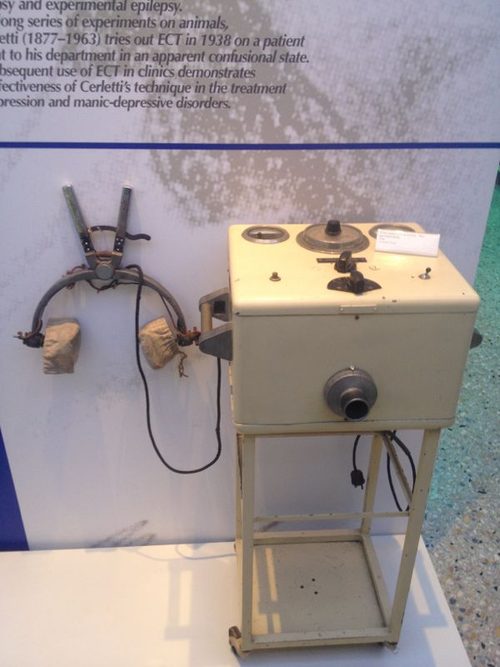
Electroconvulsive therapy, then and now
Ugo Cerletti and Lucio Bini first induced a seizure with electricity in Rome in April 1938. Unmodified ECT injured and frightened many; anaesthesia and muscle relaxants made it a treatment still used today.
 1845–1990
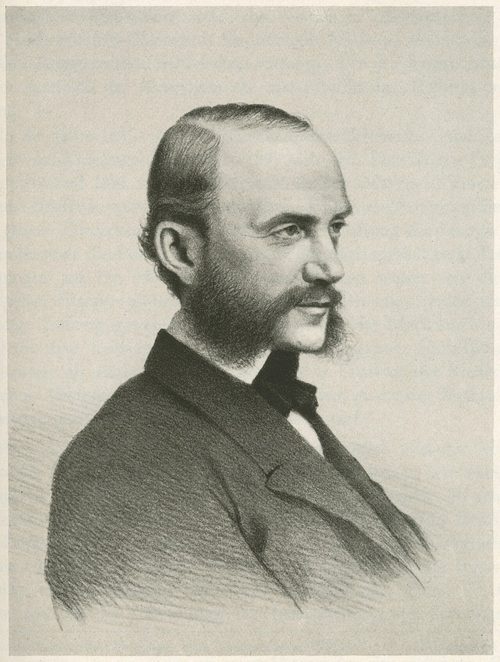
The biological turn
From Griesinger's claim in the 1840s that mental illness is brain disease, through the microscope, the shock therapies and the drug revolution, to DSM-III in 1980: how psychiatry repeatedly turned to the body.