
Treatment · 1952–present
Chlorpromazine
A French drug tried on psychiatric patients in Paris in 1952. Chlorpromazine calmed psychosis without stupor, emptied wards and began the age of psychiatric drugs, with lasting side-effects.
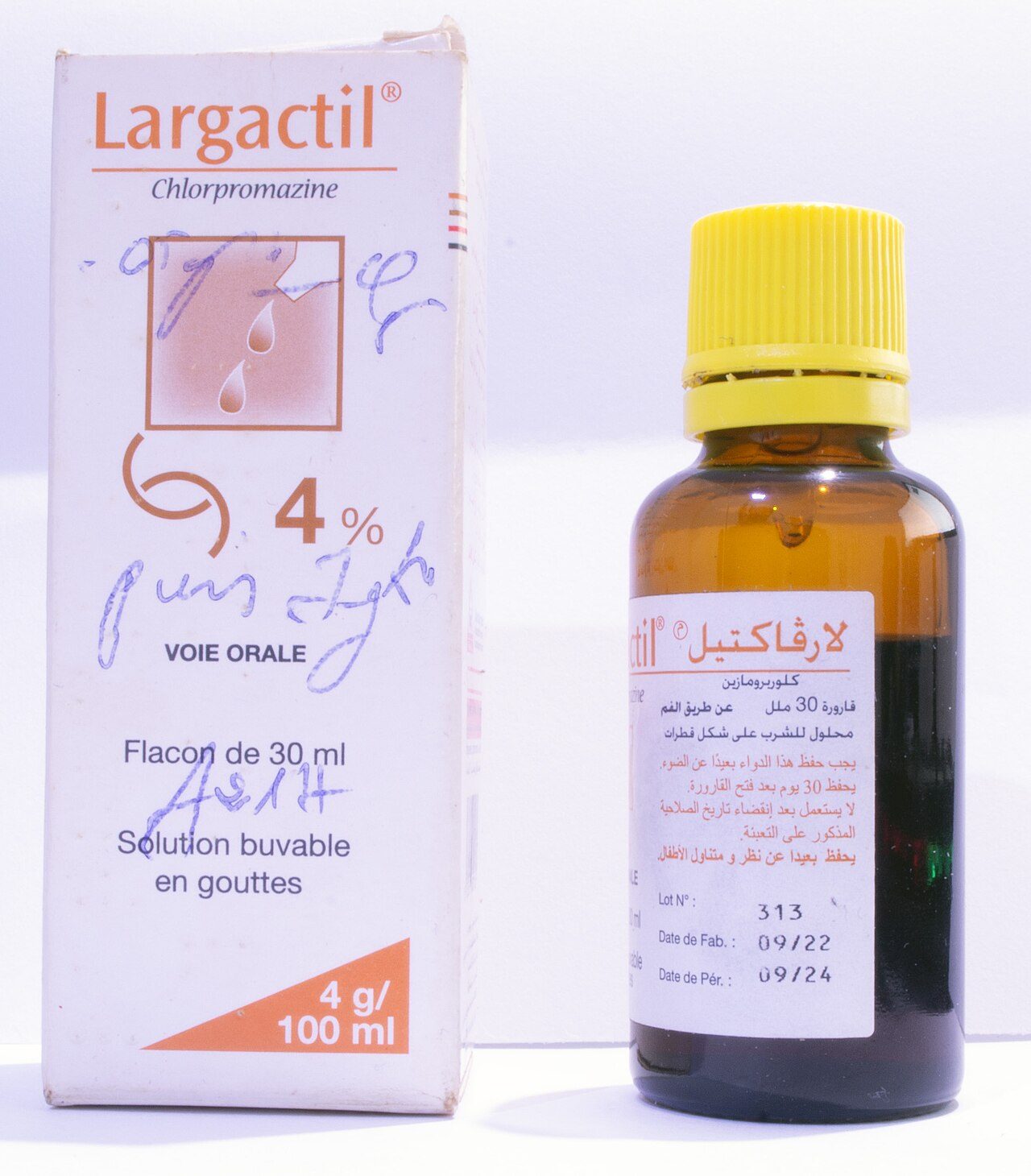
Chlorpromazine was not looked for. It came out of a French pharmaceutical laboratory's search for better antihistamines and a naval surgeon's search for a way to prevent surgical shock, and it reached psychiatry because a few doctors in Paris noticed what it did to people's minds. Within three years it was in use on every continent, and within a decade it had changed what a mental hospital was for3,4.
From the operating theatre
At Rhône-Poulenc, the chemist Paul Charpentier had been modifying promethazine, an antihistamine with strong sedative effects; adding a chlorine atom gave chlorpromazine. The pharmacologist Simone Courvoisier found that it made trained rats ignore the signal they had learned to respond to3,4. Henri Laborit, a surgeon in the French navy, was trying to protect patients from shock during operations with a drug "cocktail" and cooling, a state he called "artificial hibernation". Given chlorpromazine, his patients became calm and curiously detached, "disinterested" without losing consciousness. He persuaded psychiatrists at the Val-de-Grâce military hospital in Paris to try it, and published his first paper on the drug in February 19523,4.
The first psychiatric patient to receive it was a 24-year-old man with severe mania at the Val-de-Grâce, on 19 January 1952. He was also given barbiturates and ECT along the way, but after twenty days of treatment he was judged ready "to resume normal life"3,7. From 24 March 1952, at the Sainte-Anne hospital, Jean Delay and Pierre Deniker gave chlorpromazine alone, at higher doses, to agitated and psychotic patients, first with ice packs on the theory of "hibernation", which they soon found made no difference. In six papers over the following months they described something new: patients became calmer, less driven by hallucinations and delusions, and reachable, while remaining awake and alert3,4.
Largactil and Thorazine
Rhône-Poulenc put the drug on sale in France late in 1952 as Largactil, "large in action", for uses from surgery to nausea3,4. It spread to Switzerland, Britain, Germany, Canada and beyond within three years. In Montreal, Heinz Lehmann, a German-born psychiatrist at the Verdun Protestant Hospital, tested it on patients with long-standing psychosis, and his papers of 1954 and 1955 carried it to North America1,3. Smith, Kline & French, which had licensed the drug, won approval in the United States in 1954 and sold it as Thorazine; within eight months it had been given to more than two million patients4. By 1964 about fifty million people worldwide had taken it7.
For staff on the "disturbed" wards the change was immediate. Chlorpromazine controlled excitement and agitation better than any of the old sedatives, and it largely replaced insulin coma, hydrotherapy and psychosurgery3,7. The drug was also sold as an alternative to surgery: the historian Jack El-Hai notes that Thorazine was at first marketed as a "chemical lobotomy", with similar calming effects and none of the operation's risks, and the use of lobotomy fell away as it spread5. Its effects encouraged the belief, still central to the biological turn, that mental illness could be understood through brain chemistry; research on how it worked led in the 1960s to the theory that such drugs act by blocking dopamine receptors3,4.
The wards empty
The drug arrived just as asylum populations reached their peak. In the United States, public mental hospitals held about 559,000 patients in 1955; by the mid-1960s they held about 452,000, and the fall continued for decades4,6. In England and Wales, the number of patients in mental hospitals fell during 1955 for the first time in years, by 1,047 to 139,440, after rising by an average of 850 a year over the previous five2.
The cost
Chlorpromazine was not the cure early enthusiasts hoped for. Many patients did not respond, and those who did often relapsed when they stopped3. Its side-effects were real and sometimes severe: sedation, dry mouth, falls in blood pressure, weight gain, and, especially with the more potent drugs that followed it, stiffness, tremor and restlessness resembling Parkinson's disease3,7. Patients who took the drug and its successors for years could develop tardive dyskinesia, involuntary movements, often of the mouth, tongue and face, that may persist after the drug is stopped. It was first described in the 1950s and named in 1964; for decades it was underestimated, and it affects a substantial minority of people on the older drugs8.
In 1957 the Lasker Award honoured Laborit, Deniker and Lehmann for their part in it3. Fifty years on, the historian of psychopharmacology Thomas Ban could still call chlorpromazine one of the most reliable antipsychotic drugs: its many successors offered advantages in one side-effect or another, but in his judgement none had surpassed it in effectiveness3.
Key dates
- 1952 Rhône-Poulenc puts chlorpromazine on sale in France as Largactil.
- 19 January 1952 At the Val-de-Grâce military hospital in Paris, chlorpromazine is given for the first time to a psychiatric patient, a young man with mania.
- 13 February 1952 Henri Laborit publishes his first paper on chlorpromazine, describing a strange 'disinterest' in surgical patients.
- 24 March 1952 Jean Delay and Pierre Deniker begin treating patients with chlorpromazine alone at the Sainte-Anne hospital in Paris.
- 1954 Chlorpromazine is approved in the United States and marketed by Smith, Kline & French as Thorazine.
- 1955 The number of patients in English and Welsh mental hospitals falls for the first time in decades; the US state hospital population peaks at about 559,000.
- 1964 The term 'tardive dyskinesia' comes into use for the lasting movement disorder caused by long-term treatment.
Sources
- Primary source H. E. Lehmann, Therapeutic Results with Chlorpromazine (Largactil) in Psychiatric Conditions, Canadian Medical Association Journal 72 (1955).
- Primary source Board of Control (England and Wales), Annual Report of the Board of Control to the Lord Chancellor for the year 1955, London: HMSO (1956).
- Scholarship Thomas A. Ban, Fifty years chlorpromazine: a historical perspective, Neuropsychiatric Disease and Treatment 3(4) (2007).
- Museum or archive Paul Charpentier, Henri-Marie Laborit, Simone Courvoisier, Jean Delay, and Pierre Deniker, Science History Institute.
- Reference The Lobotomist (American Experience), PBS / WGBH (2008).
- Scholarship E. Fuller Torrey, Out of the Shadows: Confronting America's Mental Illness Crisis (excerpt), PBS Frontline / John Wiley & Sons (1997).
- Wikipedia Chlorpromazine, Wikipedia.
- Wikipedia Tardive dyskinesia, Wikipedia.
- Wikipedia Deinstitutionalisation, Wikipedia.
Cross-checked with Wikidata Q407972 and the English Wikipedia article.
Read next
 1935–1960s · Abandoned
Lobotomy
Brain surgery to cut the frontal lobes' connections, begun in Lisbon in 1935 and rewarded with a Nobel Prize in 1949. Tens of thousands were operated on before drugs and evidence of harm ended it.
 1955–2000 · Transformed
Deinstitutionalisation
From the mid-1950s Western countries emptied their great mental hospitals: US public hospitals fell from about 559,000 patients to under 72,000 in forty years. Whether patients were freed or abandoned is still argued.
 1952–1970s · Transformed
The first antidepressants
Two chance findings of the 1950s, a tuberculosis drug that lifted patients' spirits and a failed antipsychotic tested in a Swiss asylum, gave psychiatry its first antidepressants and a disputed chemical theory.
 1949–present · Still in use
Lithium
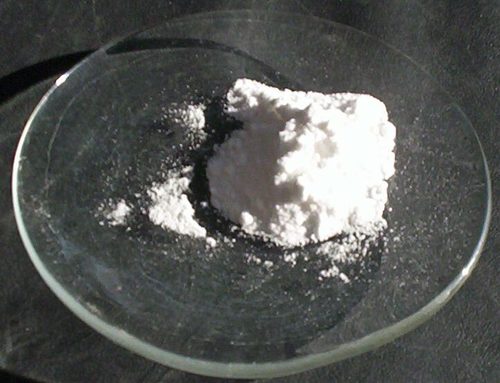
John Cade's 1949 report that lithium calmed mania was nearly buried by fear of poisoning. Mogens Schou's trials, and a bitter dispute with London critics, made it the first drug shown to prevent relapse.
 1938–present · Transformed
Electroconvulsive therapy, then and now
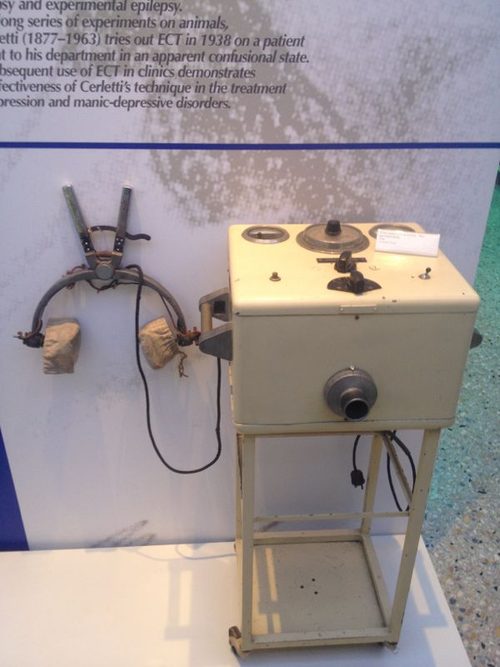
Ugo Cerletti and Lucio Bini first induced a seizure with electricity in Rome in April 1938. Unmodified ECT injured and frightened many; anaesthesia and muscle relaxants made it a treatment still used today.
 1845–1990
The biological turn
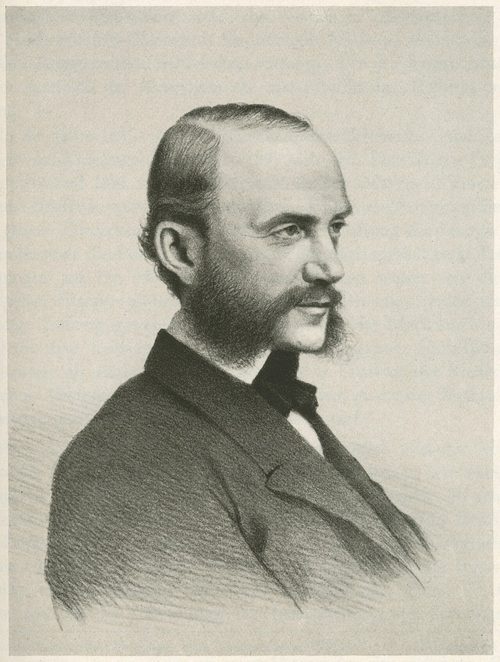
From Griesinger's claim in the 1840s that mental illness is brain disease, through the microscope, the shock therapies and the drug revolution, to DSM-III in 1980: how psychiatry repeatedly turned to the body.
Pages that mention Chlorpromazine
- Essay Counting the confined: asylum populations, 1800–2000
- Person Egas Moniz
- Person John Cade
- Person Walter Freeman
- Place Hanwell Asylum
- Theory Psychoanalysis
- Theory The biological turn
- Treatment Deinstitutionalisation
- Treatment Electroconvulsive therapy, then and now
- Treatment Hydrotherapy
- Treatment Insulin coma therapy
- Treatment Lithium
- Treatment Lobotomy
- Treatment The first antidepressants