
Treatment · 1952–1970s
The first antidepressants
Two chance findings of the 1950s, a tuberculosis drug that lifted patients' spirits and a failed antipsychotic tested in a Swiss asylum, gave psychiatry its first antidepressants and a disputed chemical theory.
Before the 1950s, a person with severe depression in a mental hospital might be given opium, barbiturates, insulin or, from the 1940s, ECT. Nothing taken by mouth reliably lifted the illness itself2. Then, within five years, two quite different drugs were found to do so, both by accident, and both were on the market in 19572,3.
A drug for tuberculosis
The first came from the tuberculosis wards. In 1951 chemists at Hoffmann-La Roche, among others, were developing isoniazid and its close relative iproniazid, and both proved powerful against the tuberculosis bacillus2,3,7. In 1952 the American physicians Irving Selikoff, Edward Robitzek and their colleague Orenstein, testing the drugs on patients with tuberculosis, reported that some became euphoric and overactive; the same year Albert Zeller and his colleagues found that iproniazid blocked monoamine oxidase, an enzyme that breaks down chemical messengers in the brain2,4. Jean Delay in Paris tried isoniazid in depressed patients as early as 19522.
The idea was slow to take hold, partly because the mood effects were inconsistent and partly because psychiatrists did not yet think of depression as something a drug could treat3. In 1957 Nathan Kline's group presented iproniazid, sold as Marsilid, as a "psychic energizer", and it was soon widely prescribed for depression2,3. Its success was brief. Iproniazid damaged the liver and was withdrawn in most countries in 1961; its successors, the monoamine oxidase inhibitors, could cause dangerous rises in blood pressure when combined with foods rich in tyramine such as mature cheese, the "cheese reaction", and with many other drugs. Their use shrank to a minority of patients2,3,7.
A failed antipsychotic
The second came from chlorpromazine. In the rush to find similar drugs, the Swiss firm Geigy sent compounds from a family it had made years before to Roland Kuhn, a psychiatrist at the cantonal asylum of Münsterlingen in north-eastern Switzerland4,6,8. Tested in patients with schizophrenia, the compound numbered G 22355 did not calm them. But in 1956 Kuhn gave it to patients with severe depression, and over a few weeks many of them recovered4. He described the change in the American Journal of Psychiatry in 1958: patients began to seek company again, to take part in games, to laugh, and said that their fatigue and the heaviness in their limbs and chest had gone. He reported no serious side-effects in 500 patients3.
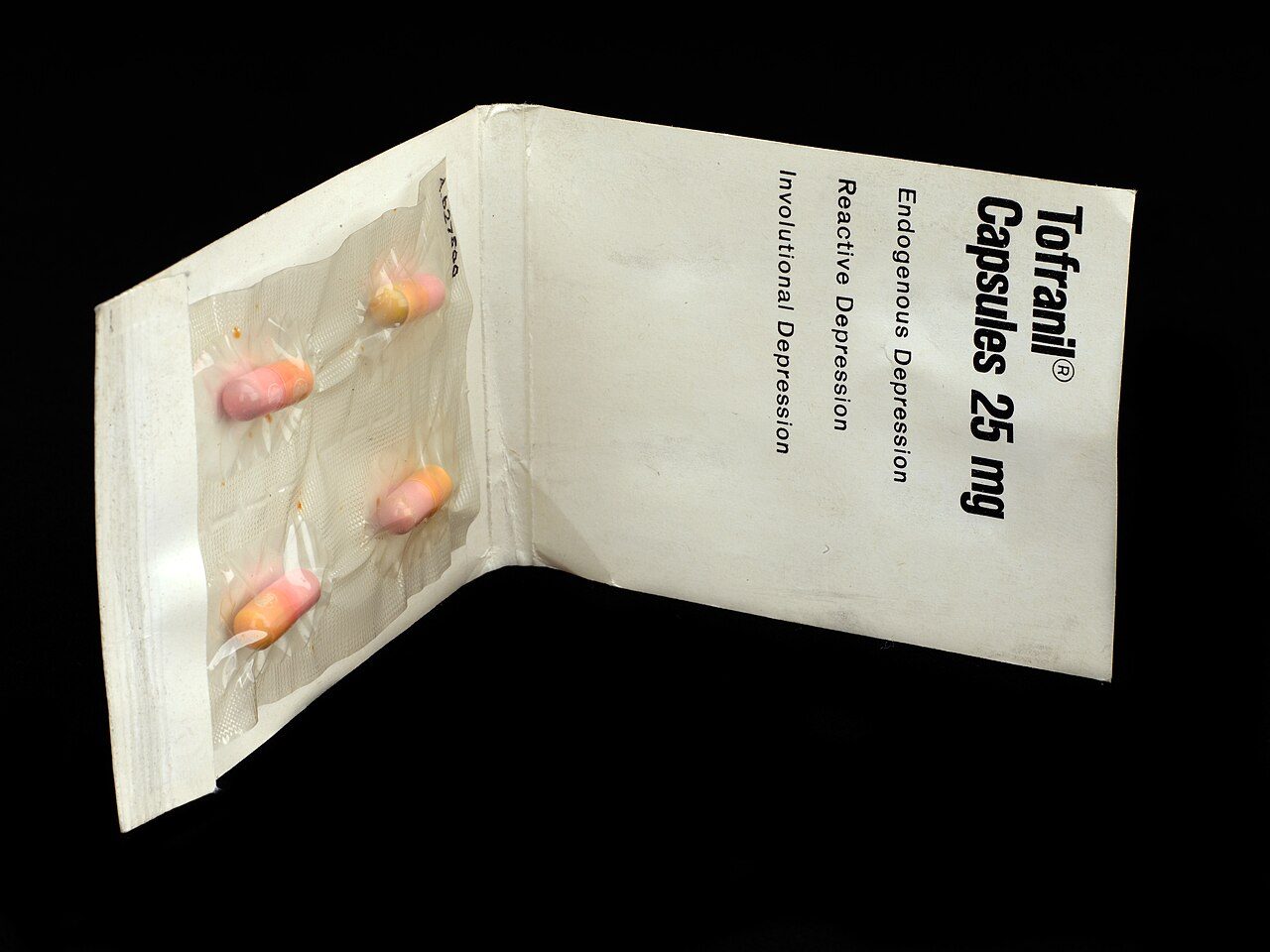
Kuhn published in 1957, and Geigy put the drug on sale that year as Tofranil4. By 1959 Canadian psychiatrists were introducing it to their colleagues as "a new drug for the depressed"1. Imipramine became the first of the "tricyclic" antidepressants, named after the three rings in its structure. Proof of its effect took longer: only in 1965 did Gerald Klerman and Jonathan Cole, pooling 23 studies with about a thousand patients, show that it worked clearly better than placebo, with about two-thirds of patients improving against under a third on placebo2. Its side-effects were considerable, among them dry mouth, constipation and dizziness2.
A chemical theory of mood
The two drugs suggested a theory. Iproniazid stopped the breakdown of monoamines, the brain messengers noradrenaline, serotonin and dopamine; imipramine, it was later found, stopped nerve cells from taking them back up. Reserpine, a blood-pressure drug that depleted the same chemicals, sometimes brought on depression2,3. In 1965 Joseph Schildkraut set out the "catecholamine hypothesis", that depression came from a shortage of noradrenaline in the brain; others argued for serotonin3. The idea shaped drug research for the rest of the century, and in the form of a "chemical imbalance" it became, by the 2010s, what most of the public believed about depression3,5.
Münsterlingen
For decades Kuhn was honoured as one of the founders of psychopharmacology; he directed Münsterlingen from 1971 to 19808. In the 2010s Swiss journalists and historians began to examine what else had happened there. A report commissioned by the canton of Thurgau, published in 2019, found that between 1946 and 1980 at least 3,000 patients had been given at least 67 substances, many of them unlicensed, often without being told what they were taking or asked to agree; among them were children and people with serious chronic illnesses. Some suffered complications and some died, though the causes of the deaths are uncertain. Pharmaceutical companies had paid Kuhn millions of francs for the work6,8. The canton apologised to those who had been tested6.
Key dates
- 1952 American physicians report that the tuberculosis drug iproniazid makes some patients euphoric and overactive; Albert Zeller shows that it blocks the enzyme monoamine oxidase.
- 1956 At the Münsterlingen asylum in Switzerland, Roland Kuhn finds that Geigy's compound G 22355, imipramine, lifts severe depression.
- 1957 Kuhn publishes his findings on imipramine; Geigy markets it as Tofranil. Nathan Kline's group presents iproniazid as a 'psychic energizer'.
- 1961 Iproniazid is withdrawn in most countries because of liver damage.
- 1965 Joseph Schildkraut sets out the catecholamine hypothesis of depression; Gerald Klerman and Jonathan Cole's analysis of 23 trials shows imipramine better than placebo.
- 2019 A report for the canton of Thurgau finds that at least 3,000 patients at Münsterlingen were used to test drugs between 1946 and 1980, rarely with their knowledge.
Sources
- Primary source H. Azima, Imipramine (Tofranil): A New Drug for the Depressed, Canadian Medical Association Journal 80 (1959).
- Scholarship Thomas A. Ban, Pharmacotherapy of depression: a historical analysis, International Network for the History of Neuropsychopharmacology.
- Scholarship Todd M. Hillhouse, Joseph H. Porter, A brief history of the development of antidepressant drugs: From monoamines to glutamate, Experimental and Clinical Psychopharmacology 23(1) (2015).
- Scholarship R. Ramachandraih, et al., Antidepressants: From MAOIs to SSRIs and more, Indian Journal of Psychiatry 53(2) (2011).
- Scholarship Joanna Moncrieff, Ruth E. Cooper, Tom Stockmann, Simone Amendola, Michael P. Hengartner, Mark A. Horowitz, The serotonin theory of depression: a systematic umbrella review of the evidence, Molecular Psychiatry 28 (2022).
- Reference Vast clinical trial undertaken on psychiatric patients in Switzerland, swissinfo.ch (2019).
- Wikipedia Iproniazid, Wikipedia.
- Wikipedia Roland Kuhn, Wikipedia.
Read next
 1952–present · Transformed
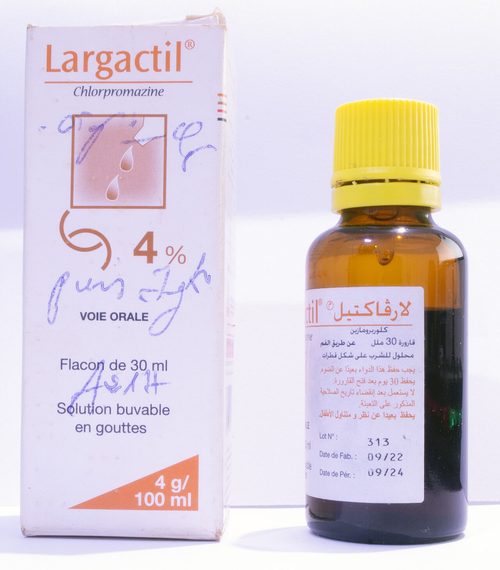
Chlorpromazine
A French drug tried on psychiatric patients in Paris in 1952. Chlorpromazine calmed psychosis without stupor, emptied wards and began the age of psychiatric drugs, with lasting side-effects.
 1949–present · Still in use
Lithium
John Cade's 1949 report that lithium calmed mania was nearly buried by fear of poisoning. Mogens Schou's trials, and a bitter dispute with London critics, made it the first drug shown to prevent relapse.
 1938–present · Transformed
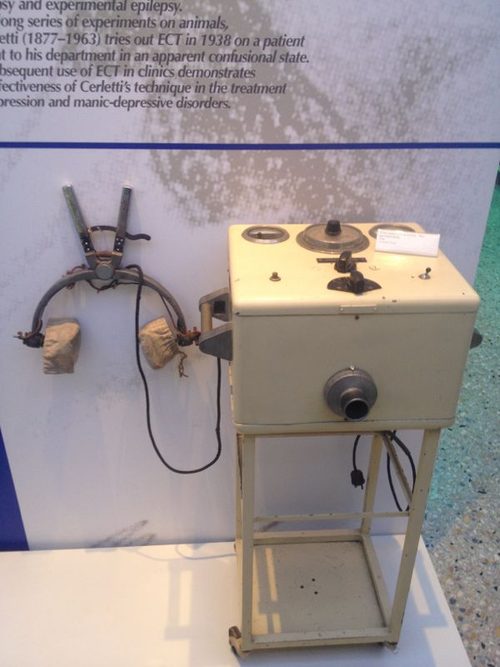
Electroconvulsive therapy, then and now
Ugo Cerletti and Lucio Bini first induced a seizure with electricity in Rome in April 1938. Unmodified ECT injured and frightened many; anaesthesia and muscle relaxants made it a treatment still used today.
 c. 400 BCE–1900s
Melancholia
For two thousand years melancholia meant fear and sorrow without cause, blamed on black bile. How physicians from Aretaeus to Kraepelin defined it, and how it became 'depression'.
 1845–1990
The biological turn
From Griesinger's claim in the 1840s that mental illness is brain disease, through the microscope, the shock therapies and the drug revolution, to DSM-III in 1980: how psychiatry repeatedly turned to the body.
1933–1960s · Abandoned
Insulin coma therapy
From the mid-1930s to the late 1950s, people diagnosed with schizophrenia were put into deep comas with insulin, day after day. A trial in 1957 found the insulin itself did nothing special.