
Person · 30 March 1876 – 9 July 1943
Clifford Beers
Yale graduate and former patient (1876–1943) whose 1908 memoir A Mind That Found Itself exposed abuse in Connecticut asylums and launched the American mental hygiene movement.
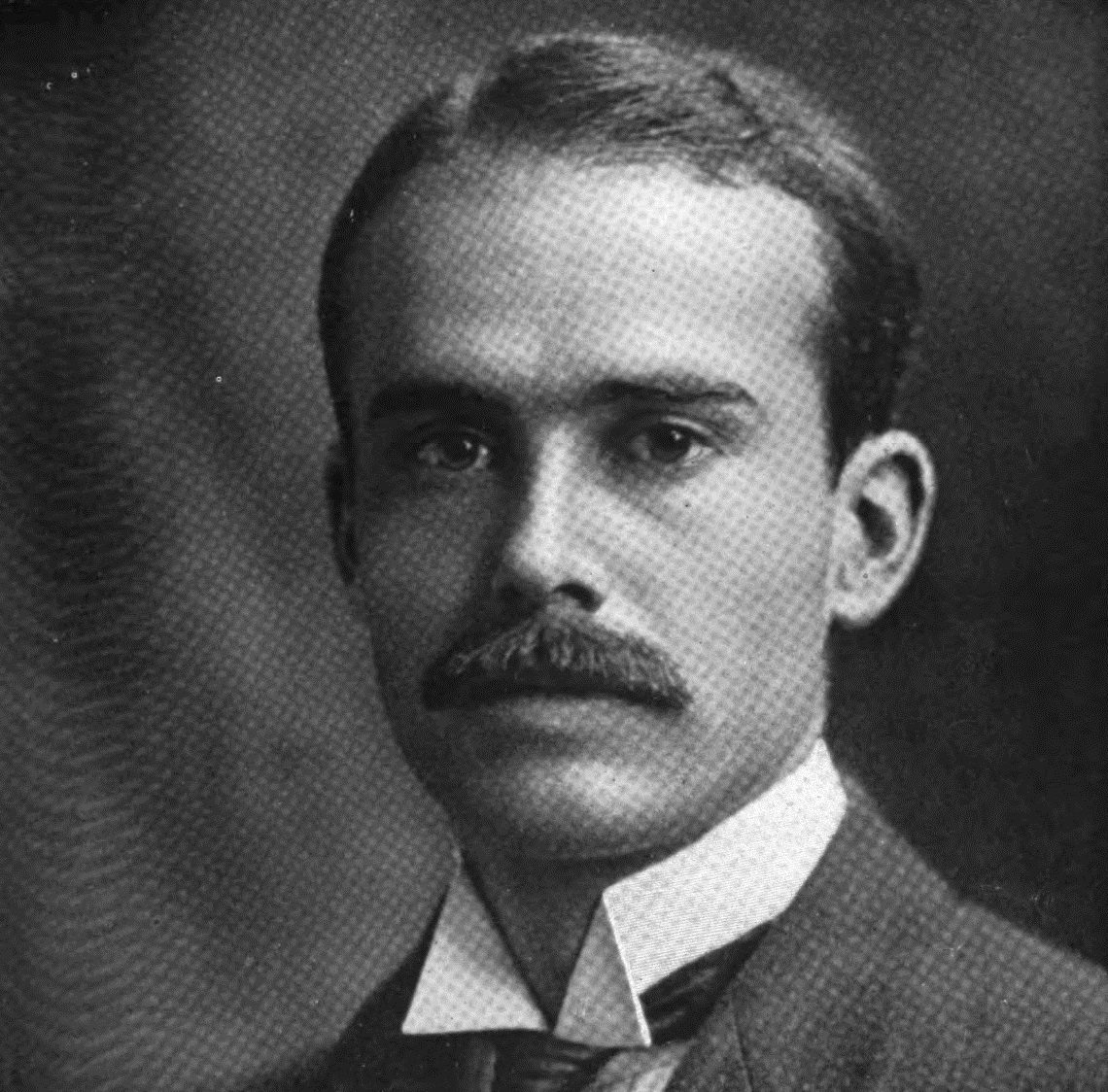
Most people who wrote about American asylums in the early twentieth century had run them. Clifford Beers had been locked in them. His memoir, A Mind That Found Itself, turned three years as a patient into a programme of reform, and the organisation he founded still exists.
A clerk in New York
Beers was born in New Haven, Connecticut, on 30 March 1876, and graduated from Yale's Sheffield Scientific School in 18971,4. He dated the start of his troubles to June 1894, when an older brother was taken ill with what the family believed was epilepsy; the brother died in a Hartford hospital on 4 July 1900, and Beers wrote that a dread of the same illness had haunted him for six years1. By then he was a clerk with a small life insurance company in New York. A bout of influenza in March 1900 left him deeply depressed, and in June 1900 he attempted suicide1,4.
Three years in three institutions
From August 1900 to September 1903 Beers was held in three Connecticut institutions: two private ones, Stamford Hall and the Hartford Retreat, and then the state's public asylum, the Connecticut Hospital for the Insane at Middletown2,4. For long stretches he was convinced that his family were impostors and that detectives were watching him. In the late summer of 1902 depression gave way to an excited, expansive state; doctors of the period would have recognised the pattern, and at least one later account calls his diagnosis manic-depressive1,5.
It was in this state, he wrote, that he resolved to expose how patients were treated, and he sometimes broke the rules deliberately to see the worst for himself1. In the three weeks before his transfer to Middletown on 8 November 1902 he was kept in a padded cell or under guard, and spent, by his count, about three hundred hours in a canvas restraint called a camisole. He had no patience with the euphemism:
A strait-jacket, indeed, is not a camisole, just as electrocution is not hanging.1
Quotation checked against the 1908 text
He recorded assaults by attendants in more than one institution, and in the state hospital's violent ward he was held in cold cells, at times without proper clothing or his drawing and writing materials. On 12 March 1903 he smuggled a long letter of protest to the Governor of Connecticut, who ordered an inquiry1. In it he set out the plan of his life:
I have decided to devote the next few years of my life to correcting abuses now in existence in every asylum in this country.1
Quotation checked against the 1908 text
He was discharged in September 1903 and went back to business in New York1.
The book and the movement
Beers spent several years drafting the book; Yale holds eleven versions of the manuscript3. He sent it to the psychologist William James, who allowed his letter of July 1906 to be printed with it:
As for contents, it is fit to remain in literature as a classic account "from within" of an insane person's psychology.1
Quotation checked against the 1908 text
A Mind That Found Itself appeared in 1908, was widely reviewed, and had gone through some 26 printings by Beers's death5. Its last part was a manifesto: kindness instead of restraint, better-paid and better-trained attendants, and a national society to campaign for both1.
That society came quickly. In 1908 Beers founded the Connecticut Society for Mental Hygiene, a name suggested by the psychiatrist Adolf Meyer, and in 1909 the National Committee for Mental Hygiene in New York, whose secretary he remained until 19393,5. The philanthropist Henry Phipps gave it its first large funds4. The committee moved, under its professional staff, from Beers's original target, the abuse of asylum patients, towards prevention, child guidance and the training of psychiatrists, a shift Dain's biography traces through Beers's sometimes stormy relations with Meyer2. Beers went on to found the American Foundation for Mental Hygiene in 1928 and an International Committee for Mental Hygiene in 1930, the year of the first International Congress on Mental Hygiene2,3,5.
Final years
Beers married Clara Louise Jepson in 19123,6. In 1939 his illness returned, and he was admitted to Butler Hospital in Providence, Rhode Island, where he died on 9 July 19436. Dain's biography gave its last chapter the same title as its first, "Crisis and Collapse"2. The National Committee became the National Association for Mental Health in 1950 and survives as Mental Health America4,6.
His book belongs with the earlier protests of Elizabeth Packard and Nellie Bly, but it did something theirs did not: it made a former patient the founder of a lasting professional movement. The story of patients who answered their doctors in print is told in The patients who wrote back.
Key dates
- 1900 Clifford Beers, a 24-year-old clerk in New York, falls severely ill and begins three years in Connecticut institutions.
- 8 November 1902 Beers is transferred to the Connecticut Hospital for the Insane at Middletown, after weeks of restraint in a strait-jacket.
- 12 March 1903 From a violent ward, Beers smuggles a letter of protest to the Governor of Connecticut, who orders an inquiry.
- 1908 Beers publishes A Mind That Found Itself, with a letter of support from William James, and founds the Connecticut Society for Mental Hygiene.
- 1909 Beers founds the National Committee for Mental Hygiene in New York, the start of the American mental hygiene movement.
- 9 July 1943 Beers dies at Butler Hospital in Providence, Rhode Island, where he had been a patient since 1939.
Beers on this site
Sources
- Primary source Clifford Whittingham Beers, A Mind That Found Itself: An Autobiography, New York: Longmans, Green, and Co. (1908). Quotations checked against this text.
- Scholarship Norman Dain, Clifford W. Beers: Advocate for the Insane, University of Pittsburgh Press (1980).
- Reference Steve Hensen, Guide to the Clifford Whittingham Beers Papers (MS 612), Manuscripts and Archives, Yale University Library (1971).
- Reference Michael Gray, Beers, Clifford Whittingham, Social Welfare History Project, Virginia Commonwealth University Libraries (2008).
- Reference Beers, Clifford, Encyclopedia.com.
- Wikipedia Clifford W. Beers, Wikipedia.
Cross-checked with Wikidata Q1101233 and the English Wikipedia article.
Read next
 1700s–1890s · Transformed
Restraint and the non-restraint movement
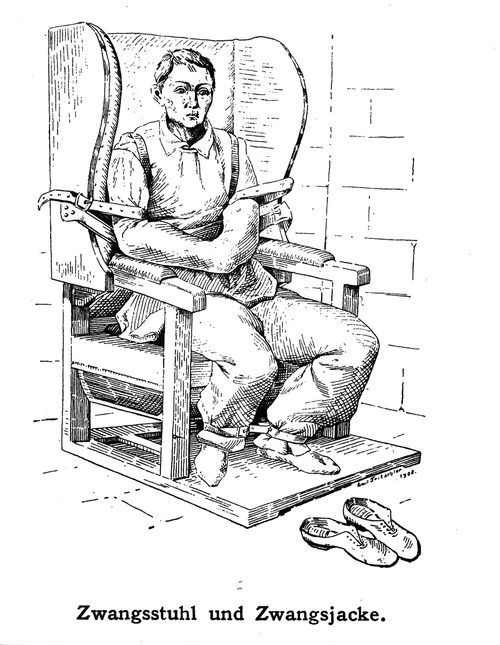
Chains, strait-waistcoats and restraint chairs were the ordinary equipment of asylums until the late 1830s, when Lincoln and then Hanwell abolished them. Britain made non-restraint a doctrine; much of the world did not.
 c. 100 CE–1980
Mania
Mania once meant madness itself: raving, sleepless, sometimes joyful. How the word narrowed from Aretaeus to Kraepelin, and how it became one pole of manic-depressive illness.
 c. 400 BCE–1900s
Melancholia
For two thousand years melancholia meant fear and sorrow without cause, blamed on black bile. How physicians from Aretaeus to Kraepelin defined it, and how it became 'depression'.
 Essay · 8 min
The patients who wrote back
From John Perceval in the 1830s to Clifford Beers in 1908, former patients wrote against the asylum. Their first battle was to be believed at all, and what they won was mostly the right to be heard.
 Essay · 7 min
The rise and fall of the asylum
How the public asylum grew from a few small madhouses into hospitals of thousands, and was then closed: an argument that its failures came from its success at taking in the people no other institution would hold.