
Essay · 1770s–1990s
The rise and fall of the asylum
How the public asylum grew from a few small madhouses into hospitals of thousands, and was then closed: an argument that its failures came from its success at taking in the people no other institution would hold.
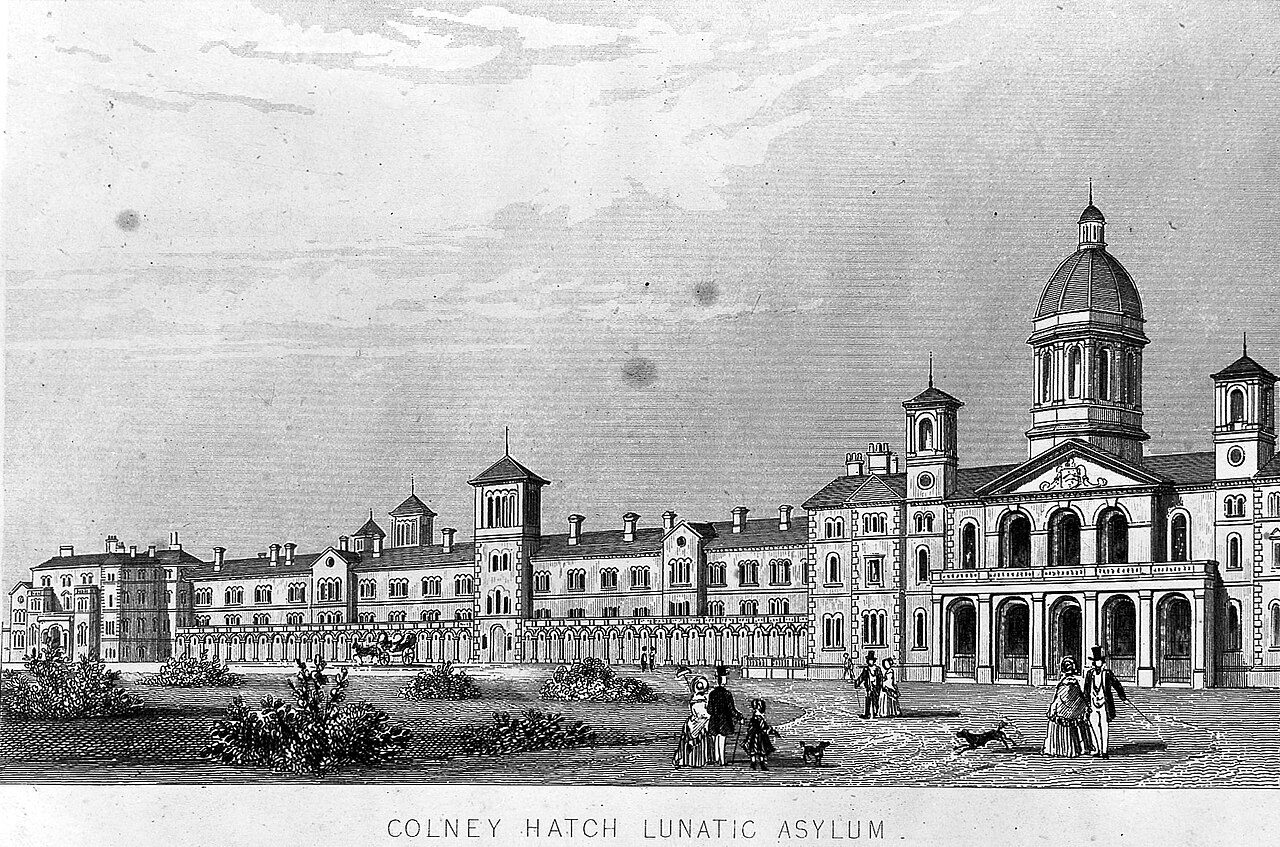
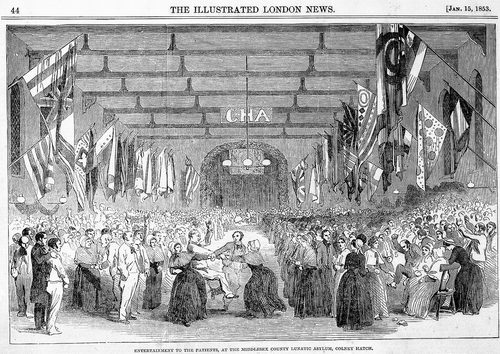
In 1993 Friern Hospital in north London closed its doors. It had opened in 1851 as Colney Hatch, one of the largest of the Victorian county asylums, and for a century and a half it had been a fixture of the city's outskirts, as such buildings were on the edge of almost every town in England. By the time it closed, most of the others had closed too, and the number of psychiatric beds in England had fallen from a high of 152,000 in 1954 to 43,0005,9. A building type that had taken a century to spread across Europe and North America was dismantled in a generation.
The usual story of the asylum has two villains, or two heroes, depending on who tells it. In one, humane reformers built hospitals that were later starved and corrupted; in the other, a society that wanted its troublesome members out of sight built prisons and called them hospitals. This essay argues something narrower. The public asylum failed in the way it did because it succeeded at a task nobody had quite given it: it became the one institution obliged to take people whom families, workhouses, almshouses and prisons would not or could not keep, and most of those people did not leave. Its overcrowding, its custodial routine and much of what its critics later attacked followed from that.
Before the asylum
For most of history, people with severe mental illness lived with their families, wandered, or ended up in whatever institution would take them. Bethlem in London had held people "taken in mind" since about 1400, but it was small2. In eighteenth-century England most of those who were confined at all were in small private madhouses, a trade run by doctors and laymen alike, often for families of means1. Andrew Scull, summarising Roy Porter's work on the period, puts the number confined around 1800 at somewhere between two and three thousand for the whole country1.
The confinement that did happen came later, and it came first as reform.
Building the cure
The reforming idea was that madness could be cured, especially if treated early, in a calm, orderly place away from home. Pinel in Paris and William Tuke's Retreat at York gave it the name moral treatment; at Hanwell John Conolly showed that a large public asylum could do without chains and straps. In England an Act of 1808 allowed counties to build asylums for paupers out of the local rates, and a minority did. A national inquiry in 1844 found asylums of every quality, from well-run establishments in open grounds to mean buildings in town centres, and in 1845 Parliament created a permanent Lunacy Commission to inspect them3,5. The Home Secretary, Sir James Graham, told the Commons that "the period had arrived" when asylum provision "ought to be compulsory", and that parishes would gain by it within ten years4. In 1847 England and Wales had 21 county asylums holding 5,486 people5.
In the United States Dorothea Dix used the same arguments, legislature by legislature, and Thomas Kirkbride gave the movement its building (The Kirkbride asylums). His plan of 1854 was explicit about size: 250 patients were as many as a superintendent could visit properly each day6. It was explicit, too, about who would fill those beds:
In State institutions, when full, at least one half of all the cases will commonly be of a chronic character, and require little medical treatment.6
Quotation checked against the 1854 text
Kirkbride expected that. He did not foresee that the chronic patients would stay for decades while new ones kept arriving, and that the hospitals would be enlarged again and again to hold them.
Filling up
The English commissioners saw the danger before the building boom began. Parishes kept poor patients in the workhouse until they were unmanageable, and sent them to the asylum when it was too late to help, a practice that, they wrote in 1844, had gone far towards
converting them into a permanent refuge for the insane, instead of hospitals for their relief or cure.3
Quotation checked against the 1844 text
The Act of 1845 made the problem national. The asylum was now the place where a county was obliged to send its insane poor, and many of those it received were old, chronically ill, epileptic, intellectually disabled, or dying of general paralysis. Some recovered and went home; many did not. By 1 January 1914 England and Wales had 97 county and borough asylums containing 105,504 people, more than a thousand in each on average, four times Kirkbride's maximum5. How those numbers grew, and what they did and did not measure, is the subject of Counting the confined: asylum populations, 1800–2000.
The American asylum filled for the same reasons. Between 1890 and the end of 1903 the number of patients in American hospitals for the insane doubled, to 150,151 in 328 hospitals7. The census office attributed the rise not to more insanity but to more hospitals, to laws that took insane people out of almshouses, and to the replacement of the old idea of a refuge by "the modern idea of a curative establishment for the sick"7. That last phrase is the paradox in small. The curative ideal was what made legislatures willing to build, and families willing to send; the people sent were often those for whom no cure existed.
Once full, the asylum changed its character. A superintendent with two thousand patients could not know them as moral treatment required, and by the end of the nineteenth century the hope of cure had given way to theories of inherited degeneration that explained why patients did not leave. The overcrowding was not a betrayal of the asylum's purpose by later, meaner administrators. It was the purpose meeting the population.
The case against the asylum
By the 1950s the American state and county hospitals held about 559,000 people, and the mental hospitals of England had some 152,000 beds10,9. The critique that followed came from several directions at once. In 1956 the sociologist Ivan Belknap suggested that abandoning the state hospitals might be both a great humanitarian reform and a great economy8. In 1961 Erving Goffman's Asylums grouped the mental hospital with prisons and concentration camps as a "total institution", and portrayed it as inherently anti-therapeutic, damaging the people it claimed to treat8. In the same year Thomas Szasz argued in The Myth of Mental Illness that mental illness was a metaphor and psychiatrists were agents of social control, and Foucault's history appeared in Paris; in 1967 R. D. Laing suggested that the madness was society's8. In Italy Franco Basaglia read Goffman and Foucault at Gorizia and set out not to reform the asylum but to abolish it.
The critics described something real. What they tended to leave out was why the asylum had become what it was: the people on its back wards had been sent there because other institutions, and often their families, could not manage them. In 1973 the Rosenhan study seemed to show that such hospitals could not tell the sane from the insane; its reliability is now in serious doubt, but it struck a public already persuaded that the asylum was itself the illness8.
Closing the doors, and where people went
Closure came by different routes. In Britain it was planned from the early 1960s and carried out slowly, then quickly, under "care in the community"; England had 130 mental hospitals in 1960 and 41 when Friern closed9. In the United States the largest falls came between 1965 and 1980, after Medicaid and federal income support made it cheaper for states to move patients out10. Italy closed its public mental hospitals to new admissions in 1978. The stages and the arguments about causes are set out under deinstitutionalisation.
The people the asylum had absorbed did not disappear. Mechanic and Rochefort noted that many elderly patients were transferred from American state hospitals into nursing homes in the 1960s and 1970s, and that general hospitals became the main providers of acute inpatient care10. Taylor, writing of her own time as a patient at Friern in the late 1980s, notes that the transfer took place in a climate increasingly hostile to dependence on welfare, and that while many former residents went home or to group homes, some ended among the urban homeless9. Historians remain divided between those who see the asylums as instruments of control and those who stress the humane intentions of their founders9.
The asylum's history suggests a test for whatever replaced it. The Victorian asylum was not built to be a warehouse. It became one because it was the institution of last resort, and an institution of last resort keeps the people every other institution turns away. When the asylums closed, that role did not close with them; it passed, less visibly, to nursing homes, hostels and families and, critics argue, to prisons and the street.
Key dates
- 27 April 1656 A royal edict creates the Hôpital général of Paris, the institution at the centre of Michel Foucault's 'Great Confinement'.
- 1844 The Metropolitan Commissioners in Lunacy report that England's public asylums are 'filled with incurable patients'.
- 1845 Parliament creates the Lunacy Commission and passes the County Asylums Act, making asylum provision compulsory for counties and boroughs.
- 1854 Thomas Kirkbride sets 250 patients as the most a state hospital should hold.
- 1 January 1914 England and Wales have 97 county and borough asylums holding 105,504 people.
- 1961 Erving Goffman's Asylums, Thomas Szasz's The Myth of Mental Illness and Michel Foucault's history of madness are published.
- 1993 Friern Hospital, formerly Colney Hatch Asylum in north London, closes.
Sources
- Scholarship Andrew Scull, Keepers (review of Roy Porter, Mind-Forg'd Manacles, and other books), London Review of Books 10(17) (1988-09-29).
- Scholarship Roy Porter, Lunatic ideas and the truth about asylums, Times Higher Education (1997-10-10).
- Primary source Metropolitan Commissioners in Lunacy, Report of the Metropolitan Commissioners in Lunacy to the Lord Chancellor, London: Bradbury and Evans (1844). Quotations checked against this text.
- Official Lunatic Asylums, HC Deb 23 June 1845 vol 81 cc1102-4, Hansard (UK Parliament) (1845-06-23).
- Primary source Commissioners in Lunacy (England and Wales), Sixty-eighth Report of the Commissioners in Lunacy to the Lord Chancellor, London: HMSO (1914). Quotations checked against this text.
- Primary source Thomas S. Kirkbride, On the Construction, Organization, and General Arrangements of Hospitals for the Insane, Philadelphia (1854). Quotations checked against this text.
- Primary source U.S. Bureau of the Census, Insane and Feeble-Minded in Hospitals and Institutions, 1904, Washington: Government Printing Office (1906). Quotations checked against this text.
- Scholarship Andrew Scull, Rosenhan revisited: successful scientific fraud, History of Psychiatry 34(2) (2023).
- Scholarship Barbara Taylor, The demise of the asylum in late twentieth-century Britain: a personal history, Transactions of the Royal Historical Society 21 (2011).
- Scholarship David Mechanic, David A. Rochefort, Deinstitutionalization: an appraisal of reform, Annual Review of Sociology 16 (1990).
Cross-checked with Wikidata Q210999 and the English Wikipedia article.
Read next
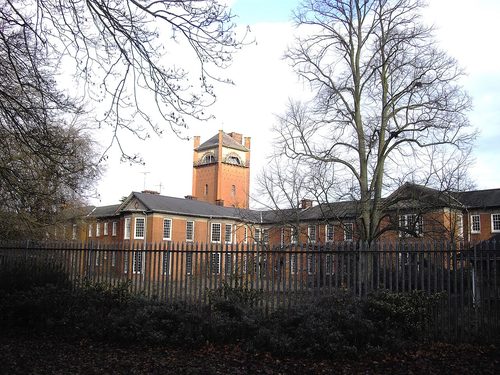 Essay · 8 min
Counting the confined: asylum populations, 1800–2000
Asylum numbers in England and the United States rose for a century and then fell by three-quarters or more. What the official counts measured was how long people stayed, not how many fell ill, as their own compilers warned.
 1955–2000 · Transformed
Deinstitutionalisation
From the mid-1950s Western countries emptied their great mental hospitals: US public hospitals fell from about 559,000 patients to under 72,000 in forty years. Whether patients were freed or abandoned is still argued.
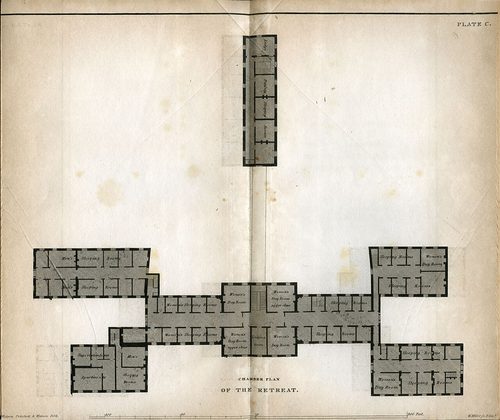 1790s–1870s · Transformed
Moral treatment
Moral treatment, developed at Bicêtre in Paris and the York Retreat in the 1790s, tried to cure madness through kindness, routine, work and self-control rather than chains and drugs. It shaped a century of asylums.
 Essay · 7 min
Who got locked up, and why
Asylum populations were never a simple sample of the mentally ill. Poverty, family, the Poor Law, sex, migration, race, age and bodily disease all decided who was confined, and historians still argue over how much each counted.
Essay · 7 min
"On being sane in insane places": Rosenhan's study and its challengers
In 1973 David Rosenhan reported that eight sane people were admitted to psychiatric hospitals by claiming to hear voices. The study helped reshape American psychiatry; later research suggests it was not done as described.
Pages that mention The rise and fall of the asylum
- Essay "On being sane in insane places": Rosenhan's study and its challengers
- Essay Counting the confined: asylum populations, 1800–2000
- Essay The patients who wrote back
- Essay Who got locked up, and why
- Person Clifford Beers
- Person Dorothea Dix
- Person Elizabeth Packard
- Person Franco Basaglia
- Person Jean-Étienne Esquirol
- Person John Conolly
- Person Nellie Bly
- Person Thomas Story Kirkbride
- Person William Tuke
- Place Bethlem Hospital ("Bedlam")
- Place Bicêtre and the unchaining
- Place Geel and family care
- Place Hanwell Asylum
- Place The Kirkbride asylums
- Place The Narrenturm, Vienna
- Place The York Retreat
- Place The asylum on Blackwell's Island
- Place Willowbrook State School
- Treatment Deinstitutionalisation
- Treatment Moral treatment
- Treatment Restraint and the non-restraint movement