
Person · 28 December 1816 – 25 July 1897
Elizabeth Packard
Minister's wife (1816–1897) committed to the Illinois asylum by her husband in 1860 under a law that needed no evidence; found sane by a jury in 1864, she campaigned for decades to change commitment laws.
Early on the morning of 18 June 1860, Elizabeth Packard saw her husband coming to her door at Manteno, Illinois, with two physicians from his congregation and the county sheriff. The doctors took her pulse, asked her nothing, and pronounced her insane; she was carried to the railway station and taken to the state asylum at Jacksonville1. It was, she wrote later, "the only medical examination I had"1. Then, and for the rest of her life, she wrote it all down.
A wife under Illinois law
Elizabeth Parsons Ware was born on 28 December 1816 in Ware, Massachusetts, the daughter of a Congregational minister. In 1839 she married the Reverend Theophilus Packard, a strict Calvinist fourteen years older, and they had six children7. By the late 1850s, in Illinois, she was openly rejecting his theology, defending her views in his Bible class, and disagreeing with him about slavery, money and the children3,7. Her husband concluded that she was insane.
He did not need to prove it. An Illinois statute of 1851 had removed, for married women, the right to a hearing that the state's earlier law gave anyone accused of insanity3. Packard printed its words in her books:
Married women and infants who, in the judgment of the medical Superintendent ... are evidently insane or distracted, may be entered or detained in the hospital on the request of the husband of the woman, or the guardian of the infant, without the evidence of insanity required in other cases.2
Quotation checked against the 1868 text
She described what had happened to her in the language of rights:
I regarded the principle of religious tolerance as the vital principle on which our government was based, and I in my ignorance supposed this right was protected to all American citizens, even to the wives of clergymen.1
Quotation checked against the 1867 text
Jacksonville
She spent about three years in the asylum. At first she was well treated, but she refused to accept that she was insane, and she began writing a document in defence of her fellow patients' rights. The superintendent, Andrew McFarland, then moved her to the Eighth ward, among the most disturbed patients2,3. "You may occupy this ward, Mrs. Packard," she remembered him saying as he left her behind the lock2. She stayed there until her discharge, observing and recording the treatment of the women around her2.
In June 1863 the asylum released her as incurable. Her husband locked her in the nursery of their house. She dropped a letter from the window, and friends took it to Judge Charles Starr in Kankakee, who issued a writ of habeas corpus and then took the unusual step of putting the question of her sanity to a jury3,4. Witnesses from her husband's family and church cited her religious opinions and her disobedience; neighbours, and the physician Dr Duncanson, who had talked with her for three hours, said she was sane3,4. She read her Bible-class essay to the court. On 18 January 1864 the jury retired, and after seven minutes returned its verdict1:
We, the undersigned, Jurors in the case of Mrs. Elizabeth P. W. Packard, alleged to be insane, having heard the evidence in the case, are satisfied that said Elizabeth P. W. Packard is sane.1
Quotation checked against the 1867 text
The campaign
Her husband had meanwhile rented out their house, sold her furniture and taken the children to Massachusetts; as a married woman she had no legal claim to either7. She never lived with him again4. Instead she published a series of books, travelled the country lobbying legislators in person, and became a national figure5. In 1867 Illinois passed "An Act for the Protection of Personal Liberty", known as Mrs Packard's law, which gave everyone accused of insanity, wives included, a jury trial; it was under this law that Mary Todd Lincoln was tried in 18753. Packard is credited with influencing some 34 bills in state legislatures, including a law of 1875 giving asylum patients access to the mail, and she also campaigned for married women's rights to their earnings and children3,5. She died in Chicago on 25 July 18974,7.
In 2023 the state of Illinois removed McFarland's name from its mental health centre in Springfield and gave it hers6. She is one of the first in a line of patients who wrote back, and her method, testimony from inside, was taken up two decades later by Nellie Bly.
Key dates
- 15 February 1851 An Illinois law allows a husband to have his wife admitted to the state hospital without the evidence of insanity required in other cases.
- 18 June 1860 Elizabeth Packard is taken from her home in Manteno, Illinois, to the state asylum at Jacksonville at her husband's request.
- June 1863 The asylum discharges Packard as incurable; her husband confines her at home.
- 18 January 1864 After a five-day hearing at Kankakee, a jury finds Packard sane after seven minutes.
- 1867 Illinois passes 'An Act for the Protection of Personal Liberty', giving everyone accused of insanity a jury trial.
- 1868 Packard publishes The Prisoners' Hidden Life, or Insane Asylums Unveiled.
- 25 July 1897 Packard dies in Chicago.
- 9 August 2023 Illinois renames the McFarland Mental Health Center in Springfield after Packard.
Packard on this site
Sources
- Primary source E. P. W. Packard, Marital Power Exemplified in Mrs. Packard's Trial, and Self-Defence from the Charge of Insanity, Hartford: Case, Lockwood & Brainard (1867). Quotations checked against this text.
- Primary source E. P. W. Packard, The Prisoners' Hidden Life, or Insane Asylums Unveiled, Chicago: the author (1868). Quotations checked against this text.
- Official Illinois Supreme Court history: Elizabeth Packard and mental health laws, Illinois Courts.
- Museum or archive Elizabeth Packard: legal and mental health reformer, Illinois History and Lincoln Collections, University of Illinois Library (2019-03-28).
- Scholarship Kathryn Burns-Howard, 'Slaves of the Marriage Union', The New York Times, Disunion (2013-06-19).
- Reference Maureen Foertsch McKinney, He oppressed her, and the state takes his name off a mental health center, NPR Illinois (2023-08-09).
- Wikipedia Elizabeth Packard, Wikipedia.
Cross-checked with Wikidata Q5363300 and the English Wikipedia article.
Read next
 Essay · 8 min
The patients who wrote back
From John Perceval in the 1830s to Clifford Beers in 1908, former patients wrote against the asylum. Their first battle was to be believed at all, and what they won was mostly the right to be heard.
 Essay · 7 min
Who got locked up, and why
Asylum populations were never a simple sample of the mentally ill. Poverty, family, the Poor Law, sex, migration, race, age and bodily disease all decided who was confined, and historians still argue over how much each counted.
 Essay · 7 min
The rise and fall of the asylum
How the public asylum grew from a few small madhouses into hospitals of thousands, and was then closed: an argument that its failures came from its success at taking in the people no other institution would hold.
 1790s–1870s · Transformed
Moral treatment
Moral treatment, developed at Bicêtre in Paris and the York Retreat in the 1790s, tried to cure madness through kindness, routine, work and self-control rather than chains and drugs. It shaped a century of asylums.
 United States · 1839
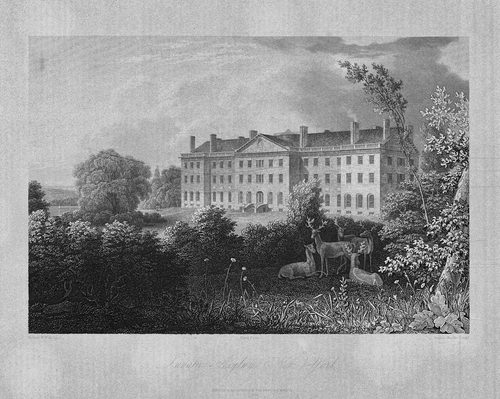
The asylum on Blackwell's Island
New York City's first public asylum, opened in 1839 on an East River island beside a prison and workhouse; Dickens found it painful in 1842 and Nellie Bly exposed it in 1887. Its Octagon tower survives.