
Person · 29 September 1745 – 7 April 1811
Jean-Baptiste Pussin
A tanner who came to Bicêtre as a patient, became governor of its ward for insane men, taught Pinel moral treatment and in 1797 replaced the chains there with strait-waistcoats. He died at the Salpêtrière in 1811.
Almost everything known about Jean-Baptiste Pussin comes from three kinds of record: the registers of the Paris hospitals, a short report he wrote in 1797, and the pages that Philippe Pinel devoted to him. Together they show the man who did much of what Pinel became famous for.
From patient to governor
Pussin was born in September 1745 at Lons-le-Saunier in the Jura, the son of a master tanner, and worked as a tanner himself until he was 252,4. On 5 June 1771 he was admitted to Bicêtre, the vast hospice for poor men outside Paris, as an incurable suffering from scrofula, a tuberculous disease of the glands of the neck2,5. He recovered, and stayed. From 1780 he held a junior post in the hospice, and on 3 September 1785 he was made governor of the emploi Saint-Prix, the ward for insane men2.
He ran it with his wife, Marguerite Jubline. No doctor visited the ward regularly; patients were discharged on the governor's word2. When food ran short in 1791, he raised the daily bread ration for men who were dying of exhaustion3. Pinel later described Madame Pussin calming the most disturbed patients and persuading them to eat when they had refused food from everyone else5.
Teaching Pinel
Pinel arrived as physician in September 1793 and recognised what he had found:
Thus was I introduced to a man, whose friendship was an invaluable acquisition to me. Our acquaintance matured into the closest intimacy.1
Quotation checked against the 1806 text
Pinel's Treatise is full of Pussin's methods: firmness without blows, close knowledge of each man's delusions, and theatre when needed. When a man with religious melancholia had refused all food for days, Pussin staged a scene at his door one night:
Citizen Pussin appeared one night at the door of his chamber, and, with fire darting from his eyes, and thunder in his voice, commanded a group of domestics, who were armed with strong and loudly clanking chains, to do their duty.1
Quotation checked against the 1806 text
The threat was never carried out; the soup was left with orders to eat it by morning, and he did, and recovered1. It is a reminder that moral treatment used fear as well as kindness.
The chains
Pinel left for the Salpêtrière in 1795. In 1798 he asked the minister of the interior to send Pussin to help him there, with testimonials from senior physicians: one called Pussin "the only man capable of seconding Pinel in his undertaking" (our translation). He enclosed a report by Pussin, who wrote that in prairial of the year V, that is May–June 1797, he had managed to do away with the chains used to hold the most agitated men and had replaced them with strait-waistcoats that left them free to walk about2. The letter and report were lost in the minister's private papers until Dora Weiner found and published them in 19796,2.
At the Salpêtrière
Pussin finally took charge of the women's insane division at the Salpêtrière on 27 March 18022. Pinel called him the "chief of internal police" and insisted that his judgements on order, discipline and even family visits should be final and without appeal, whatever a doctor might want2. Pussin died on 7 April 18112,3. Three days later Pinel proposed his own pupil, the physician Jean-Étienne Esquirol, for the post. The historians Marcel Gauchet and Gladys Swain took that handover, from a self-taught keeper to a doctor, as the moment the asylum became a fully medical institution2. In 1936, when histories of nursing did not mention him, the nurse and historian Elizabeth Bixler claimed him as a forerunner of the psychiatric nurse5.
Key dates
- 5 June 1771 Pussin, a 25-year-old tanner, is admitted to Bicêtre as a patient with scrofula.
- 3 September 1785 Pussin is made governor of Bicêtre's ward for insane men, the emploi Saint-Prix.
- September 1793 Philippe Pinel arrives at Bicêtre and begins to learn from Pussin's methods.
- 1797 Pussin replaces the chains used on the most agitated men with strait-waistcoats.
- 27 March 1802 Pussin takes charge of the division for insane women at the Salpêtrière.
- 7 April 1811 Pussin dies; Esquirol, a physician, takes over his post.
Pussin on this site
Sources
- Primary source Philippe Pinel, A Treatise on Insanity (trans. D. D. Davis), Sheffield: W. Todd (1806). Quotations checked against this text.
- Scholarship Jack Juchet and Jacques Postel, Le « surveillant » Jean-Baptiste Pussin à la Salpêtrière, Histoire des sciences médicales 30(2) (1996).
- Scholarship Jean-Pierre Schuster, Nicolas Hoertel and Frédéric Limosin, The man behind Philippe Pinel: Jean-Baptiste Pussin (1746–1811), The British Journal of Psychiatry 198(3) (2011).
- Reference Robin Pape and Burkhart Brückner, Pussin, Jean-Baptiste, Biographical Archive of Psychiatry (BIAPSY).
- Scholarship Elizabeth S. Bixler, A forerunner of psychiatric nursing: Jean-Baptiste Pussin, Annals of Medical History, new series 8 (1936).
- Scholarship Dora B. Weiner, The apprenticeship of Philippe Pinel: a new document, 'Observations of Citizen Pussin on the insane', American Journal of Psychiatry 136(9) (1979).
Cross-checked with Wikidata Q3164384 and the English Wikipedia article.
Read next
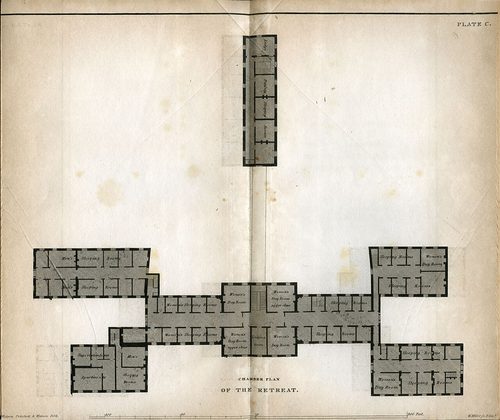 1790s–1870s · Transformed
Moral treatment
Moral treatment, developed at Bicêtre in Paris and the York Retreat in the 1790s, tried to cure madness through kindness, routine, work and self-control rather than chains and drugs. It shaped a century of asylums.
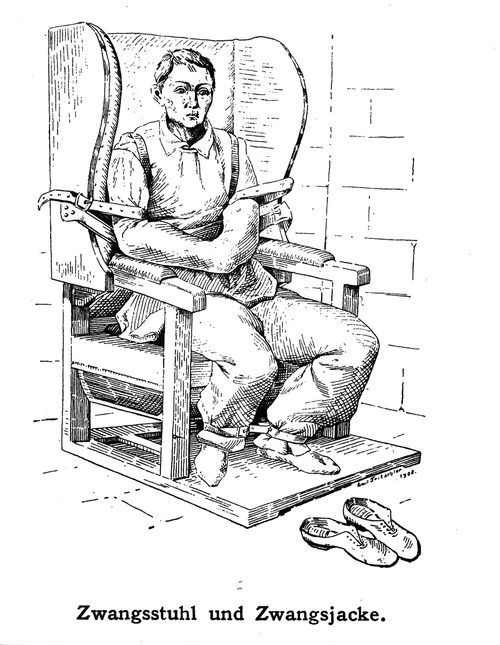 1700s–1890s · Transformed
Restraint and the non-restraint movement
Chains, strait-waistcoats and restraint chairs were the ordinary equipment of asylums until the late 1830s, when Lincoln and then Hanwell abolished them. Britain made non-restraint a doctrine; much of the world did not.
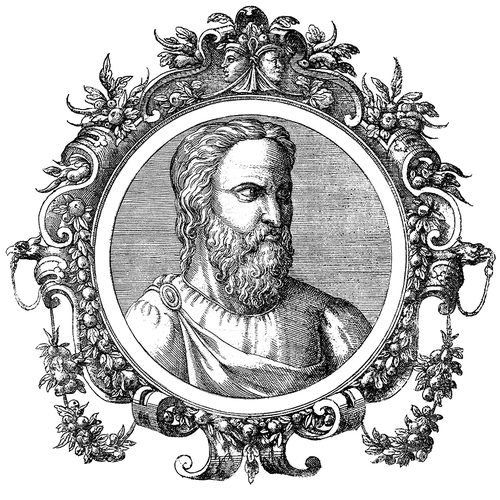 c. 100 CE–1980
Mania
Mania once meant madness itself: raving, sleepless, sometimes joyful. How the word narrowed from Aretaeus to Kraepelin, and how it became one pole of manic-depressive illness.
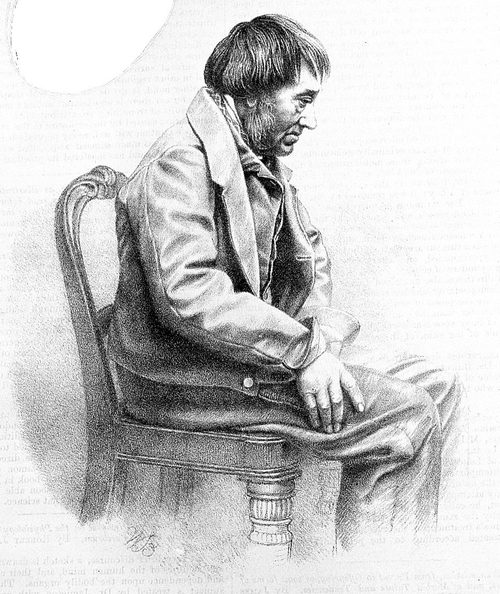 c. 400 BCE–1900s
Melancholia
For two thousand years melancholia meant fear and sorrow without cause, blamed on black bile. How physicians from Aretaeus to Kraepelin defined it, and how it became 'depression'.