
Place · 1656 – today
Bicêtre and the unchaining
The hospice south of Paris where Jean-Baptiste Pussin ran the ward for insane men, Philippe Pinel learned his trade in 1793–95, and chains were replaced by strait-waistcoats in 1797, a change later told as a legend.
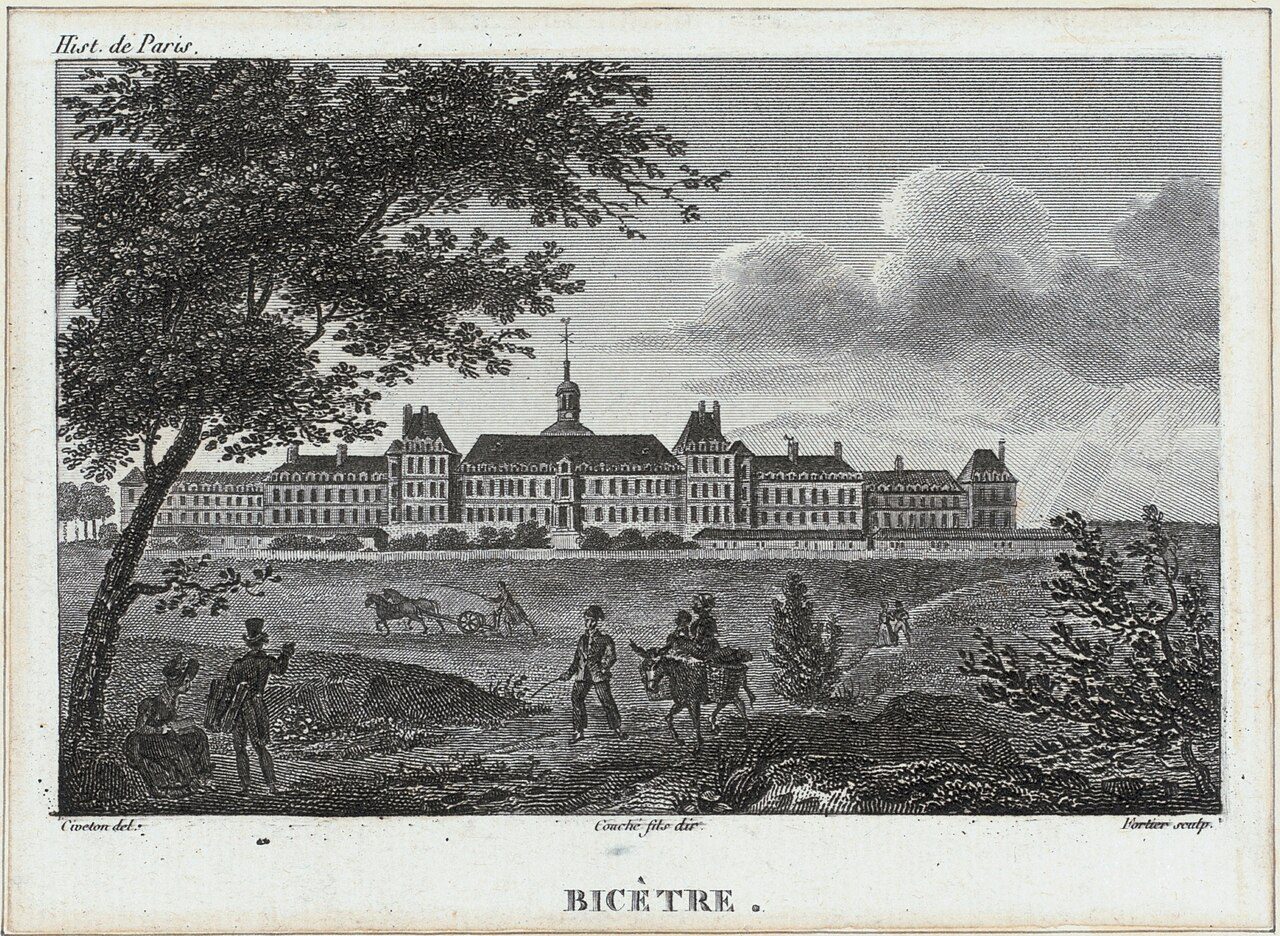
In 1788, according to the hospital's register, 151 men were admitted to the section for the insane at Bicêtre, and 95 of them died. Philippe Pinel, who copied the figures into his Treatise on Insanity, put much of the blame on hunger: before the Revolution the daily bread was handed out once, in the morning, and "devoured in an instant". After the ration was increased in 1792 and given out three times a day with soup, deaths fell to about one in eight1. The story of Bicêtre's famous reform begins there, with food and order, rather than with a single dramatic gesture.
A house for men the city did not want
Bicêtre stands on a low hill just south of Paris, in what is now the commune of Le Kremlin-Bicêtre. Building began in 1634 as a hospital for old soldiers10. On 27 April 1656 a royal edict created the Hôpital général of Paris to confine beggars and set them to work, and Bicêtre became its house for men and boys, as the Salpêtrière was for women8,10. It was never mainly a medical place. Over the next century it held the old and infirm, vagrants, boys sent for correction, men with venereal disease, prisoners of the state and people with mental illness, sometimes side by side6,10.
The Revolution brought violence as well as reform. In the September Massacres of 1792, armed bands came to Bicêtre and killed about 170 of the people held there9.
Pussin's ward
The men judged insane lived in a section called the emploi Saint-Prix. From 3 September 1785 its governor was Jean-Baptiste Pussin, a tanner from the Jura who had first entered Bicêtre in 1771 as a patient with scrofula, recovered, and stayed on to work. He ran the ward with his wife, Marguerite Jubline. No doctor was regularly present; it was on the governor's word that patients were released2.
Philippe Pinel took up his post as physician to the infirmaries on 11 September 1793 and stayed about eighteen months. Juchet and Postel argue that in this time he was mainly an attentive observer of what Pussin and his wife were already doing2. Pinel said as much himself:
I saw a great number of maniacs assembled together, and submitted to a regular system of discipline. Their disorders presented an endless variety of character: but their discordant movements were regulated on the part of the governor by the greatest possible skill, and even extravagance and disorder were marshalled into order and harmony.1
Quotation checked against the 1806 text
From this he drew the lesson that became moral treatment: many patients could be calmed and even cured by firm, kind management and attention to their state of mind, without blows1.
The unchaining
Pinel left for the Salpêtrière in the spring of 1795. Pussin stayed. In 1798 Pinel asked the minister of the interior to transfer Pussin to the Salpêtrière and enclosed a report by Pussin on his methods. In it Pussin wrote that in the month of prairial, year V (May–June 1797), he had succeeded in doing away with the chains used to hold the most agitated men, replacing them with strait-waistcoats that let them walk about2. The document lay forgotten in a minister's private papers until the historian Dora Weiner published it in 19793,2.
So the change was real, but it was Pussin's, it came after Pinel had gone, and it swapped one form of restraint for a milder one rather than ending restraint altogether. Pinel himself later wrote that chains had been abolished at Bicêtre three years before he and Pussin did the same at the Salpêtrière2.
Later Bicêtre
Bicêtre kept a large asylum division through the nineteenth century, with room for about 900 patients with mental illness by 1840; by 1872 the number had fallen to about 3006. Visitors were not always impressed: John Conolly reported cells below ground level, about six feet square, with a plank and straw for a bed and no light but what came through the door6.
The old hospice became a general hospital. In 1962 the French state protected parts of it as historic monuments, among them the seventeenth-century pavilions, the great well, the remains of the cells and the nineteenth-century divisions built for the insane7. Bicêtre is now a university teaching hospital of the Paris public hospital system10,6.
Key dates
- 27 April 1656 A royal edict creates the Hôpital général of Paris; Bicêtre becomes its house for poor men and boys.
- 3 September 1785 Jean-Baptiste Pussin, a former patient of the hospital, is made governor of the ward for insane men.
- September 1792 During the September Massacres armed crowds enter Bicêtre and kill about 170 of those held there.
- 11 September 1793 Philippe Pinel takes up his post as physician to the infirmaries of Bicêtre.
- 1797 Pussin replaces the chains in the insane ward with strait-waistcoats, after Pinel has left for the Salpêtrière.
- 1849 The Académie de médecine commissions Charles-Louis Müller's painting of Pinel unchaining the insane of Bicêtre.
- 8 March 1962 Parts of the old hospice, including its nineteenth-century divisions for the insane, are protected as historic monuments.
Also on this site
Sources
- Primary source Philippe Pinel, A Treatise on Insanity (trans. D. D. Davis), Sheffield: W. Todd (1806). Quotations checked against this text.
- Scholarship Jack Juchet and Jacques Postel, Le « surveillant » Jean-Baptiste Pussin à la Salpêtrière, Histoire des sciences médicales 30(2) (1996).
- Scholarship Dora B. Weiner, The apprenticeship of Philippe Pinel: a new document, 'Observations of Citizen Pussin on the insane', American Journal of Psychiatry 136(9) (1979).
- Museum or archive Natasha Ruiz-Gómez, The painter, the psychiatrist and a fashion for hysteria, Wellcome Collection (2020-03-04).
- Museum or archive Himetop, Università Campus Bio-Medico di Roma, Pinel faisant tomber, à Bicêtre, les fers des aliénés (Charles-Louis Müller), Himetop: The History of Medicine Topographical Database.
- Museum or archive Bethlem Museum of the Mind, European journeys: Bicêtre, Bethlem Museum of the Mind.
- Official Ministère de la Culture, Ancien hospice de Bicêtre (notice PA00079883), Plateforme ouverte du patrimoine (base Mérimée).
- Wikipedia Hôpital général de Paris, Wikipédia.
- Wikipedia September Massacres, Wikipedia.
- Wikipedia Bicêtre Hospital, Wikipedia.
Cross-checked with Wikidata Q15217751 and the English Wikipedia article.
Read next
 1790s–1870s · Transformed
Moral treatment
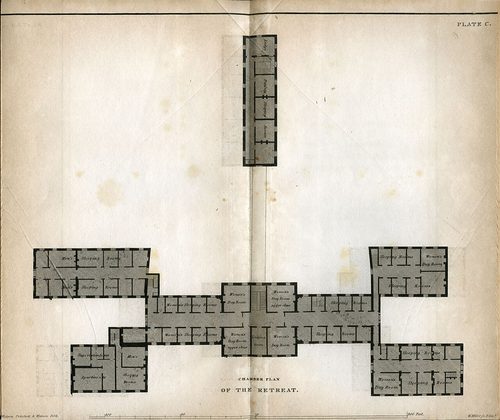
Moral treatment, developed at Bicêtre in Paris and the York Retreat in the 1790s, tried to cure madness through kindness, routine, work and self-control rather than chains and drugs. It shaped a century of asylums.
 1700s–1890s · Transformed
Restraint and the non-restraint movement
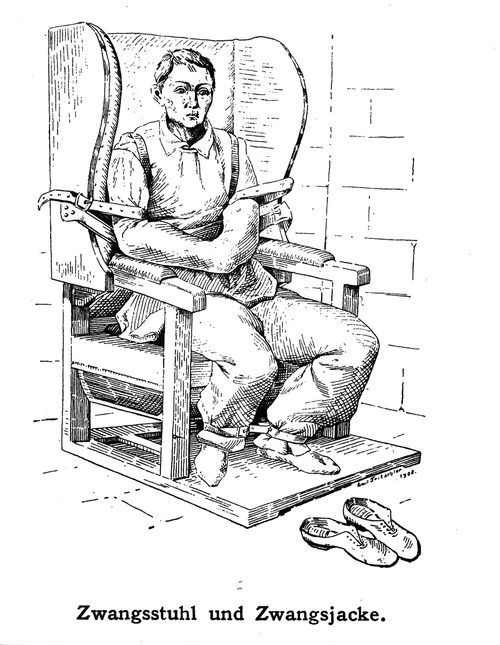
Chains, strait-waistcoats and restraint chairs were the ordinary equipment of asylums until the late 1830s, when Lincoln and then Hanwell abolished them. Britain made non-restraint a doctrine; much of the world did not.
 c. 100 CE–1980
Mania
Mania once meant madness itself: raving, sleepless, sometimes joyful. How the word narrowed from Aretaeus to Kraepelin, and how it became one pole of manic-depressive illness.
 Essay · 7 min
The rise and fall of the asylum
How the public asylum grew from a few small madhouses into hospitals of thousands, and was then closed: an argument that its failures came from its success at taking in the people no other institution would hold.
 Essay · 7 min
Who got locked up, and why
Asylum populations were never a simple sample of the mentally ill. Poverty, family, the Poor Law, sex, migration, race, age and bodily disease all decided who was confined, and historians still argue over how much each counted.
Pages that mention Bicêtre and the unchaining
- Diagnosis Mania
- Diagnosis Moral insanity
- Essay The rise and fall of the asylum
- Person Jean-Baptiste Pussin
- Person Jean-Étienne Esquirol
- Person Philippe Pinel
- Place Bethlem Hospital ("Bedlam")
- Place Hanwell Asylum
- Place The Narrenturm, Vienna
- Place The Salpêtrière
- Place The York Retreat
- Treatment Moral treatment
- Treatment Restraint and the non-restraint movement