
Person · 31 July 1809 – 16 December 1883
Thomas Story Kirkbride
Quaker physician (1809–1883) who ran the Pennsylvania Hospital for the Insane for 43 years and whose 1854 book set the plan for dozens of American state asylums, built on the belief that the right building could cure.
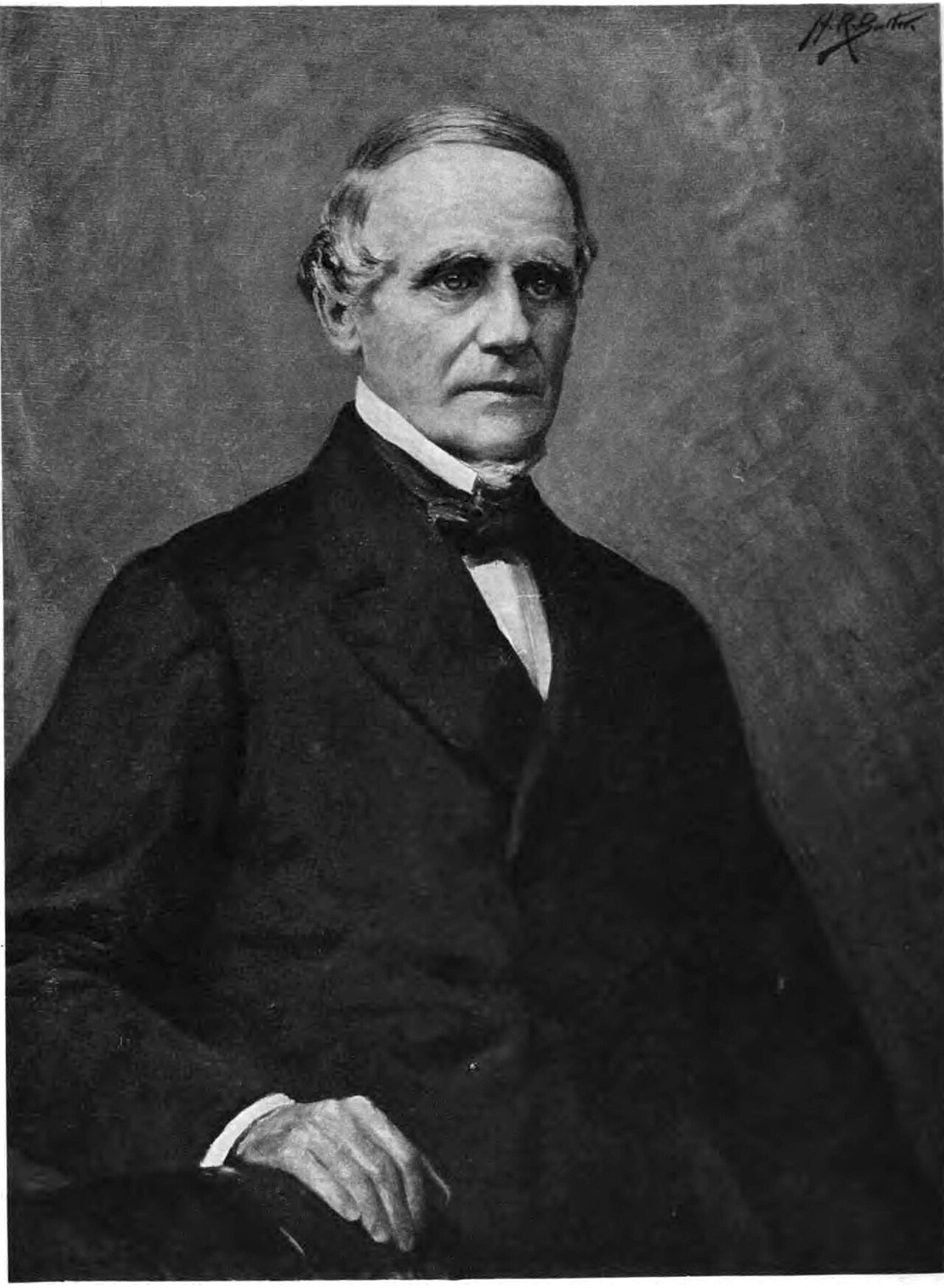
Thomas Kirkbride believed that nothing in an asylum was too small for its doctor. His book on the subject says so directly:
It is a great error to suppose that there is any detail about the management of a Hospital for the Insane, beneath the dignity, or unworthy the attention of its Chief Medical Officer.1
Quotation checked against the 1854 text
Food, furniture, heating, the hours of meals, the choice of attendants and the shape of the building were all, for him, part of the treatment. That conviction, applied by one man in one Philadelphia hospital for 43 years and then written down as a specification, shaped the landscape of American psychiatry for the rest of the century.
A Quaker doctor
Kirkbride was born on 31 July 1809 near Morrisville, Pennsylvania, into an Orthodox Quaker farming family6. He took his medical degree at the University of Pennsylvania in 1832 and became resident physician at the Friends' Asylum at Frankford, the Quaker hospital for the insane near Philadelphia6. After some years in general practice and surgery he was appointed, in October 1840, the first superintendent of the Pennsylvania Hospital for the Insane, a new branch of the Pennsylvania Hospital built outside the city, which admitted its first patients in January 18416. He remained there until his death.
In October 1844 he was one of the small group of superintendents who met in Philadelphia to form the Association of Medical Superintendents of American Institutions for the Insane, the body that became the American Psychiatric Association; he later served eight years as its president6. He lived in the hospital grounds with his family, and his second wife had been one of his patients6. The historian Nancy Tomes has made his hospital the subject of a full study of how a nineteenth-century asylum was actually run4.
The plan
Kirkbride's On the Construction, Organization, and General Arrangements of Hospitals for the Insane (1854; revised 1880) set out a complete state hospital: 250 patients at most, a central administration block, long wings for men and women stepped back so that every ward had light and air, classification of patients from the quietest near the centre to the most disturbed at the ends, farms and grounds, workshops, a library and lectures (The Kirkbride asylums)1. It was the architectural form of moral treatment: orderly surroundings, occupation, amusement and firm, kindly authority. The superintendent was to hold that authority without division:
A man to whom this amount of power cannot be safely intrusted, certainly is not the proper person to be placed at the head of an institution containing 250 insane patients.1
Quotation checked against the 1854 text
Behind the plan was a promise. "Of the recent cases of insanity, properly treated," Kirkbride wrote, "between 80 and 90 per cent recover"; and a state that paid for early treatment would save the cost of supporting incurable patients for life1. Campaigners such as Dorothea Dix used the same argument with legislators, and states built many hospitals on his lines5,6.
Doubts
The promise did not survive scrutiny. In 1887 the Massachusetts superintendent Pliny Earle, examining his colleagues' statistics, pointed out that of 7,167 admissions recorded in the 1875 report of Kirkbride's own hospital, 1,981 were for second or later attacks; one woman had been admitted for her thirty-third, and so had presumably "recovered" thirty-two times2. Earle noted that Kirkbride had "very prudently and properly avoided" classifying patients by how long they had been ill, the device behind the highest claimed cure rates, but his book helped end the age of confident recovery statistics2.
Outsiders were blunter. In 1894, a decade after Kirkbride's death, the neurologist Silas Weir Mitchell told the superintendents' association, at its fiftieth annual meeting in Philadelphia, that their faith in the asylum was misplaced:
One is the superstition (almost is it that) to the effect that an asylum is in itself curative.3
Quotation checked against the 1894 text
Kirkbride died of pneumonia at his home in the hospital grounds on 16 December 1883 and was buried, in a plain Quaker grave, at Laurel Hill Cemetery6. Many of the buildings his book inspired outlived the system they served; their later history, from neglect to demolition or conversion into flats and hotels, is told under The Kirkbride asylums and deinstitutionalisation.
Key dates
- 1832 Kirkbride graduates in medicine at the University of Pennsylvania and becomes resident physician at the Friends' Asylum at Frankford.
- January 1841 The Pennsylvania Hospital for the Insane, with Kirkbride as its first superintendent, admits its first patients.
- October 1844 Kirkbride helps found the Association of Medical Superintendents of American Institutions for the Insane, forerunner of the American Psychiatric Association.
- 1854 Kirkbride publishes On the Construction, Organization, and General Arrangements of Hospitals for the Insane.
- 1862 Kirkbride begins eight years as president of the superintendents' association.
- 1880 A revised second edition of Kirkbride's book appears.
- 16 December 1883 Kirkbride dies at his home in the grounds of the hospital he ran for 43 years.
Kirkbride on this site
Sources
- Primary source Thomas S. Kirkbride, On the Construction, Organization, and General Arrangements of Hospitals for the Insane, Philadelphia: Lindsay & Blakiston (1854). Quotations checked against this text.
- Primary source Pliny Earle, The Curability of Insanity: A Series of Studies, Philadelphia: J. B. Lippincott (1887). Quotations checked against this text.
- Primary source S. Weir Mitchell, Address before the Fiftieth Annual Meeting of the American Medico-Psychological Association, Philadelphia, May 16th, 1894, Journal of Nervous and Mental Disease 21(7) (1894). Quotations checked against this text.
- Scholarship Nancy Tomes, A Generous Confidence: Thomas Story Kirkbride and the Art of Asylum-Keeping, 1840–1883, Cambridge University Press (1984).
- Scholarship Insane asylums: professor explores a 19th-century architectural experiment to cure social ills, Rutgers University News.
- Wikipedia Thomas Story Kirkbride, Wikipedia.
Cross-checked with Wikidata Q3525601 and the English Wikipedia article.
Read next
 1790s–1870s · Transformed
Moral treatment
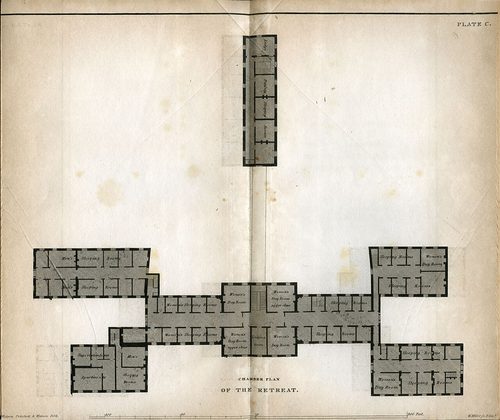
Moral treatment, developed at Bicêtre in Paris and the York Retreat in the 1790s, tried to cure madness through kindness, routine, work and self-control rather than chains and drugs. It shaped a century of asylums.
 Essay · 7 min
The rise and fall of the asylum
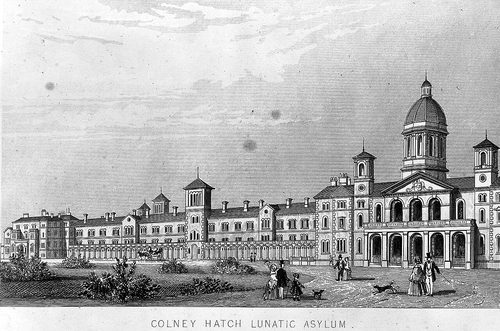
How the public asylum grew from a few small madhouses into hospitals of thousands, and was then closed: an argument that its failures came from its success at taking in the people no other institution would hold.
 1700s–1890s · Transformed
Restraint and the non-restraint movement
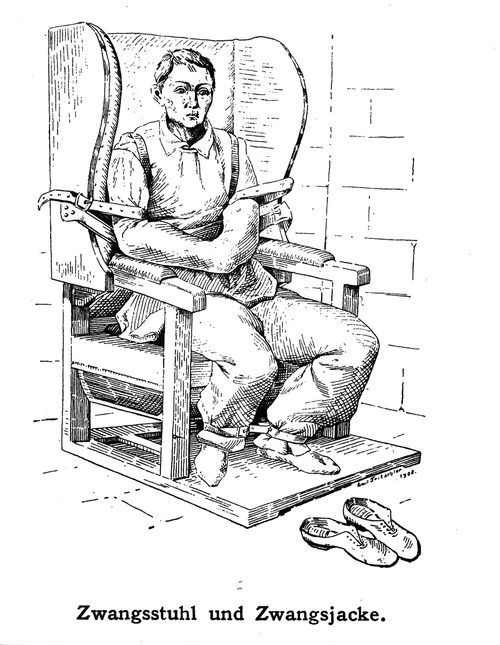
Chains, strait-waistcoats and restraint chairs were the ordinary equipment of asylums until the late 1830s, when Lincoln and then Hanwell abolished them. Britain made non-restraint a doctrine; much of the world did not.
 1955–2000 · Transformed
Deinstitutionalisation
From the mid-1950s Western countries emptied their great mental hospitals: US public hospitals fell from about 559,000 patients to under 72,000 in forty years. Whether patients were freed or abandoned is still argued.