
Place · 1848 – today
The Kirkbride asylums
About seventy American state asylums built from 1848 to about 1910 to Thomas Kirkbride's plan of a central block with staggered wings, meant to heal by light, air and order. Many are demolished; some reused.
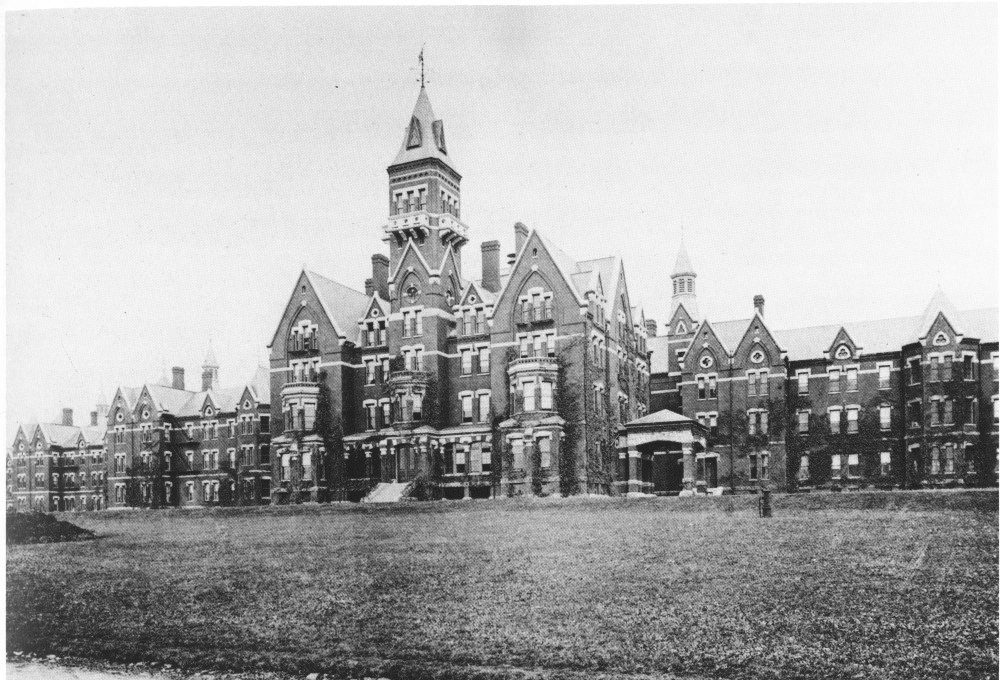
Across the eastern and midwestern United States, on hilltops outside small towns, stand or stood dozens of very long buildings of the same peculiar shape: a towered centre and, on each side, a chain of wings set back one behind another. They are the Kirkbride asylums, built between the 1840s and about 1910 to a design meant to cure insanity by architecture5.
The doctor and his book
Thomas Story Kirkbride was a Philadelphia Quaker physician who in 1840 became the first superintendent of the Pennsylvania Hospital for the Insane, which admitted its first patients the next year6. In 1844 he helped found the association of asylum superintendents that later became the American Psychiatric Association6. Like other believers in moral treatment, he held that insanity was often curable if treated early, away from home, in a calm, orderly and humane setting, and that the building was part of the treatment2,5.
In 1854 he published On the Construction, Organization, and General Arrangements of Hospitals for the Insane, a detailed specification for a state hospital, revised in 18801,6. It set the size at 250 patients, "as many as should be collected in any one institution", and insisted that physicians, not architects, should decide the plan1. Appearance mattered too:
A hospital for the insane should have a cheerful and comfortable appearance, every thing repulsive and prison-like should be carefully avoided, and even the means of effecting the proper degree of security should be masked, as far as possible, by arrangements of a pleasant and attractive character.1
Quotation checked against the 1854 text
The plan
Kirkbride's building had a central block holding the offices, kitchens, chapel and the superintendent's family, and long wings on either side, men on one side and women on the other, divided into eight classes of patients for each sex1. The wings were stepped back en échelon, so that every corridor had windows at both ends and every ward had light, air and a view, and the "most noisy, violent or careless" patients were placed in the farthest wings, away from the quiet ones near the centre1,5. He preferred this staggered line, he wrote, to wings at right angles, which gave patients on opposite sides the chance of "seeing or calling to each other"1. Grounds of at least a hundred acres, farms and gardens were part of the design5.
The first asylum built to these principles was the New Jersey State Lunatic Asylum at Trenton, designed by John Notman and founded on 15 May 1848 after a campaign by Dorothea Dix5,8. Dozens followed, in styles from Gothic to Romanesque. At Buffalo, H. H. Richardson's twin-towered State Asylum for the Insane, with grounds by Frederick Law Olmsted and Calvert Vaux, was begun in 1871 and admitted its first patients on 15 November 1880, when only the eastern wards were finished4,9. Danvers in Massachusetts opened in 1878, and Athens in Ohio in 18747,10.
Overcrowding and decline
The design assumed small numbers, and the numbers did not stay small. States found money to build and too little to run the hospitals, which filled with chronic patients whom no building could cure2. At Athens there were some 1,800 patients in the 1950s, almost three times what the plan had envisaged3. By the end of the nineteenth century doctors had lost faith in the "curability" that the plan promised, and new asylums were built on the "cottage plan" of many small buildings instead2,4,5.
Ruins, hotels and flats
Deinstitutionalisation emptied the buildings. Of 73 Kirkbride hospitals identified in the United States, about 40 had gone by 2016, many demolished for newer hospitals, and about 33 survived in some form5. Danvers, closed in 1992, was sold to a housing developer; despite a preservation lawsuit most of it was demolished in 2006–07, leaving part of the central block's shell within an apartment complex7. At Buffalo, where the last patients left the historic wards in the 1970s, a third of the complex reopened as a hotel and architecture centre after 20064,9. At Athens, transferred to Ohio University in 1988 and emptied of patients in 1993, the asylum now houses the Kennedy Museum of Art and university offices3,10. Trenton, the first of them all, is still a state psychiatric hospital8.
Key dates
- January 1841 Thomas Kirkbride, superintendent of the new Pennsylvania Hospital for the Insane in Philadelphia, admits its first patients.
- October 1844 Kirkbride and other superintendents found the Association of Medical Superintendents of American Institutions for the Insane, forerunner of the American Psychiatric Association.
- 15 May 1848 The New Jersey State Lunatic Asylum at Trenton, founded after Dorothea Dix's campaign and designed by John Notman, is established as the first asylum built to Kirkbride's principles.
- 1854 Kirkbride publishes On the Construction, Organization, and General Arrangements of Hospitals for the Insane.
- 15 November 1880 The Buffalo State Asylum for the Insane, designed by H. H. Richardson with grounds by Olmsted and Vaux, admits its first patients.
- 24 June 1992 Danvers State Hospital in Massachusetts closes; most of its Kirkbride building is demolished in 2006–07.
Also on this site
Sources
- Primary source Thomas S. Kirkbride, On the Construction, Organization, and General Arrangements of Hospitals for the Insane, Philadelphia (1854). Quotations checked against this text.
- Scholarship Rutgers University (on Carla Yanni, The Architecture of Madness, University of Minnesota Press, 2007), Insane asylums: Professor explores a 19th-century architectural experiment to cure social ills, Rutgers University.
- Official The History of The Ridges, Ohio University.
- Museum or archive Then: history of the Richardson Olmsted Campus, Richardson Olmsted Campus.
- Wikipedia Kirkbride Plan, Wikipedia.
- Wikipedia Thomas Story Kirkbride, Wikipedia.
- Wikipedia Danvers State Hospital, Wikipedia.
- Wikipedia Trenton Psychiatric Hospital, Wikipedia.
- Wikipedia Richardson Olmsted Complex, Wikipedia.
- Wikipedia Athens Lunatic Asylum, Wikipedia.
Cross-checked with Wikidata Q2473959 and the English Wikipedia article.
Read next
 1790s–1870s · Transformed
Moral treatment
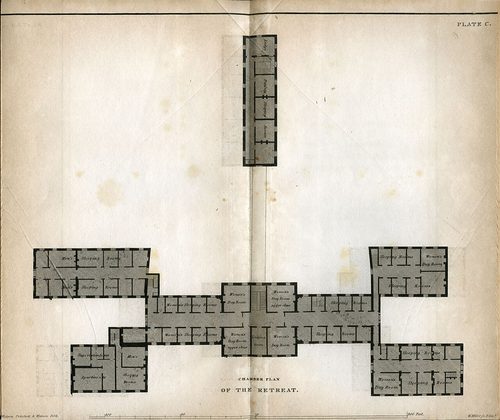
Moral treatment, developed at Bicêtre in Paris and the York Retreat in the 1790s, tried to cure madness through kindness, routine, work and self-control rather than chains and drugs. It shaped a century of asylums.
 Essay · 7 min
The rise and fall of the asylum
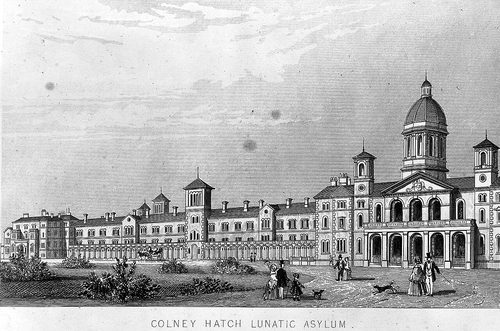
How the public asylum grew from a few small madhouses into hospitals of thousands, and was then closed: an argument that its failures came from its success at taking in the people no other institution would hold.
 1955–2000 · Transformed
Deinstitutionalisation
From the mid-1950s Western countries emptied their great mental hospitals: US public hospitals fell from about 559,000 patients to under 72,000 in forty years. Whether patients were freed or abandoned is still argued.
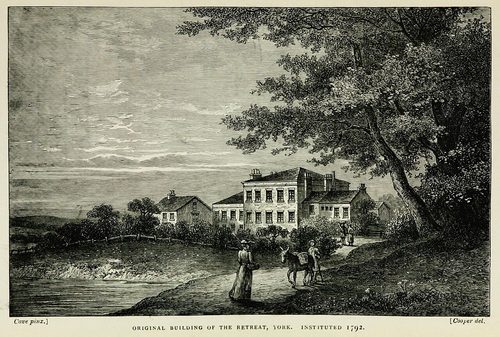 United Kingdom · 1796
The York Retreat
A small Quaker house outside York, opened in 1796 after a Friend died in the city asylum, whose mild regime, described by Samuel Tuke in 1813, made 'moral treatment' famous across Britain and America.
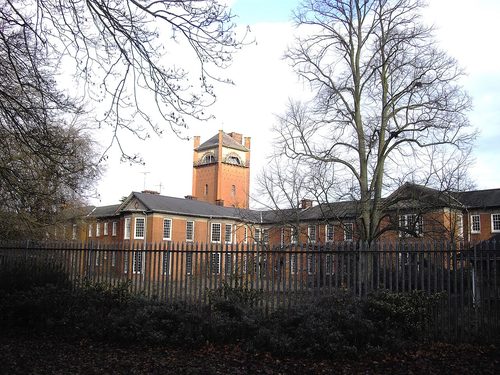 Essay · 8 min
Counting the confined: asylum populations, 1800–2000
Asylum numbers in England and the United States rose for a century and then fell by three-quarters or more. What the official counts measured was how long people stayed, not how many fell ill, as their own compilers warned.
Pages that mention The Kirkbride asylums
- Essay Counting the confined: asylum populations, 1800–2000
- Essay The patients who wrote back
- Essay The rise and fall of the asylum
- Essay Who got locked up, and why
- Person Dorothea Dix
- Person Silas Weir Mitchell
- Person Thomas Story Kirkbride
- Place Geel and family care
- Place The York Retreat
- Place The asylum on Blackwell's Island
- Treatment Deinstitutionalisation
- Treatment Moral treatment