
Treatment · 1933–1960s
Insulin coma therapy
From the mid-1930s to the late 1950s, people diagnosed with schizophrenia were put into deep comas with insulin, day after day. A trial in 1957 found the insulin itself did nothing special.
For about twenty-five years, many psychiatric hospitals in Europe and North America kept a special ward where, each morning, a group of patients was injected with insulin and slipped, over a few hours, into a deep coma. Nurses watched them through the sweating, restlessness and occasional convulsions of low blood sugar, then brought them round with sugar. The next day it happened again. Insulin coma therapy was the first of the "shock" treatments for schizophrenia, and for a generation it was the most prestigious3,5.
Sakel's discovery
Manfred Sakel, a young Austrian doctor, began using small doses of insulin in a Berlin clinic in the late 1920s, mainly to ease withdrawal in people addicted to morphine. When some patients slipped by accident into insulin coma and seemed clearer afterwards, he decided to produce comas deliberately in people with psychosis. Back in Vienna he did so with patients diagnosed with schizophrenia, and reported his results to the Medical Society of Vienna in 19335,3.
His claims were remarkable. In his first published series he said that 88 per cent of over 100 patients with recent illness showed good improvement and 70 per cent recovered fully3. For a diagnosis that had long been seen, since Emil Kraepelin's account of dementia praecox, as having a poor outlook, this was news, and it was taken up quickly3,1.
Uptake
The method spread fast. In 1936 the Board of Control, which supervised mental hospitals in England and Wales, sent one of its commissioners, Dr Isabel Wilson, to study it in Vienna and at Münsingen in Switzerland. Its annual report weighed the risk against the disease:
The treatment is admittedly not without danger, though it is probably not more dangerous than malaria therapy in the treatment of general paralysis.1
Quotation checked against the 1937 text
The comparison with malaria therapy was apt: both were dangerous treatments justified by the hopelessness of the illness. The Board went on to call schizophrenia "perhaps the gravest and hitherto the least hopeful of all the mental disorders" and urged careful trial1. Sakel moved to New York in 1936 and promoted the treatment there, and by the late 1940s most American psychiatric hospitals were using it5. In 1938 the Board's survey found insulin, the convulsant drug cardiazol or both in use at 92 institutions in England and Wales, although cardiazol accounted for most cases2.
On the insulin ward
Insulin coma was labour-intensive. A course usually ran six days a week for around two months, often to fifty or sixty comas, and needed doctors and nurses trained to recognise and reverse dangerous reactions5. Patients were chosen for a good outlook and the physical strength to stand the treatment. Between comas they were kept together as a group, given outings, games and attention far beyond what most hospital patients received5. Many gained a great deal of weight5.
The risks were real. Contemporary estimates of deaths ranged from 0.5 per cent to 4.5 per cent; a standard textbook put the figure in skilled hands at about one per cent. Prolonged coma could cause lasting brain damage3,5.
"The insulin myth"
Doubts were voiced from the start. Some early comparisons reported strikingly better outcomes for treated patients; others found little difference, and one follow-up study in 1950 found only 6 per cent fully recovered3. The best-known challenge came in 1953 from Harold Bourne, a junior psychiatrist, in a paper in The Lancet called "The insulin myth". He argued that there was no proof of any specific effect of insulin. Patients did well, he suggested, because they had been selected for a good outlook and then received exceptional care3,4. The Journal of Mental Science had held the paper for a year before rejecting it with advice to "get more experience"4.
The response in The Lancet's letters pages was mostly hostile; leading psychiatrists, including William Sargant, defended the treatment3,4. Bourne later said the paper left him "unemployable in any self-respecting psychiatric department", and he spent many years teaching in New Zealand4.
Decline
In 1957 Ackner, Harris and Oldham published a randomised trial at the Maudsley, Bethlem and Cane Hill hospitals. Fifty patients received either insulin coma or the same regime with unconsciousness produced by a barbiturate. There was no difference in outcome; the authors concluded cautiously that insulin was not the specific agent3. By then chlorpromazine offered a cheaper alternative, and early comparisons in 1956–58 tended to favour the drug3.
Insulin coma therapy was not abolished; it was quietly dropped. Henderson and Gillespie's influential textbook advised against it in 1962, although another leading text still defended it in 19603. Most hospitals had abandoned it by the late 1960s, though it lingered in a few places for longer3.
Key dates
- 1933 Manfred Sakel reports to the Medical Society of Vienna on treating schizophrenia with insulin comas.
- 1936 The Board of Control sends Dr Isabel Wilson to Vienna and Münsingen to study insulin treatment; her report is published that September.
- 1938 A Board of Control survey finds insulin or cardiazol treatment in use at 92 institutions in England and Wales.
- 1953 Harold Bourne's paper 'The insulin myth' in The Lancet questions whether insulin coma therapy works at all.
- 1957 A trial at the Maudsley, Bethlem and Cane Hill hospitals finds no difference between insulin coma and barbiturate-induced unconsciousness.
- 1962 Henderson and Gillespie's textbook recommends that insulin coma therapy no longer be used.
Sources
- Primary source Board of Control (England and Wales), Twenty-third Annual Report of the Board of Control for the year 1936, London: HMSO (1937). Quotations checked against this text.
- Primary source Board of Control (England and Wales), Twenty-fifth Annual Report of the Board of Control for the year 1938, London: HMSO (1939). Quotations checked against this text.
- Scholarship Rebecca Freudenthal, Joanna Moncrieff, 'A landmark in psychiatric progress'? The role of evidence in the rise and fall of insulin coma therapy, History of Psychiatry 33(1) (2022).
- Scholarship Jonathan Pimm, Profile: Dr Bourne's identity – credit where credit's due, The Psychiatric Bulletin 38(2) (2014).
- Wikipedia Insulin shock therapy, Wikipedia.
Cross-checked with Wikidata Q122694 and the English Wikipedia article.
Read next
 1934–1950s · Abandoned
Metrazol convulsive therapy
In 1934 Ladislas Meduna began causing seizures with drugs to treat schizophrenia, first camphor and then cardiazol (Metrazol). Patients dreaded it, and within a decade electricity had replaced the drug.
 1917–1950s · Abandoned
Malaria therapy
From 1917 doctors deliberately infected people with general paralysis with malaria, hoping the fever would halt the disease. It won a Nobel Prize in 1927 and was used until penicillin replaced it.
 1938–present · Transformed
Electroconvulsive therapy, then and now
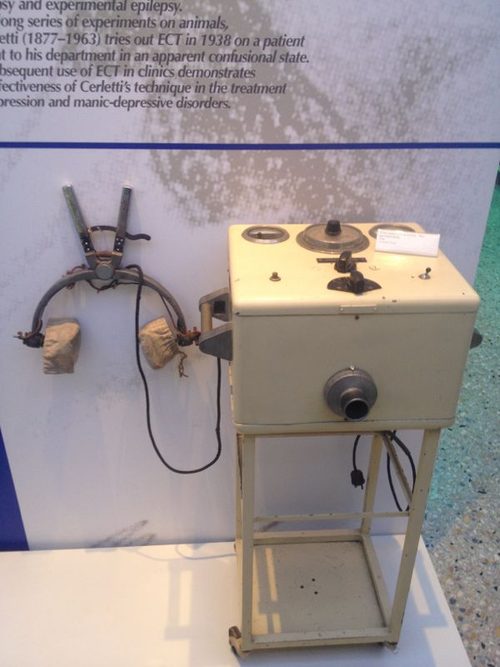
Ugo Cerletti and Lucio Bini first induced a seizure with electricity in Rome in April 1938. Unmodified ECT injured and frightened many; anaesthesia and muscle relaxants made it a treatment still used today.
 1952–present · Transformed
Chlorpromazine
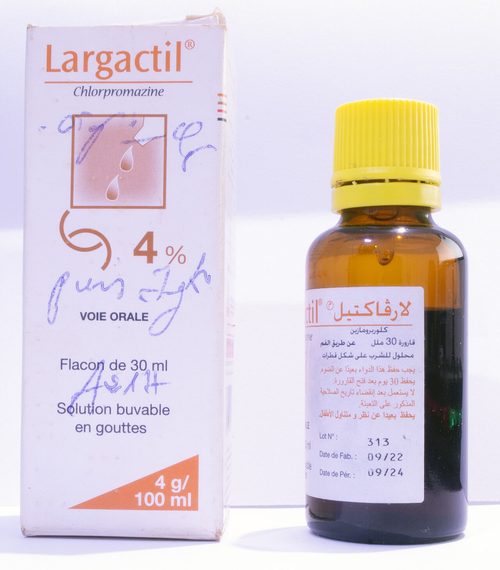
A French drug tried on psychiatric patients in Paris in 1952. Chlorpromazine calmed psychosis without stupor, emptied wards and began the age of psychiatric drugs, with lasting side-effects.
 1890s–1950s
Dementia praecox
Emil Kraepelin's 'early dementia' of the 1890s: a psychosis of youth he thought led to lasting decline. Contested from the start, it was renamed schizophrenia and reshaped twentieth-century psychiatry.
 1845–1990
The biological turn
From Griesinger's claim in the 1840s that mental illness is brain disease, through the microscope, the shock therapies and the drug revolution, to DSM-III in 1980: how psychiatry repeatedly turned to the body.