
Treatment · Mesolithic–17th century
Trepanation
Holes cut in living skulls survive from the Stone Age onwards, many of them healed. What the archaeology shows, why the idea that they let out evil spirits is a nineteenth-century guess, and where madness fits in.
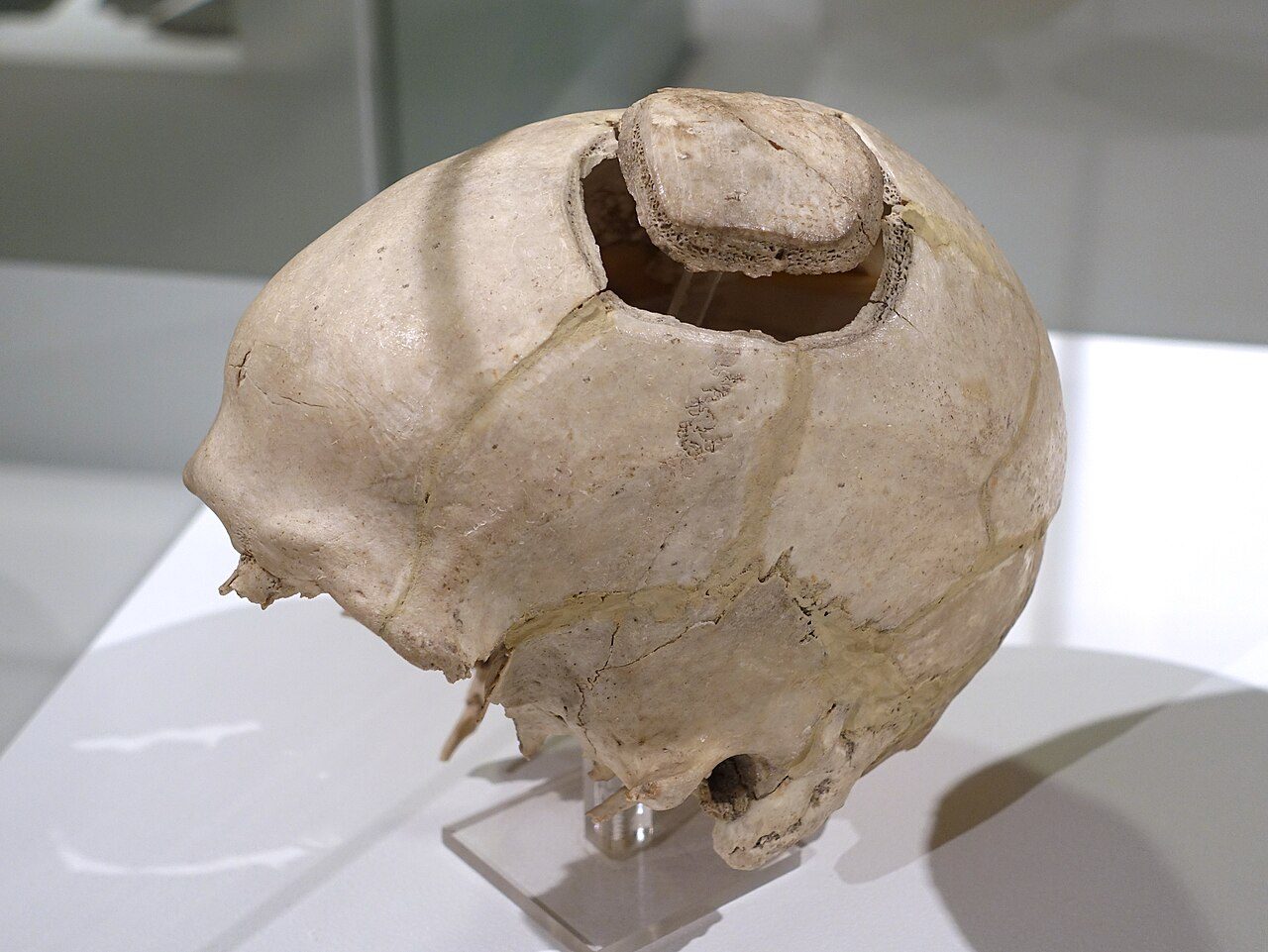
Of all the operations people have performed on one another, opening the skull leaves the most durable record. Bone survives where soft tissue does not, and a hole cut during life looks different from a hole made after death: if the patient lived for some weeks or longer, the cut edges round off and new bone grows across them. On that evidence alone archaeologists know that people in Mesolithic and Neolithic Europe, in ancient China, in the Andes and elsewhere scraped, cut and drilled openings in living skulls, and that many of their patients survived5,6,7.
That is close to the limit of what can be known. Nobody wrote down why the earliest operations were done. The popular story that trepanation was a cure for madness, a way to let evil spirits out of a troubled head, is much younger than the skulls, and it rests on a guess.
The skull from Yucay
The modern history of the subject begins with a piece of bone. In the 1860s the American diplomat and archaeologist E. George Squier visited Cuzco, where a collector, Señora Zentino, showed him her museum of antiquities1:
In some respects, the most important relic in Senora Zentino's collection is the frontal bone of a skull, from the Inca cemetery in the valley of Yucay, which exhibits a clear case of trepanning before death.1
Quotation checked against the 1877 text
The opening was a neat rectangle about 15 by 17 millimetres, made with four intersecting cuts1. Squier showed it to surgeons in New York and then in Paris, where the anatomist and anthropologist Paul Broca examined it for the Anthropological Society. Broca noticed a smooth, sharply bordered zone around the cut where the bone had been stripped of its covering, and an inflamed, porous zone beyond it: the living bone had reacted. His conclusion was cautious but decisive1:
it seems to me impossible to admit that the subject could have survived the denudation less than seven or eight days.1
Quotation checked against the 1877 text
There was no fracture, so Broca guessed the surgeon had operated because of symptoms, perhaps to let out a fluid collecting inside the skull1.
What the bones show
Discoveries in France soon confirmed Broca's view, and the record has grown ever since. Trepanned skulls are known from Mesolithic and Neolithic sites across Europe; a cow skull from Champ-Durand in western France, dated to about 3400–3000 BCE, was opened with the same technique used on human skulls, perhaps as practice5. Peru has more trepanned skulls than the rest of the world combined: more than 800, the earliest from about 400 BCE3. Studying them, the anthropologist John Verano and his colleagues found that survival, judged by healing, rose from roughly 40 per cent in the earliest period to an average of 75–83 per cent under the Inca, as surgeons learned to make smaller openings and to avoid cutting the membrane over the brain3,6. Survival rates in Late Iron Age Switzerland, measured the same way, have been put at 78 per cent6.
Healing proves that a patient lived; it does not say why the operation was done6. Many openings sit beside fractures or other injuries, and treatment of head wounds is the best-supported explanation for a large share of them6,7. Others show no injury at all, which is where speculation begins.
Spirits, headaches and vapours
Broca himself proposed that some Neolithic operations were done for ritual or religious reasons, to free demons thought to be shut inside the head, or to obtain discs of bone as charms4,7. This was an inference from the absence of any visible injury, coloured by the anthropology of his day, and it became the stock explanation. In 1902 the London physician Thomas Lauder Brunton suggested the holes had been made to "let the headache out" of migraine sufferers; in 1913 William Osler listed "epilepsy, infantile convulsions, headache, and various cerebral diseases believed to be caused by confined demons" among the reasons for the practice4. The historian Katherine Foxhall, tracing this chain, finds the migraine story to be a myth, with no evidence from prehistory behind it4.
In literate medicine the reasons are on record, and they are physical rather than spiritual. The Hippocratic treatise On Injuries of the Head taught trepanation for skull fractures, with careful rules about depth6. For mental illness the clearest evidence comes from the early modern period, inside humoral theory. Robert Burton, gathering the advice of Renaissance physicians for melancholia that resisted every other remedy, reported cauteries on the crown of the head and the boring of the skull:
'Tis not amiss to bore the skull with an instrument, to let out the fuliginous vapours.2
Quotation checked against the 1621 text
He added the story, from one of his authorities, of a melancholic man at Rome whom no remedy could help until he was wounded in the head by chance and his skull broken, after which he was "excellently cured"2. The aim was to release smoky vapours rising from black bile, not spirits.
Opening the skull did not end with prehistory. It became the burr hole and the craniotomy of modern neurosurgery, and in the 1930s the first leucotomies were carried out through holes drilled in the skull7.
Key dates
- c. 400 BCE The earliest trepanned skulls from Peru date from about this time; the practice continues there until the Spanish conquest.
- 1621 Robert Burton reports Renaissance authorities who advised boring the skull of a melancholic patient to let out 'fuliginous vapours'.
- 1877 Squier publishes the Peruvian skull and Broca's report in Peru: Incidents of Travel and Exploration in the Land of the Incas.
- 2018 Kushner, Verano and Titelbaum estimate survival in Inca-period trepanations at 75–83 per cent, judged from healed bone.
Sources
- Primary source E. George Squier, Peru: Incidents of Travel and Exploration in the Land of the Incas (with Paul Broca's report, appendix A), New York: Harper & Brothers (1877). Quotations checked against this text.
- Primary source Robert Burton, The Anatomy of Melancholy, Oxford (1621). Quotations checked against this text.
- Reference Maya Bell, Holes in the Head (on Kushner, Verano and Titelbaum, World Neurosurgery 114, 2018), University of Miami News@TheU (2018-06-08).
- Scholarship Katherine Foxhall, People used to drill holes in their skulls, and we're still not sure why (first published in The Conversation), Popular Science (2018-03-07).
- Scholarship Fernando Ramirez Rozzi and Alain Froment, Earliest animal cranial surgery: from cow to man in the Neolithic, Scientific Reports 8: 5536 (2018).
- Scholarship D. Natera-Rodriguez, E. Harty and A. Grande, Historical vignette on trepanation: the evolution of opening the skull, Cureus (2026).
- Wikipedia Trepanning, Wikipedia (2026).
Cross-checked with Wikidata Q472953 and the English Wikipedia article.
Read next
 1935–1960s · Abandoned
Lobotomy
Brain surgery to cut the frontal lobes' connections, begun in Lisbon in 1935 and rewarded with a Nobel Prize in 1949. Tens of thousands were operated on before drugs and evidence of harm ended it.
 Antiquity–19th century
Demonic possession and its critics
Many cultures have explained fits, voices and despair as the work of spirits. How Europeans argued over possession from Hippocrates to Charcot, and why the story that medicine simply defeated superstition is too simple.
 c. 400 BCE–1800s
The four humours
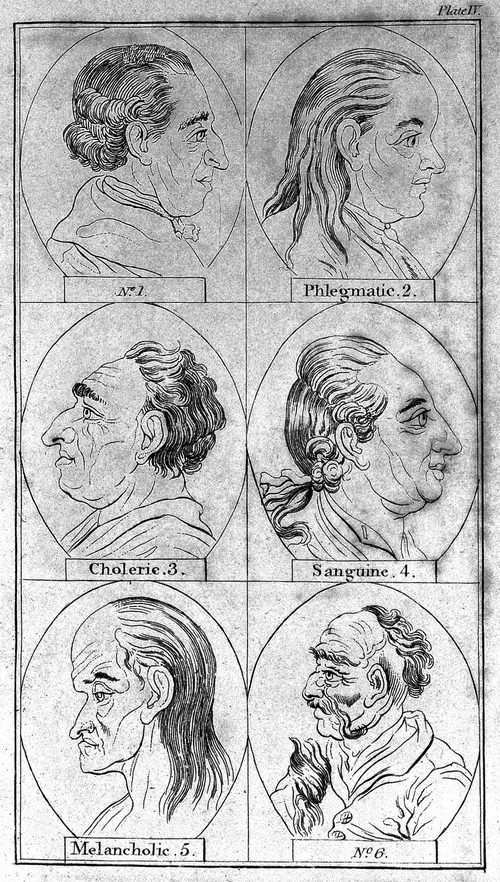
For two thousand years, European and Islamic medicine explained madness and melancholy by four bodily fluids. What the theory claimed about the mind, how it shaped treatment, and how it slowly lost its hold.
 c. 400 BCE–1900s
Melancholia
For two thousand years melancholia meant fear and sorrow without cause, blamed on black bile. How physicians from Aretaeus to Kraepelin defined it, and how it became 'depression'.
 Essay · 6 min
Can we diagnose the dead?
Why this site never diagnoses historical figures, and hedges every modern equivalent it gives: the evidence was made for other purposes, diseases change their identities, and each age's diagnoses of the dead reflect its own medicine.