
Place · 1349 – today
Geel and family care
In the Flemish town of Geel, people with mental illness have lived as boarders with local families since the Middle Ages. The state took the system over in the 1850s, and it still runs today.
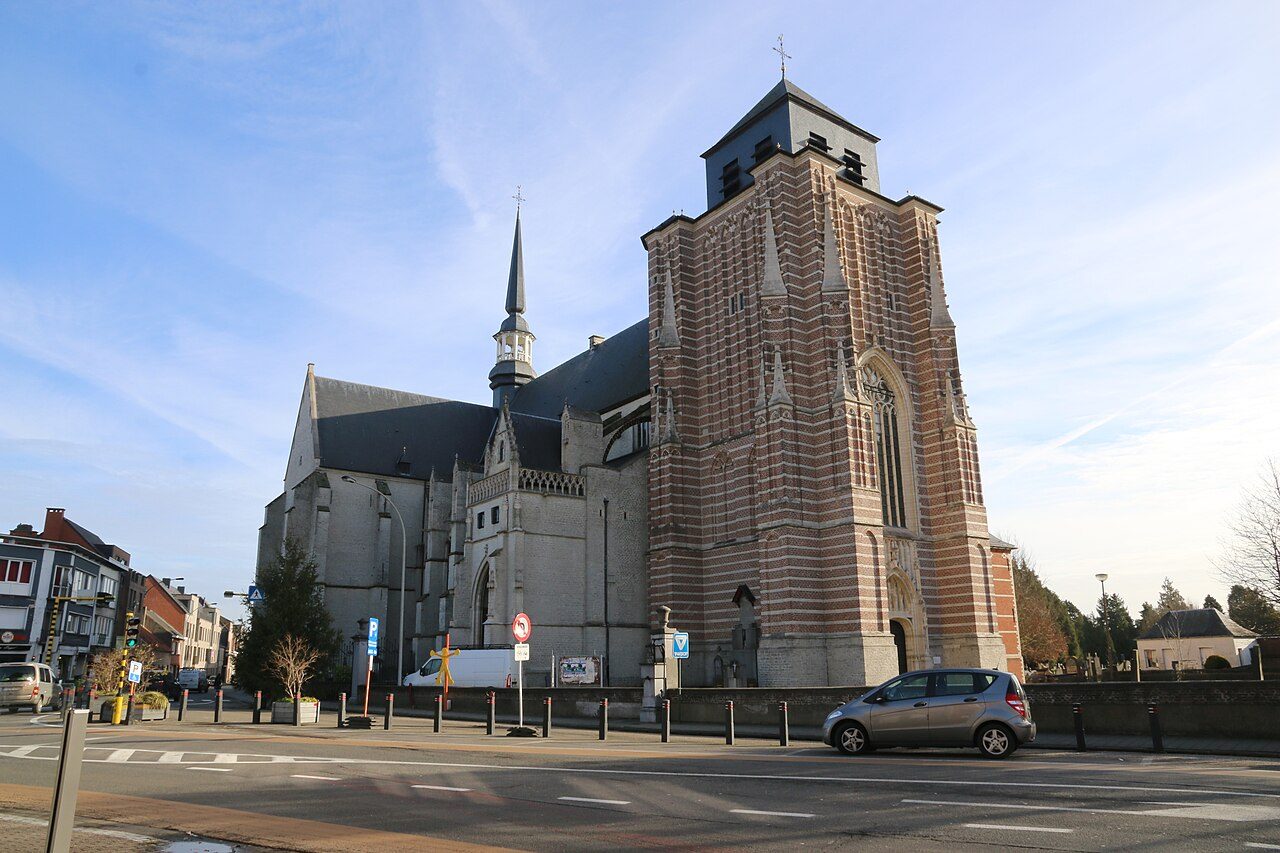
For most of the nineteenth century, European doctors who believed in the asylum had to reckon with a small town in the Campine heath east of Antwerp. In Geel (spelled Gheel until the mid-twentieth century), hundreds of people judged "insane" did not live behind walls at all. They lodged with farming and working families, ate at their tables, worked in their fields and walked the streets. The arrangement was centuries old, it was still running, and it still runs4,5.
A saint and a shrine
The tradition grew from a legend. According to a Latin life written in the thirteenth century for the bishop of Cambrai, Dymphna was the daughter of a seventh-century Irish king who, after his wife's death, wished to marry her. She fled across the sea with her confessor Gerebernus and was overtaken and killed at Geel8,6. Her father's act was remembered as one of madness, and she became the saint to whom people prayed for the "afflicted in mind"5,6.
The story is legend, not history, but the pilgrimage it drew was real. A church was built around her shrine in 1349, and an annex for pilgrims followed in 14805. People brought there for a cure lodged at the church's sick-room and attended its services. Those who had not recovered after nine weeks were often left with townspeople to wait for the next festival of the saint, and this waiting, as later writers explained, became the system itself3,6. Family care was established well before the first purpose-built asylums opened elsewhere in Europe; the first written patient records date from 16934.
The "Geel question"
In 1821 Jean-Étienne Esquirol, the leading French authority on asylums, visited and was struck by the sight of hundreds of patients moving about freely5. Others followed, and Geel became a test case: a relic of the past to some, a model of the future to others. In England, James Cowles Prichard described it in 1835 as a scattered village where "five or six hundred" patients lived among the cottages, worked in the fields and were "summoned to their homes by the village bell"2.
The German psychiatrist Wilhelm Griesinger, who favoured reform of the closed asylum, admitted that critics had found "serious defects" but drew the lesson that mattered to him:
But the experiment at Gheel has proved that the greater number of insane do not require the confinement of an asylum; that many of them can safely be trusted with more liberty than these institutions allow; and that association in the family life is very beneficial to many insane patients.1
Quotation checked against the 1867 text
Under the state
Belgium's lunacy law of 1850 brought Geel under public supervision; the church's role ended, families were paid and inspected, and restraint and corporal punishment were forbidden or restricted to a doctor's order5,1. (Henck van Bilsen dates the handover from church to state to 18524.) In 1861 an infirmary opened on the edge of town, where new arrivals were observed before placement and boarders went if they fell ill or became unmanageable5,3.
An 1892 account by Jules Morel in Daniel Hack Tuke's Dictionary of Psychological Medicine shows the system in detail. Boarders numbered 717 in 1840 and over 1,800 by the time he wrote. A household could take no more than two, of the same sex; each had a room of fixed size and the same food as the family; the state paid a daily rate, more for those needing more care, and five doctors and a corps of nurses visited the homes3. The International Congress of Psychiatry, meeting in Antwerp in 1902, held Geel up as an example to follow5.
Geel today
Numbers peaked just before the Second World War, at about 3,700 boarders in a town of some 16,0008,5. They fell after the war, as hospitals elsewhere emptied and new drugs changed care. Recent estimates range from about 300 to just over 500, supported by district nurses from the town's psychiatric centre, and many boarders have lived with the same families for decades5,4,6. Van Bilsen, who had judged the system harshly as a student visitor in 1977, later argued that its value lies in ordinary life rather than therapy: being accepted as a lodger and neighbour, not managed as a case4.
In 2023 UNESCO added Geel's family care to its Register of Good Safeguarding Practices for intangible heritage7. Its longer lesson, argued over since Esquirol's day, is that many people the nineteenth century confined did not need confining at all.
Key dates
- 1349 A church is built around the shrine of St Dymphna at Geel, a goal for pilgrims seeking cures for madness.
- 1480 An annex for pilgrims is added to St Dymphna's church at Geel.
- 1821 Jean-Étienne Esquirol visits Geel and praises its open care of the insane.
- 1850 Belgium's new lunacy law brings Geel's boarding system under state and medical supervision.
- 1861 An infirmary opens at Geel to observe new arrivals before they are placed with families.
- 1938 Geel's family care reaches its peak, with about 3,700 boarders living in the town.
- 2023 UNESCO lists Geel's foster-care heritage on its Register of Good Safeguarding Practices.
Also on this site
Sources
- Primary source Wilhelm Griesinger, Mental Pathology and Therapeutics (trans. C. Lockhart Robertson and James Rutherford), London: New Sydenham Society (1867). Quotations checked against this text.
- Primary source James Cowles Prichard, A Treatise on Insanity and Other Disorders Affecting the Mind, London: Sherwood, Gilbert and Piper (1835). Quotations checked against this text.
- Primary source Jules Morel; ed. Daniel Hack Tuke, Gheel (in A Dictionary of Psychological Medicine, vol. 1), London: J. & A. Churchill (1892). Quotations checked against this text.
- Scholarship Henck P. J. G. van Bilsen, Lessons to be learned from the oldest community psychiatric service in the world: Geel in Belgium, BJPsych Bulletin 40(4) (2016).
- Scholarship Mike Jay, The Colony of the Mad, mikejay.net (versions in Aeon and The Psychologist, 2015) (2015).
- Reference Werkplaats immaterieel erfgoed, Sint-Dimpnaverering en Geelse psychiatrische gezinsverpleging, immaterieelerfgoed.be.
- Official UNESCO Intangible Cultural Heritage, Safeguarding foster care heritage in the merciful city of Geel: a community-based care model, UNESCO (2023).
- Wikipedia Geel, Wikipedia.
Cross-checked with Wikidata Q464454 and the English Wikipedia article.
Read next
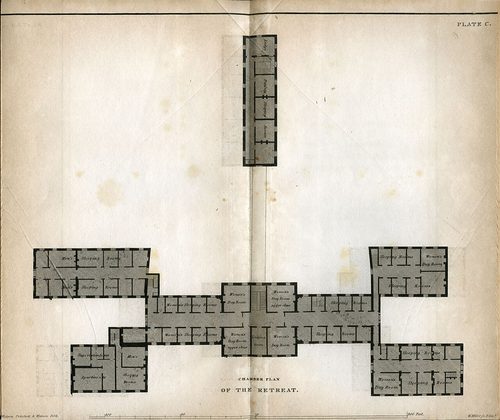 1790s–1870s · Transformed
Moral treatment
Moral treatment, developed at Bicêtre in Paris and the York Retreat in the 1790s, tried to cure madness through kindness, routine, work and self-control rather than chains and drugs. It shaped a century of asylums.
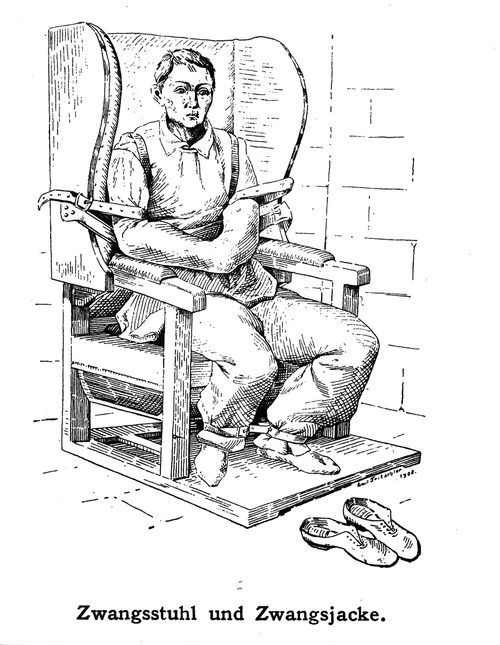 1700s–1890s · Transformed
Restraint and the non-restraint movement
Chains, strait-waistcoats and restraint chairs were the ordinary equipment of asylums until the late 1830s, when Lincoln and then Hanwell abolished them. Britain made non-restraint a doctrine; much of the world did not.
 1955–2000 · Transformed
Deinstitutionalisation
From the mid-1950s Western countries emptied their great mental hospitals: US public hospitals fell from about 559,000 patients to under 72,000 in forty years. Whether patients were freed or abandoned is still argued.
 Essay · 7 min
The rise and fall of the asylum
How the public asylum grew from a few small madhouses into hospitals of thousands, and was then closed: an argument that its failures came from its success at taking in the people no other institution would hold.
 Essay · 7 min
Who got locked up, and why
Asylum populations were never a simple sample of the mentally ill. Poverty, family, the Poor Law, sex, migration, race, age and bodily disease all decided who was confined, and historians still argue over how much each counted.