
Place · 1247 – today
Bethlem Hospital ("Bedlam")
London's hospital for the mentally ill since the Middle Ages: a priory of 1247, a palace at Moorfields, a parliamentary scandal in 1815, and a working hospital and museum at Beckenham today.
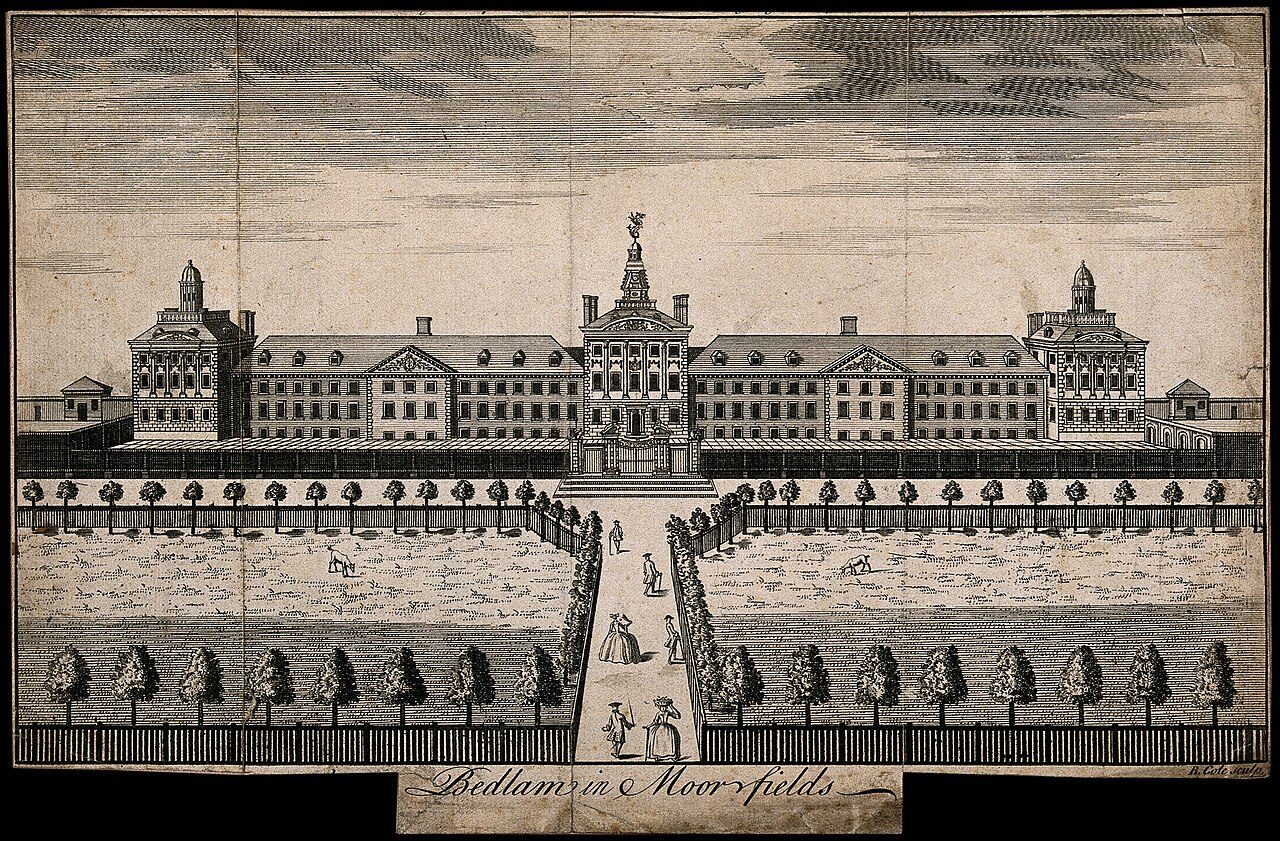
Few institutions have given a language a word. "Bedlam", the old London pronunciation of Bethlehem, meant one hospital before it meant uproar in general, and the hospital it named has never closed. Bethlem has moved three times in nearly eight centuries and is still treating patients, now as part of the National Health Service, on a wooded site at Monks Orchard in south London2,9.
A priory outside Bishopsgate
Bethlem began in 1247, when the London alderman Simon FitzMary gave land just outside the city wall at Bishopsgate to the Order of St Mary of Bethlehem, a crusader order raising money for its bishop in the Holy Land2. For its first century and a half it was a small religious house that collected alms and gave shelter, not a place for the mentally ill.
When that changed is less certain than many histories claim. The date 1377, still often repeated, comes from a guess by the hospital's chaplain Edward O'Donoghue in his 1914 history. The first firm record is a visitation of 1403, which listed six men who were mente capti, "taken in mind", among the inmates, alongside manacles, chains and stocks whose use is not explained9,2. By the later fifteenth century the house had become what it would remain: a place for people whom London could not otherwise keep6.
Moorfields and the visitors
In 1676 the hospital moved half a mile north to Moorfields, into a long building designed by Robert Hooke that looked more like a palace than a hospital. It held around 150 patients, more than twice the old house2. For about a century anyone could walk in on visiting days, and Bethlem's reputation as a London sight, where idle crowds came to stare at the "mad", dates from these years4,3.
In 1770 the Governors closed the gates to casual visitors: from then on, entry needed a ticket signed by a Governor3. Historians have pointed out an unwelcome side effect. With fewer outsiders walking the galleries, there was also less public scrutiny of how patients were treated9.
The scandal of 1814–15
That lack of scrutiny ended with Edward Wakefield, a Quaker land agent and campaigner for lunacy reform. He went round the decaying Moorfields building with friends, including a member of Parliament, in the spring of 1814, and his evidence to the House of Commons committee on madhouses the following year was printed in full1. He described patients chained to the walls of side rooms, many without proper clothing, and men and women with no separation according to their condition1.
His account centred on one man, a former marine of about 55, held in the incurable wing. After a struggle with a keeper years earlier, an iron collar had been riveted round his neck and an iron frame round his body and arms, chained to an upright bar in the wall; he had lived like this for over a decade1,9. Wakefield stressed how coherent the man was:
he read a great deal of books of all kinds, history, lives, or any thing that the keepers could get him; the newspaper every day, and conversed perfectly coherent on the passing topics and events of the war1
Quotation checked against the 1815 text
The printed evidence and George Arnald's etching, made from a sketch "from the life" on 2 May 1814, call him William Norris; some later histories give his name as James1,7,9. The irons were removed after members of Parliament came to see him, and he died in February 18151. The committee's work led to the departure of Bethlem's physician Thomas Monro and its apothecary John Haslam in 1816; Andrews has argued that Haslam was in part unfairly made a scapegoat for a system run by the Governors9,8.
Southwark, Beckenham and the museum
The first patients moved to a new building at St George's Fields in Southwark in August 1815. It included a wing for people sent there by the courts, whose criminal patients were transferred to the new Broadmoor asylum in 18632,9. In 1930 Bethlem moved again, to Monks Orchard on the Beckenham–Croydon border, a set of villas in parkland. The central block of the Southwark building became the Imperial War Museum in 19369. In 1948 Bethlem entered the National Health Service together with the Maudsley Hospital2.
Bethlem Museum of the Mind, opened by the artist Grayson Perry in March 2015, occupies an Art Deco building in the hospital grounds that it shares with the Bethlem Gallery. It keeps the archives of Bethlem and the Maudsley, and an art collection that includes work by patients5,2. Its archives, which also include those of Warlingham Park Hospital, are the main source for the history told here5.
Key dates
- 1247 Simon FitzMary gives land outside Bishopsgate for a priory of the Order of St Mary of Bethlehem.
- 1403 A visitation records six men 'mente capti' at Bethlem, the first certain mention of patients with mental illness there.
- 1676 Bethlem moves into Robert Hooke's new building at Moorfields.
- 1770 Bethlem's Governors end open public visiting; entry now needs a Governor's ticket.
- 2 May 1814 Edward Wakefield and companions see William Norris chained in Bethlem; a sketch made that day becomes a famous print.
- August 1815 The first patients move from Moorfields to the new Bethlem at St George's Fields, Southwark.
- 1930 Bethlem moves to Monks Orchard on the Beckenham–Croydon border.
- March 2015 Bethlem Museum of the Mind opens in the hospital grounds.
Also on this site
- Treatment Bloodletting, purging and emetics
- Essay How words for madness changed
- Treatment Hydrotherapy
- Person William Tuke
- Essay The rise and fall of the asylum
- Treatment Restraint and the non-restraint movement
- Person John Conolly
- Diagnosis Puerperal insanity
- Diagnosis General paralysis of the insane
- Diagnosis Moral insanity
- Essay Counting the confined: asylum populations, 1800–2000
- Essay Who got locked up, and why
- Treatment Insulin coma therapy
Sources
- Primary source House of Commons Select Committee on Madhouses, Report, together with the Minutes of Evidence, and an Appendix of Papers, from the Committee appointed to consider of provision being made for the better regulation of Madhouses in England, London: House of Commons (1815). Quotations checked against this text.
- Museum or archive David Luck, The historic records held at Bethlem Museum of the Mind, British Online Archives (2021-11-18).
- Scholarship Colin Gale, The Lost Hospitals of London: Bethlem Hospital – Worth a Visit? (lecture), Gresham College (2012-03-19).
- Museum or archive Bethlem Museum of the Mind, Visiting Bethlem, Bethlem Museum of the Mind.
- Museum or archive Bethlem Museum of the Mind, About the museum, Bethlem Museum of the Mind.
- Scholarship Jonathan Andrews, Asa Briggs, Roy Porter, Penny Tucker, Keir Waddington, The History of Bethlem, London: Routledge (1997).
- Museum or archive George Arnald, William Norris restrained by chains at the neck and ankles in Bethlem hospital, London (etching by G. Arnald), Wellcome Collection (1815-10-20).
- Scholarship Jonathan Andrews, Review of Masters of Bedlam (Scull, MacKenzie and Hervey), Reviews in History, Institute of Historical Research (1997-03).
- Wikipedia Bethlem Royal Hospital, Wikipedia.
Cross-checked with Wikidata Q831377 and the English Wikipedia article.
Read next
 1700s–1890s · Transformed
Restraint and the non-restraint movement
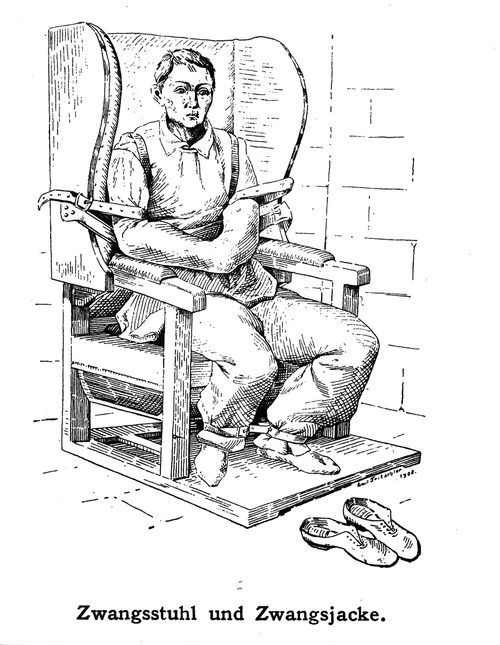
Chains, strait-waistcoats and restraint chairs were the ordinary equipment of asylums until the late 1830s, when Lincoln and then Hanwell abolished them. Britain made non-restraint a doctrine; much of the world did not.
 1790s–1870s · Transformed
Moral treatment
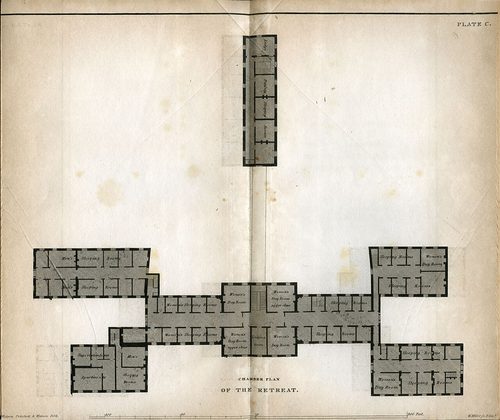
Moral treatment, developed at Bicêtre in Paris and the York Retreat in the 1790s, tried to cure madness through kindness, routine, work and self-control rather than chains and drugs. It shaped a century of asylums.
 1820s–1940s
General paralysis of the insane
The deadliest diagnosis in the Victorian asylum: grandiose delusions, failing speech and paralysis, usually fatal within a few years. In 1913 it was proved to be a late form of syphilis.
 Essay · 7 min
The rise and fall of the asylum
How the public asylum grew from a few small madhouses into hospitals of thousands, and was then closed: an argument that its failures came from its success at taking in the people no other institution would hold.
Essay · 6 min
How words for madness changed
From the Latin insania and furor to 'lunatic', 'alienist', 'mental hospital' and 'schizophrenia': why the words for madness kept changing, and why the change usually came from law and institutions rather than discovery.
Pages that mention Bethlem Hospital ("Bedlam")
- Diagnosis General paralysis of the insane
- Diagnosis Moral insanity
- Diagnosis Puerperal insanity
- Essay Counting the confined: asylum populations, 1800–2000
- Essay How words for madness changed
- Essay The rise and fall of the asylum
- Essay Who got locked up, and why
- Person John Conolly
- Person William Tuke
- Place Bicêtre and the unchaining
- Place Geel and family care
- Place Hanwell Asylum
- Place The Narrenturm, Vienna
- Place The Salpêtrière
- Place The York Retreat
- Place The asylum on Blackwell's Island
- Treatment Bloodletting, purging and emetics
- Treatment Hydrotherapy
- Treatment Insulin coma therapy
- Treatment Restraint and the non-restraint movement