
Theory · 1770s–1850s
Animal magnetism and mesmerism
Franz Anton Mesmer claimed an invisible fluid linked all living things and could cure nervous disorders. A royal commission found only imagination at work, but his methods led to hypnotism and the psychology of suggestion.
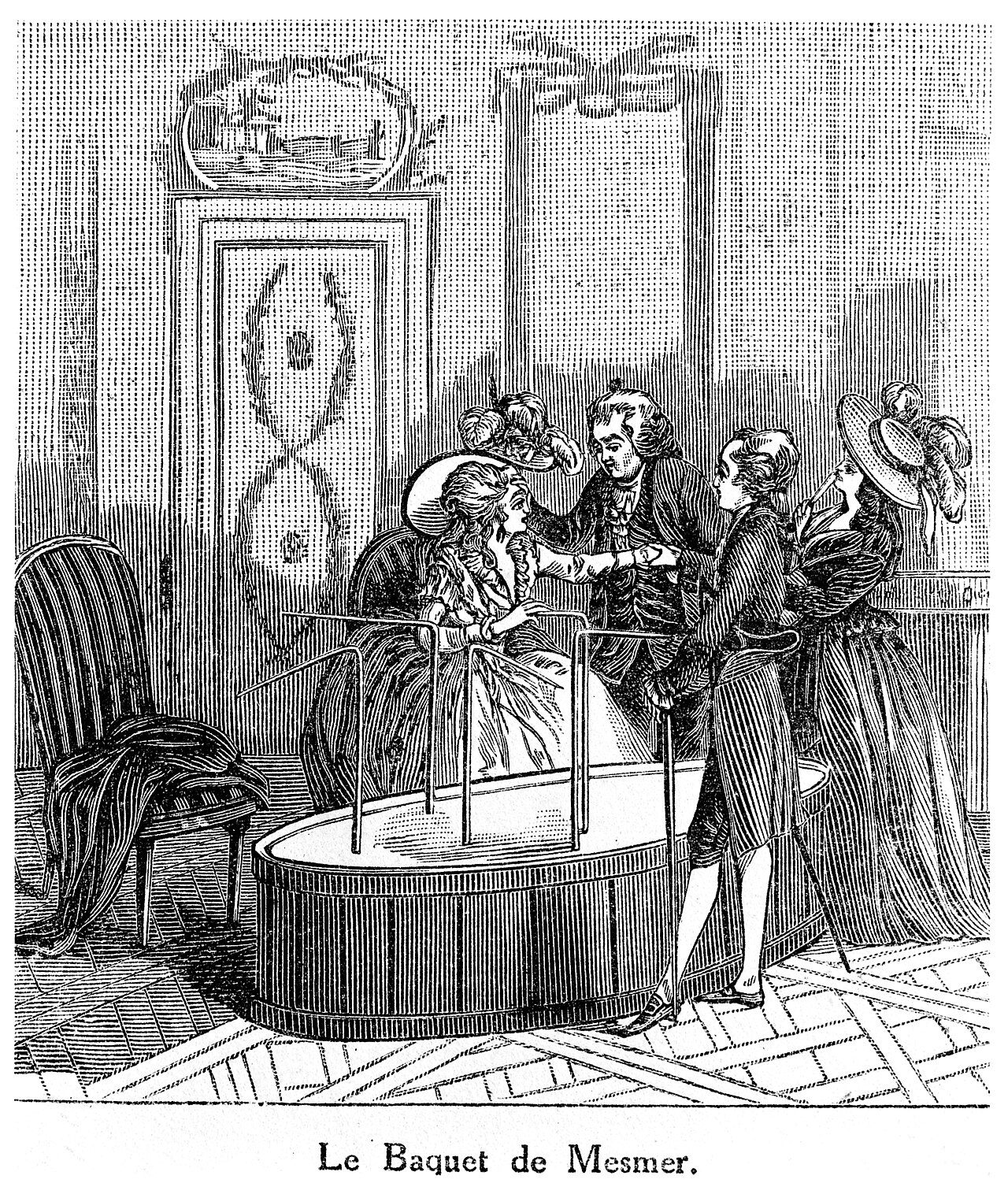
In 1784, in the garden of the house at Passy, outside Paris, where Benjamin Franklin was living as the American envoy to France, a disciple of Franz Anton Mesmer "magnetised" one of five trees. A young subject said to be highly sensitive to the magnetic fluid was then brought among them. He fell into a faint at the foot of one of the trees. It was the wrong one1,2. In another experiment, at Lavoisier's house, a subject who drank ordinary water believing it magnetised responded just as if it had been2. With tests like these, a royal commission settled the scientific question of animal magnetism in a few months. The cultural question took another century.
Mesmer's fluid
Franz Anton Mesmer was a Swabian-born physician who had studied medicine in Vienna, where his doctoral dissertation of 1766 dealt with the influence of the planets on the human body3. In 1774 he treated a patient with nervous symptoms by applying magnets to her body; she reported streams of a strange fluid running through her and her symptoms eased. Mesmer concluded that the magnets were incidental and that the cure had come from a force accumulated in himself, which he called animal magnetism3.
The theory, as he set it out in Paris in 1779 in twenty-seven propositions, held that an invisible fluid fills the universe and passes through all bodies. Illness was an obstruction of its flow; the physician, acting as a conductor, restored the flow by touch and by "passes" of the hands along the body, provoking a crisis of convulsions or tears that preceded cure3,7. A disciple, Charles d'Eslon, explained that to cure a person of insanity it might first be necessary to provoke a fit of madness3. The idea drew on old medical notions of crises and on the new science of electricity and magnetism, and it had an obvious appeal to patients with the "nervous" complaints, fits and hysterical symptoms that orthodox medicine treated poorly3,4.
Mesmer left Vienna in 1777 after a controversial attempt to cure the blindness of the young pianist Maria Theresia von Paradis, and settled in Paris in February 17782,3. There his clinic became fashionable. Patients sat around the baquet, a large covered tub from which bent iron rods projected to touch the affected parts of the body, linked to one another by a cord, while the magnetiser moved among them and music played3.
The royal commissions
In 1784 Louis XVI appointed two commissions. One combined four physicians of the Paris Faculty of Medicine, among them Joseph-Ignace Guillotin, with five members of the Academy of Sciences, including the astronomer Jean-Sylvain Bailly, the chemist Antoine Lavoisier and Franklin; the other came from the Société royale de médecine2. They studied d'Eslon's practice rather than Mesmer's, and they did something new: they compared what happened when subjects knew they were being magnetised with what happened when they did not, blindfolding them or deceiving them about what had been treated2. The results were consistent. Effects appeared when people believed they were being magnetised, whether or not they were, and failed to appear when they were magnetised without knowing it1,2.
The Franklin commission's report, presented to the king on 11 August 1784 and printed in at least 20,000 copies, was blunt2:
This agent, this fluid has no existence.1
Quotation checked against the 1785 text
What remained was the power of the mind over the body. The commissioners named three causes, touch, imitation and imagination, and gave imagination first place:
But the imagination is that active and terrible power, by which are operated the astonishing effects, that have excited so much attention to the public process.1
Quotation checked against the 1785 text
Historians of medicine now read the inquiry as one of the earliest blind trials and an early recognition of what would be called the placebo effect3. One commissioner of the second commission, the botanist Antoine-Laurent de Jussieu, published a dissenting report, arguing that some effects deserved further study2.
Magnetic sleep
The commissions ended Mesmer's career in Paris but not mesmerism. In the same year the Marquis de Puységur, magnetising a young man named Victor, produced not convulsions but a calm, sleep-like state in which his subject was said to speak articulately and even to diagnose his own illness7. This "magnetic sleep" or artificial somnambulism, rather than the crisis, became the centre of the practice. Through the early nineteenth century magnetisers worked in France and Germany, where Romantic physicians saw in the trance a window on the hidden powers of the soul, and on the stage4.
In London the physician John Elliotson, professor at University College, began magnetising two young patients with epilepsy, the sisters Elizabeth and Jane Okey, in 1837. After a hostile series of tests by the editor of The Lancet, Thomas Wakley, in August 1838, the college resolved on 27 December 1838 to forbid mesmerism in its hospital, and Elliotson resigned5. In the 1840s, before ether and chloroform, Elliotson and the surgeon James Esdaile reported surgery performed painlessly on mesmerised patients4.
From mesmerism to hypnotism
The decisive change came from a sceptic. In November 1841 the Manchester surgeon James Braid watched a performance by the travelling magnetiser Charles Lafontaine, convinced himself that something real was happening, and set out to explain it without any fluid6. In Neurypnology (1843) he described the trance as a nervous state brought on by straining the attention, typically by fixing the eyes on an object, and named it "hypnotism"3,6. Hypnotism passed to the French neurologists of the 1880s: Charcot at the Salpêtrière treated hypnotisability as a sign of hysteria, while Hippolyte Bernheim at Nancy argued that hypnosis was simply heightened suggestion4. Freud used hypnosis in his early practice before replacing it with free association, the method of psychoanalysis8.
Key dates
- 1774 In Vienna Mesmer treats a patient with magnets and concludes that the cure came from a force in himself, 'animal magnetism'.
- 1775 Mesmer tells the Munich Academy that the exorcist Johann Joseph Gassner cures by animal magnetism.
- February 1778 Mesmer settles in Paris after leaving Vienna in controversy.
- 1784 The Marquis de Puységur produces 'magnetic sleep', a calm trance, in a young man named Victor.
- 11 August 1784 The Franklin commission reports to Louis XVI that the magnetic fluid does not exist and that imagination explains the effects.
- 27 December 1838 University College London bans mesmerism from its hospital; John Elliotson resigns.
- 1843 James Braid of Manchester publishes Neurypnology and names the trance 'hypnotism'.
Sources
- Primary source Benjamin Franklin, Jean-Sylvain Bailly, Antoine Lavoisier and others, Report of Dr. Benjamin Franklin, and Other Commissioners, Charged by the King of France, with the Examination of the Animal Magnetism, London: J. Johnson (1785). Quotations checked against this text.
- Wikipedia Royal Commission on Animal Magnetism, Wikipedia (2026).
- Wikipedia Franz Mesmer, Wikipedia (2026).
- Scholarship Burkhard Peter, Hypnosis in psychotherapy, psychosomatics and medicine. A brief overview, Frontiers in Psychology 15: 1377900 (2024).
- Wikipedia John Elliotson, Wikipedia (2026).
- Wikipedia James Braid (surgeon), Wikipedia (2026).
- Wikipedia Animal magnetism, Wikipedia (2026).
- Wikipedia Psychoanalysis, Wikipedia (2026).
Cross-checked with Wikidata Q547546 and the English Wikipedia article.
Read next
 1680s–1980
Hysteria
Named for the womb, hysteria became medicine's catch-all for symptoms it could not explain. Its history from Greek texts to Sydenham, Charcot and Freud, and why it was dropped in 1980.
 Antiquity–19th century
Demonic possession and its critics
Many cultures have explained fits, voices and despair as the work of spirits. How Europeans argued over possession from Hippocrates to Charcot, and why the story that medicine simply defeated superstition is too simple.
 1890s–1980
Psychoanalysis
Freud's theory of the unconscious began as a treatment for hysteria in 1890s Vienna and came to dominate American psychiatry after 1945. Its history, its place in psychiatry, and the long argument over whether it works.
 1796–1850s
Phrenology
Phrenology held that the mind was a set of faculties, each with its own organ in the brain, readable on the skull. Long dismissed as a fad, it also shaped how early asylum reformers thought about madness.
 1869–1920s
Neurasthenia
George Beard's 'nervous exhaustion' of 1869 blamed modern life for tired, anxious, aching patients. It became the fashionable diagnosis of the 1880s, faded by 1920, and lived on in China.