
Place · 16 May 1831 – today
Hanwell Asylum
The Middlesex county asylum west of London, opened in 1831 for poor patients, where William Ellis made work a therapy and John Conolly abolished mechanical restraint among some 800 patients in 1839.
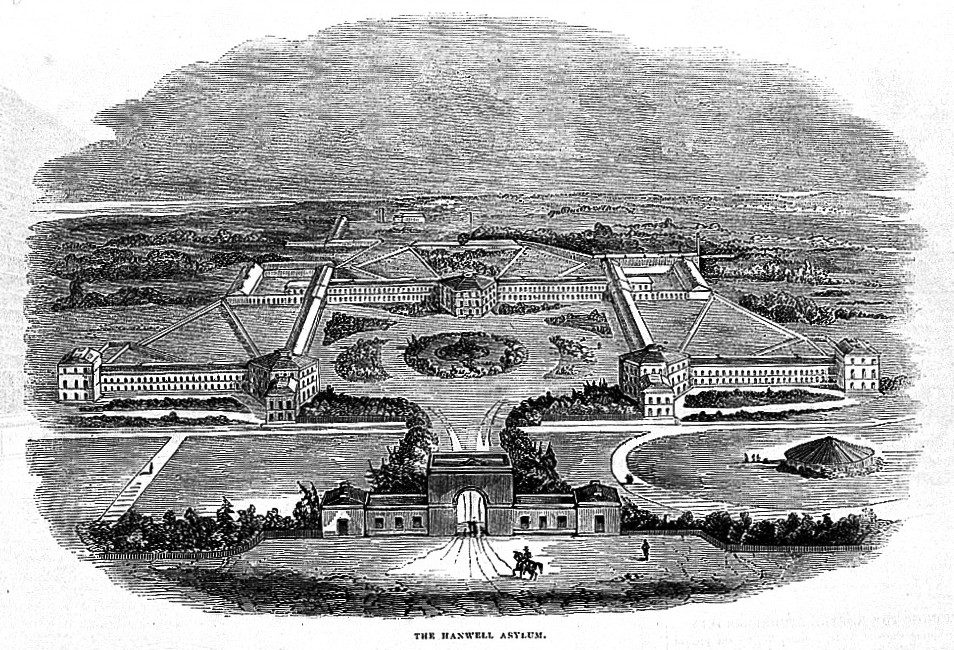
When John Conolly took charge at Hanwell in the summer of 1839, he had the instruments of restraint in the wards gathered up and counted:
Instruments of restraint, of one kind or other, were so abundant in the wards as to amount, when collected together, to about six hundred—half of these being leg-locks or handcuffs.1
Quotation checked against the 1856 text
On the women's side alone, forty patients were almost always in restraint, fourteen of them usually strapped into "coercion chairs"1. By the end of September none were. What happened at Hanwell that summer made it, for a generation, the most famous asylum in the world.
A county asylum for the poor
Hanwell was built under the County Asylums Act of 1808, which let counties raise money from local rates to house "pauper lunatics", the period's term for people with mental illness who had no means. The Middlesex magistrates resolved to build in November 1827, bought most of the land from the Earl of Jersey, and opened the First Middlesex County Asylum, a three-storey yellow-brick building beside the canal, on 16 May 18317,5. It was meant for several hundred patients and was full within six months; extensions began almost at once7,5.
Its first superintendent, William Charles Ellis, came from the West Riding asylum at Wakefield, and his wife Mildred became matron6. Ellis's "great principle" was work. Patients were set to the trades they knew or could learn, in workshops and in the asylum's fields, which he thought restored self-respect as well as order; historians see in it an early form of occupational therapy6,5. He was knighted in 1835. In 1838 the Ellises resigned after disagreements with the visiting justices, who wanted the asylum enlarged and run more cheaply, and opened a private asylum nearby at Southall Park6.
Non-restraint
Conolly was appointed in 1839, having visited the small Lincoln asylum where Edward Charlesworth and Robert Gardiner Hill had already given up restraint. He began his residence on 1 June. From July he demanded a daily return of every patient restrained. The number never exceeded 18 a day; after 31 July it never exceeded eight; after 12 August, one; "after the twentieth of September no restraints were employed at all" among some 800 patients1. The details are on our page on restraint and non-restraint.
The system was more than kindness. It needed more attendants and better ones, constant occupation, and padded rooms where a disturbed patient could be secluded until calm1. His methods were controversial at first, but The Times and The Lancet supported him, and by 1846 the national Lunacy Commission had adopted non-restraint as orthodoxy4.
The great asylum
Hanwell kept growing. By 1888 it held about 1,900 patients and was described as the largest asylum in Europe5. In 1889 the new London County Council took it over as the London County Asylum, Hanwell; it became Hanwell Mental Hospital in 1929 and St Bernard's Hospital in 19375,7. It joined the National Health Service in 1948 and still held about 2,200 patients in the early 1960s, a few years after drugs such as chlorpromazine arrived. As care moved out of the old asylums (Deinstitutionalisation), it fell to about 950 beds by 1980 and fewer than 400 by 20087,5.
St Bernard's today
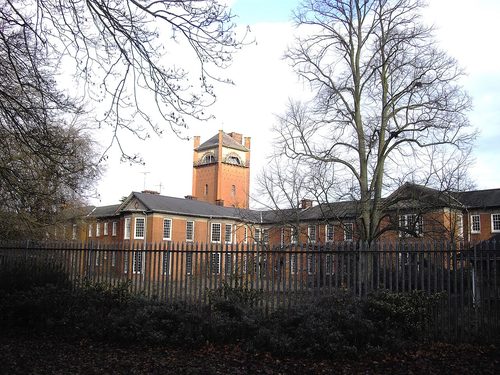
St Bernard's is still a mental health hospital, run by West London NHS Trust, which has its headquarters in some of the original buildings; Ealing Hospital was built in part of the grounds and opened in 19795,7. The chapel, the gatehouses and a long stretch of the wall beside the canal survive and are listed; the western block, with its octagonal tower, has become private flats5. On 27 May 2022, the anniversary of Conolly's birth, English Heritage unveiled a blue plaque to him and the asylum on the old building4,7.
Key dates
- 15 November 1827 The Middlesex magistrates resolve to build a county asylum for poor patients.
- 16 May 1831 The First Middlesex County Asylum opens at Hanwell under William Charles Ellis and his wife Mildred.
- 1838 Ellis resigns after disagreements with the visiting justices over the asylum's expansion.
- 20 September 1839 Under John Conolly, mechanical restraint ceases to be used at Hanwell.
- 1844 Conolly gives up residence as physician; he stays on as visiting physician until 1852.
- 1937 The asylum, by then Hanwell Mental Hospital, is renamed St Bernard's Hospital.
- 27 May 2022 An English Heritage blue plaque to Conolly and the asylum is unveiled at St Bernard's.
Also on this site
Sources
- Primary source John Conolly, The Treatment of the Insane without Mechanical Restraints, London: Smith, Elder (1856). Quotations checked against this text.
- Scholarship Akihito Suzuki, The politics and ideology of non-restraint: the case of the Hanwell Asylum, Medical History 39(1) (1995).
- Scholarship Jonathan Andrews, Review of Masters of Bedlam (Scull, MacKenzie and Hervey), Reviews in History, Institute of Historical Research (1997-03).
- Official English Heritage, Dr John Conolly and the former Hanwell Asylum receive English Heritage blue plaque, English Heritage (2022-05-12).
- Reference Lost Hospitals of London, St Bernard's Hospital, Lost Hospitals of London.
- Wikipedia William Charles Ellis, Wikipedia.
- Wikipedia St Bernard's Hospital, Hanwell, Wikipedia.
Cross-checked with Wikidata Q5651415 and the English Wikipedia article.
Read next
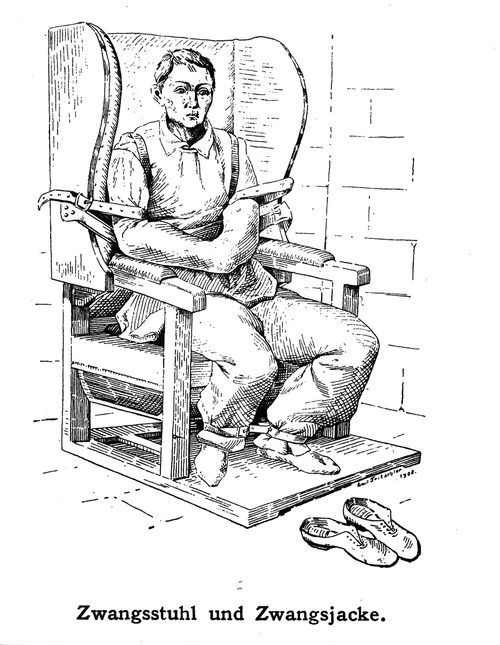 1700s–1890s · Transformed
Restraint and the non-restraint movement
Chains, strait-waistcoats and restraint chairs were the ordinary equipment of asylums until the late 1830s, when Lincoln and then Hanwell abolished them. Britain made non-restraint a doctrine; much of the world did not.
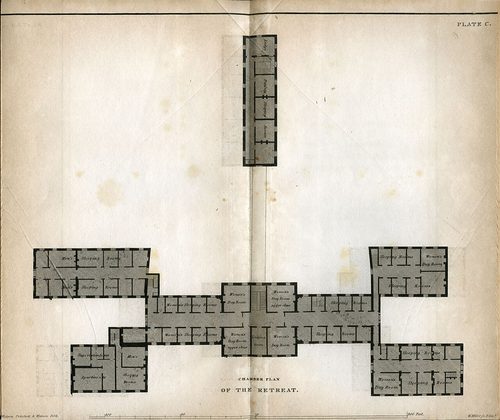 1790s–1870s · Transformed
Moral treatment
Moral treatment, developed at Bicêtre in Paris and the York Retreat in the 1790s, tried to cure madness through kindness, routine, work and self-control rather than chains and drugs. It shaped a century of asylums.
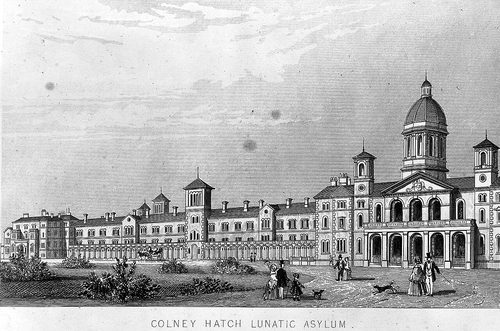 Essay · 7 min
The rise and fall of the asylum
How the public asylum grew from a few small madhouses into hospitals of thousands, and was then closed: an argument that its failures came from its success at taking in the people no other institution would hold.
 Essay · 8 min
Counting the confined: asylum populations, 1800–2000
Asylum numbers in England and the United States rose for a century and then fell by three-quarters or more. What the official counts measured was how long people stayed, not how many fell ill, as their own compilers warned.
 1952–present · Transformed
Chlorpromazine
A French drug tried on psychiatric patients in Paris in 1952. Chlorpromazine calmed psychosis without stupor, emptied wards and began the age of psychiatric drugs, with lasting side-effects.