
Place · 11 May 1796 – December 2018
The York Retreat
A small Quaker house outside York, opened in 1796 after a Friend died in the city asylum, whose mild regime, described by Samuel Tuke in 1813, made 'moral treatment' famous across Britain and America.
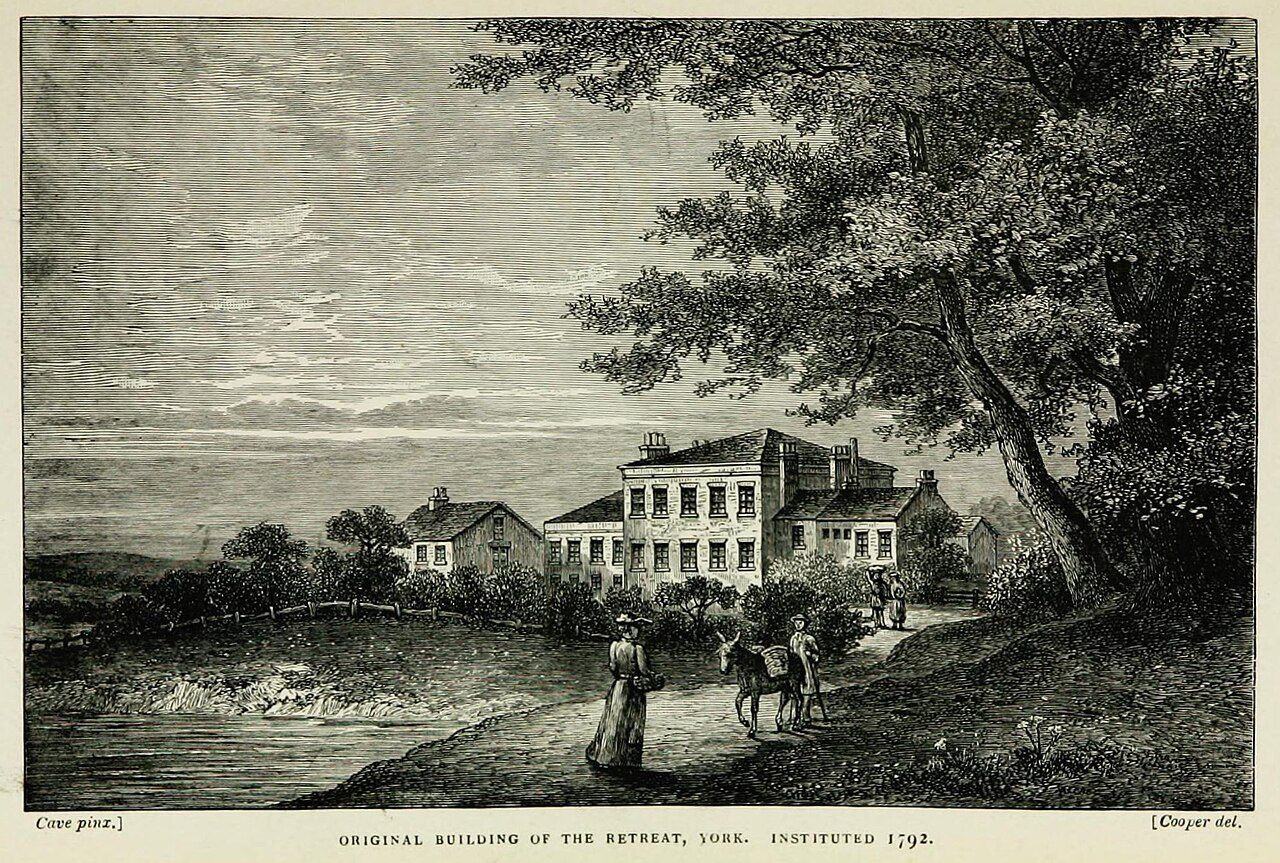
Samuel Tuke began his history of the Retreat with a death. A Quaker woman had been placed in the asylum outside York; her family, living far away, asked Friends in the city to visit her; the visits were refused on the ground that she was not fit to be seen by strangers; and within a few weeks she died. "The origin of the Institution which forms the subject of the following pages," he wrote, "has much the appearance of accident"1.
Hannah Mills
Tuke did not name her. Later research has. Hannah Mills was a widow from Hunslet, Leeds, whose husband had died in 1786 and three of whose children died in the next two years. She had joined the Society of Friends in 1788. Quakers in Leeds helped arrange, and appear to have paid for, her admission to the York Lunatic Asylum, where she was entered in the register on 15 March 1790, suffering from what was then called "melancholy" (Melancholia). She died there at the end of April3,4. The asylum's own early records were later destroyed in a fire, so how she was treated is not known3.
The suspicion that she had been neglected was well founded in general, if not provable in her case. In 1814 a magistrate, Godfrey Higgins, made a surprise inspection of the York Asylum and found secret cells in a state he called "horrible beyond description"; deaths had been kept out of its published reports4.
A house for Friends
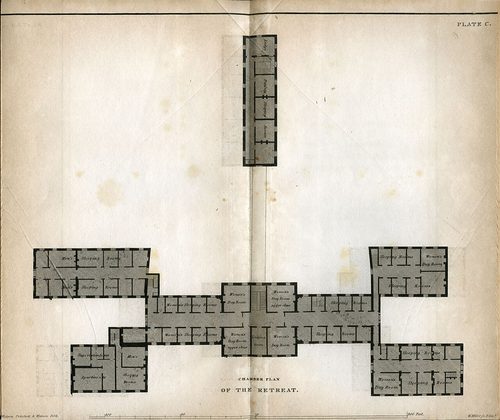
The tea merchant William Tuke took up the idea of an asylum run by Quakers for Quakers, and in March 1792, after the Quarterly Meeting at York, he put it to Friends1. Money came slowly, from annuities, donations and subscriptions across the Society. The building, by the Quaker surveyor John Bevans, stood in open country outside the city, with a central block, wings for men and for women, and a single room for each patient off a central corridor2,1. The house opened on 11 May 1796 and took its first three patients the next month. Patients paid fees according to their accommodation1,2. Its first superintendent, Timothy Maud, died within about two months; George Jepson succeeded him, and after he married the matron, Katharine Allen, in 1806 the two ran the house together1,7.
The Retreat's way
Samuel Tuke, William's grandson, described the regime in 1813, and his Description made "moral treatment" a byword. The Retreat relied on regular work, exercise in the grounds, small comforts, kindness from attendants and the patient's own wish to be thought well of. Tuke was emphatic about one point:
Neither chains nor corporal punishments are tolerated, on any pretext, in this establishment.1
Quotation checked against the 1813 text
That was not the same as abolishing restraint. The strait-waistcoat, seclusion and feeding by force were used for patients thought dangerous or refusing food2. Visitors, even so, were struck by the contrast with places such as Bethlem: the Scottish architect William Stark praised the Retreat's "government of humanity and consummate skill"2.
Influence and its critics
Its influence, as R. H. S. Mindham puts it, far outweighed the modesty of its beginnings: moral treatment became the founding creed of the new public asylums of Britain and America, institutions many times the Retreat's size2,6. In 1845 a new Lunacy Act required a medically qualified superintendent, and John Thurnam was appointed in 1846; the Retreat gradually opened to patients who were not Quakers7.
Its reputation has been argued over ever since. Michel Foucault, in his history of madness (1961; abridged in English as Madness and Civilization), saw the Retreat's mildness as a new kind of control: patients were no longer chained, but they were watched, judged and made to feel responsible for their own conduct6. Anne Digby's history of the Retreat from 1796 to 1914, built on its unusually full archive, is the standard modern account5.
After 1945
The building was listed Grade II* in 1954. The Retreat continued as an independent psychiatric hospital, later specialising in eating disorders and personality disorders, until it ended inpatient care at the end of December 2018; outpatient services continue at its Tuke Centre, and its archive is kept at the Borthwick Institute in York7,4.
Key dates
- 15 March 1790 Hannah Mills, a Quaker widow from Leeds, is admitted to the York Lunatic Asylum, where she dies some six weeks later.
- March 1792 William Tuke puts the plan for a Quaker asylum to Friends after the Quarterly Meeting at York.
- 11 May 1796 The Retreat opens; its first patients are admitted the following month.
- 1813 Samuel Tuke publishes his Description of the Retreat.
- 1846 John Thurnam becomes the Retreat's first medically qualified superintendent, as the Lunacy Act of 1845 required.
- 14 June 1954 The Retreat and its boundary walls are listed Grade II*.
- December 2018 The Retreat ends its inpatient services; outpatient work continues at the Tuke Centre.
Also on this site
Sources
- Primary source Samuel Tuke, Description of the Retreat, an Institution near York, for Insane Persons of the Society of Friends, York: W. Alexander (1813). Quotations checked against this text.
- Scholarship R. H. S. Mindham, The Retreat at York of 1796 – psychiatry in pictures, The British Journal of Psychiatry 218(5) (2021).
- Scholarship HERStory.York, HERStory.York Research: Hannah Mills, HERStory.York (2024).
- Museum or archive Alexandra Medcalf, The York Lunatic Asylum Scandal, Borthwick Institute for Archives, University of York (2014-10-10).
- Scholarship Andrew Scull, Review of Anne Digby, Madness, Morality and Medicine: A Study of the York Retreat 1796–1914, Medical History 31(1) (1987).
- Wikipedia Moral treatment, Wikipedia.
- Wikipedia The Retreat, Wikipedia.
Cross-checked with Wikidata Q2146269 and the English Wikipedia article.
Read next
 1790s–1870s · Transformed
Moral treatment
Moral treatment, developed at Bicêtre in Paris and the York Retreat in the 1790s, tried to cure madness through kindness, routine, work and self-control rather than chains and drugs. It shaped a century of asylums.
 1700s–1890s · Transformed
Restraint and the non-restraint movement
Chains, strait-waistcoats and restraint chairs were the ordinary equipment of asylums until the late 1830s, when Lincoln and then Hanwell abolished them. Britain made non-restraint a doctrine; much of the world did not.
 c. 400 BCE–1900s
Melancholia
For two thousand years melancholia meant fear and sorrow without cause, blamed on black bile. How physicians from Aretaeus to Kraepelin defined it, and how it became 'depression'.
 Essay · 7 min
The rise and fall of the asylum
How the public asylum grew from a few small madhouses into hospitals of thousands, and was then closed: an argument that its failures came from its success at taking in the people no other institution would hold.
 Essay · 7 min
Who got locked up, and why
Asylum populations were never a simple sample of the mentally ill. Poverty, family, the Poor Law, sex, migration, race, age and bodily disease all decided who was confined, and historians still argue over how much each counted.